Arts & Entertainment
Schoodic Point
The Weekly Article and Photograph of Fine Art Photographer Colin Seitz

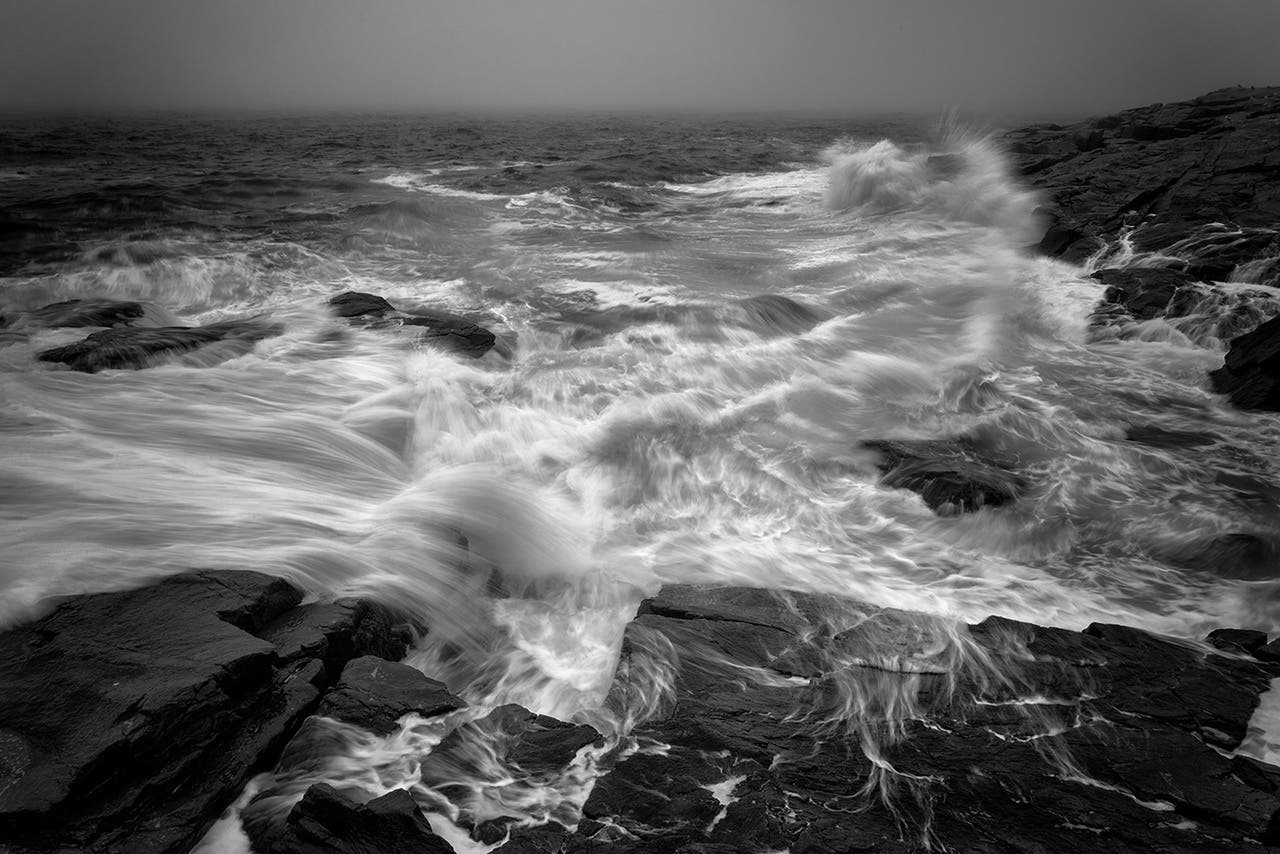
The rocky coast of Maine is a sight that is well worth the long drive to see. (Of course, I write this from New Jersey, which represents about a 10 hour trip; those lucky enough to live in Maine surely are aware of its beauty already and have a much shorter trip to see this beautiful coastline.) Several of my more favorite photographs were made while in Maine, during a week long trip, and I think the finest of those we all taken on the same day. We were there in late September, initially hoping for fall foliage, which we missed by about 2 weeks from being in full swing, however, the weather really didn’t cooperate much to take in much of the colors, except for a day or two, along with a few hours mixed in here and there with sun and partly clear skies. I was ok with this though; I had only seen a few photographs of Acadia National Park, mainly the key icons of the park system, and I had also seen some photographs of the surrounding coastline, both north and south of the park. Through this narrow vision, I created my own idea of what it would look like. I must have read somewhere about the rapidly changing weather the area is famous for along with the tidal swings, which reach a peak at the Bay of Fundy just north of Acadia in Nova Scotia. Driving up, mostly in rain, I had in my mind a coast with crashing waves, displaying their sheer power, a power that countless mariners have encountered and challenged; some victorious, others not. I pictured fog, limiting the distance that the eye can scan, and in doing so, creating an eeriness with the weather and environment, obscuring objects gradually as they drifted farther away from where you would stand along the granite coastline.
One of the reasons I have been attracted to black and white photography is because of the enormous creative and artistic control that it allows. With black and white, both film and digital, the artist is able to control how bright or dark areas are as well as accentuate or communicate a feeling the artist wishes to convey. Sometimes this is done by adding light to draw a viewer’s eye; other times, it is burning and dodging (darkening and lightening, respectively) to create what they saw and felt. This print is a good example of this. When I arrived at the location that I made this photograph, the scene satisfied what I had initially wanted, most importantly, the active sea. Making the exposure to include all brightness ranges, and also being sure to expose for a digital sensor (exposing for digital and negative film are different). From there, I brought the image into my computer and went to work with taking the image my camera recorded and turning it into what my mind saw and felt. The end result is the print you see here. This print was recently awarded the “Al Goldstein Award for Landscape” at the Guild of Creative Art’s annual juried “Eyesights” exhibit. This exhibit opened Sunday and will run through March and into April. If you have some free time, I highly recommend you make a trip to Shrewsbury, NJ to take in the show. There is an excellent display of many different types of photography, something there for everyone I think, and many if not all are local artists. Without doubt, the best award was being selected to share wall space with the many talented artists that were accepted into the show.
I realized recently that photography may be one of the easiest of the visual arts to enter into, aside from perhaps drawing. (I think photography is also difficult, but in a sneaky way. Many of the things that separate fine prints from average, in my opinion come down to some very fine details and choices) I say this because most people now walk around with a camera, capable of taking photographs that only a few years back required a dedicated camera. Now, most people with a phone can take snapshots of anything that catches their eye. The reach and impact of this should not be overlooked, for I think it has the potential to open up the art of photography to many. Every photograph, whether taken with a large format camera, professional digital camera or a camera housed in a phone requires a choice, at the most basic level. What you choose to photograph, or compose within the the viewing screen, and importantly, what you choose not to photograph are the decisions that every single person making a photograph must make, prior to making the exposure.
Find out what's happening in Brickfor free with the latest updates from Patch.
In the coming weeks and months, I will be adding some more pages to my website, aimed at introducing people to photography, and some basic “how-to” articles. My hope is to help people gain a comfort level with their camera and encourage more people to enjoy making images that match what they see, and not just replicating a scene in front of them. I will add articles and photos from my wet darkroom as well as from my use of the digital camera and digital darkroom, along with some of the basics of aperture and lens selection. Surely, if there is something you would like to learn more about, you can always email me; I would love to hear from you!
You can find this print, along with many others, canvas prints and notecards on my website, www.colinseitzphotography.com.
Find out what's happening in Brickfor free with the latest updates from Patch.
I hope everyone has a great week,
Colin