Politics & Government
Tension Marks Meeting On Proposed Brick Medical Marijuana Site
The standing-room-only meeting turned into a glimpse of what the Oct. 10 Board of Adjustment meeting may be like.


BRICK, NJ — For medical marijuana patients in Ocean County, the proposal to open a dispensary in Brick Township is seen as a God-send: a facility that won't require them to drive three hours roundtrip to get the medication that relieves their conditions.
For neighbors of the proposed Adamston Road site for Jersey Shore Therapeutic Health Care, it is a nightmare in the making, a lure for dangerous violent criminals.
"It's not about being against medical marijuana," said Michael Doumas, whose home is across the street from the site at 385 Adamston Road, which until two years ago had been a bank dating back to 1978. "Our hearts bleed for those who need this product."
Find out what's happening in Brickfor free with the latest updates from Patch.
"I'm worried because it's cash business. I'm worried that people will use it as an opportunity to rob the place," said Diana Diaz, another neighbor who spoke out at the meeting at the Brick Township municipal building Tuesday night. "All it takes is one incident to change a lifetime for a family.
The meeting was held in advance of the Brick Township Board of Adjustment meeting on Oct. 10, where Jersey Shore Therapeutic Health Care's site plan application is scheduled to be heard.
Find out what's happening in Brickfor free with the latest updates from Patch.
Jersey Shore Therapeutic Health Care was created by Anne Davis, an attorney who has lived in Brick for 30 years and medical marijuana patient, and Karen Medlin, a Marlboro resident whose daughter suffers from Rett syndrome and uses cannabis to manage her symptoms. The organization is seeking to turn the former bank into what would be the first medical marijuana dispensary in Ocean or Monmouth counties.
New Jersey currently has six medicinal marijuana dispensaries, with one in Egg Harbor Township the closest one for Ocean County residents. In July, Gov. Phil Murphy announced the state would accept applications to add six more dispensaries — two in each region of the state, north, central and south — to improve access. Jersey Shore Therapeutic Health Care was one of 146 applicants for the six new licenses.
Davis said New Jersey's regulations on medical marijuana are extremely detailed and include significant requirements related to security issues. To that end, the company hired as its chief operating officer Joel Allcock, who started medical marijuana dispensaries in Rhode Island and in Delaware, with the Delaware site being the template for others in that state.
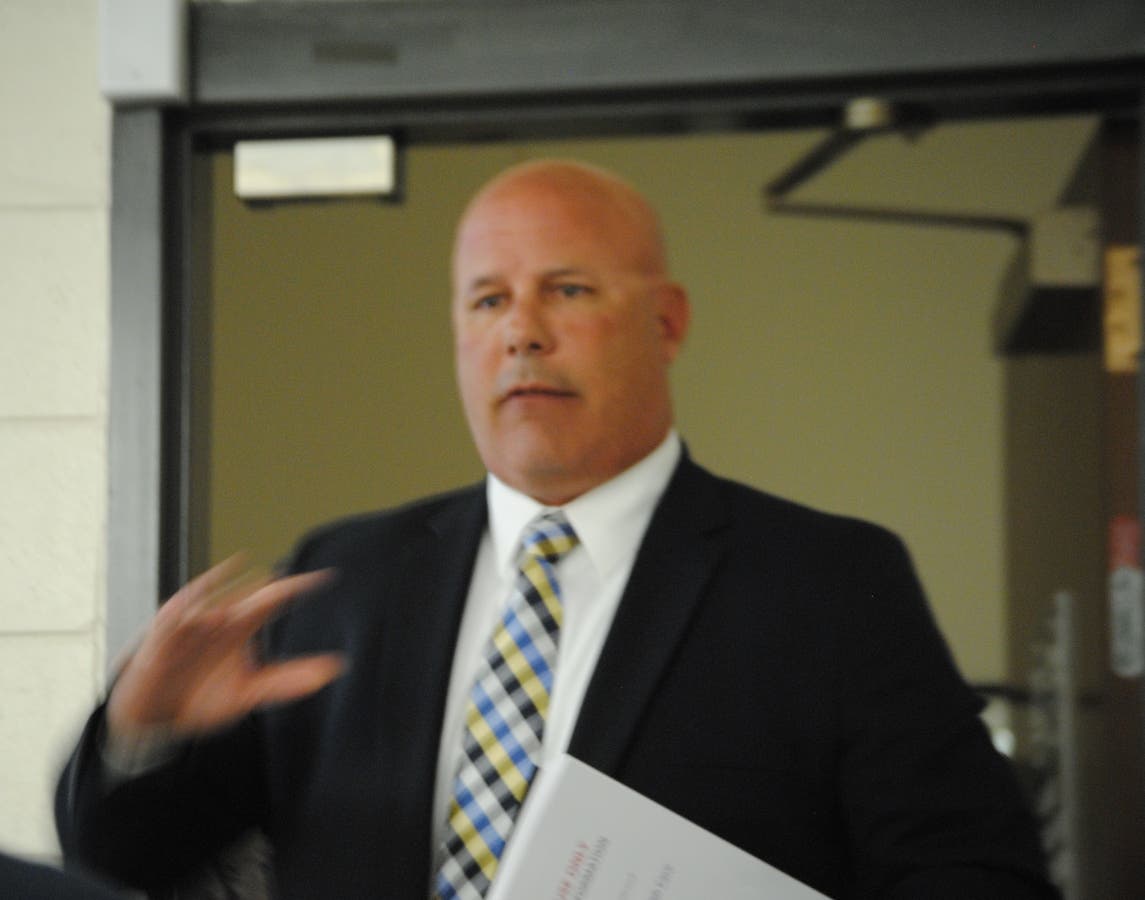
The group also has hired Michael White, a 26-year veteran of the New Jersey State Police, as its security director. White has experience with homeland security in what he referred to as "target-hardening assignments" and currently is working in school security with a focus on making schools more difficult targets for attacks.
White said the proposal for the dispensary has multiple layers of security, including more than 150 surveillance cameras, a locked vestibule that will only be accessible to patients or caregivers who have cards under New Jersey's medical marijuana program, and a fence that will make climbing it nearly impossible. The site will have security guards during its hours of operation, and surveillance around the clock. Only patients and caregivers registered to use the Brick dispensary would be permitted to purchase their supply there, Davis said.
But residents expressed concerns that extensive security will not be enough to deter someone who wants to get at the cash the dispensary takes in. Dispensaries typically operate primarily on a cash basis because marijuana is still banned in every form at the federal level.
The doors will have magnetic locks and every employee will have to enter with a card that gives limited access and time-stamps every usage of the card, White said. Patients will not be permitted to smoke their marijuana in the parking lot and those who fail to follow the rules can be banned from the medical marijuana program.
White said the extensive security measures are meant to make criminals realize the chances of getting caught while committing a crime at the site are extremely high, and deter them from trying.
Doumas and other residents remained unconvinced. Doumas related a report of an October 2012 robbery in California where a dispensary owner was kidnapped from his home, ziptied, forced to give the robbers cash and then cut the man's genitals off. Four men were arrested and later sent to prison in that case.
Doumas also insisted dispensaries are targeted more frequently for crime, a statement both John Paul Doyle, the attorney leading the meeting, and Allcock pushed back against.
A Princeton University study of medical marijuana laws said police department data in cities that have dispensaries does not bear that out. In Los Angeles, the police department looked at crimes in the city in 2009-10 and found the city's 350 banks had 71 robbery reports, while there were 47 robbery reports filed for the more than 800 medical marijuana dispensaries at that time.
It was an implication of fraud in the system, however, that sparked significant anger among medical marijuana patients in the room and led to several heated exchanges.
"There are ways to buck the system," said the man, who identifed himself as Diana Diaz's husband and said he knows three people who have medical marijuana cards. Two of them have them for verifiable ailments, but one admits he got into the program strictly so for recreational use.
Doyle cut him off and tried to counter the comment as others responded angrily to Diaz's statement.
"This is a life-changing medication for me," said Richie Campbell, who is medically retired from the U.S. Navy and uses a cane. "It has helped me not have to take opiates. It has saved my life."
In a follow-up email to Patch, Diaz said, "What I was going to say before Doyle shut me down was that my friend that has a med card said he would rather pay the higher price knowing that if he was carrying or smoking it, that nothing could happen to him legally which would cost him more if caught without a card including possible arrest and possibly losing his job."
Jessica Duff, a Brick resident who is a recovering addict, said the opiate issue is creating far more crime throughout Brick and Ocean County, and having a medical marijuana dispensary closer to home will give more people who are fighting to break the grip of opiates a better chance.
She also said crime in Brick is a possibility regardless of the site.
"I grew up in Brick. We had the Dee Rose attack. We had a robbery at the 7-Eleven across the street from my home. I have five children. I understand your fear," Duff said.
Diaz said the six current dispensaries all are in commercial zones, with only one in Montclair close to residences because of apartments above commercial spaces. Adamston Road is a mix, particularly at the end near Mantoloking Road, with the Veterans of Foreign Wars post next door to the proposed site and an auto repair shop a short distance away.
Davis said the group chose the Adamston Road property after nearly two years of research. The fact that it was formerly a bank and as such has a vault was attractive. The site, which is zoned commercial, also would allow them to keep the facility as low-key and unobtrusive as possible.
"There won't be any big signs," she said.
Several people on both sides noted the former banks at the site had been robbed multiple times.
"I don't think it should be a bank again, either," Doumas said.
The conflict between the neighbors and Doyle, who several times raised his voice to tell people to stop talking over each other, prompted more anger and accusations that the organization had stacked the room with supporters.
"He's just shutting us down. They don't want to listen to what we have to say," said one as much of the group of neighbors got up and left.
"I wasn't yelling," said Doyle, who served in the New Jersey Assembly from 1974 through 1991, prompting derisive comments from a couple of neighbors who stayed to the end.
Davis said the group wants to be good neighbors and is trying to respond as much as possible to neighbors' concerns. "One person said the bank had a sign that was too bright and shined into her home. We will make sure we don't do that," she said.
Compromise may not be easy.
"There are so many empty buildings in Brick. Why not just move it to another site?" asked one neighbor, who did not give her name. "It's not just about my neighborhood; I don't want it in anybody's neighborhood."
Click here to get Patch email notifications on this or other local news articles or get Patch breaking news alerts sent right to your phone with our new app. Download here. Have a news tip? Email karen.wall@patch.com
Follow us on Facebook. Click here to like our page.
Note: This article has been updated to clarify a resident's comment and add an comment from that resident.
Michael White, the security director of Jersey Shore Therapeutic Health Care, discusses some of the security measures for the site. Photo by Karen Wall, Patch staff
Get more local news delivered straight to your inbox. Sign up for free Patch newsletters and alerts.