Neighbor News
The Daedalus String Quartet To Perform In Chatham Nov. 17
The Daedalus String Quartet will play music of Beethoven, Dvorak and William Grant Still on Nov. 17 at the Presbyterian Church of Chatham
Czech composer Antonin Dvorak said in 1893 during a four-year stay in the United States that American composers should look to their own country’s culture for inspiration, especially the music of African-Americans.
Two years later, William Grant Still, one of the United States’ greatest African-American composers, was born.
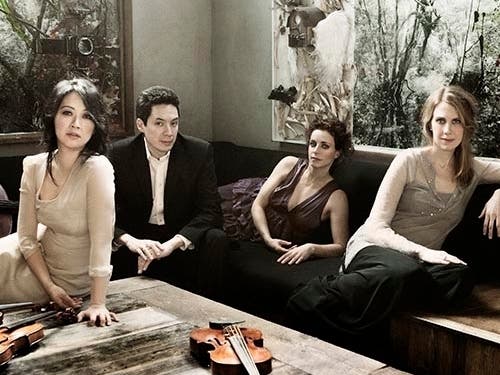
The Daedalus String Quartet will explore a thread of American music that began with Dvorak and reached full expression in the works of Still when Lyrica Chamber Music presents the quartet in concert Sunday, Nov. 17 at 3 p.m., at the Presbyterian Church of Chatham Township, 240 Southern Blvd.
Find out what's happening in Chathamfor free with the latest updates from Patch.
Echoing Dvorak’s advice, the Daedalus Quartet has titled their program, “Call for an American Voice.” It will feature Dvorak’s String Quartet in G major, Op. 106, Still’s “Lyric Quartet,” and Beethoven’s early string quartet, Op. 18, No. 1.
“Still grew up hearing musicians on tour and recordings of operas as well as African-American spirituals sung by his maternal grandmother,” said Min-Young Kim, Daedalus violinist.
Find out what's happening in Chathamfor free with the latest updates from Patch.
After studying the violin from the time he was 14 and studying composition with Edgard Varese and George W. Chadwick, Still went on the create his own unique music.
“His best known work is probably his first symphony, ‘the Afro-American’ in which he began incorporating African-American musical styles into classical forms,” Kim said. “We are performing his ‘Lyric Quartet” from 1960 which is subtitled ‘Musical Portraits of Three Friends,’ and is comprised of ‘The Sentimental One,’ ‘The Quiet One,’ based on an Inca melody, and ‘The Jovial One.’”
It’s not known if Still was familiar with Dvorak’s suggestion. But Dvorak followed his own advice, writing several pieces of music with an American flavor. Although he was a Czech composer, his most famous composition is probably his Symphony No. 9, “From the New World.”
Among his chamber music, the string quartet known as “The American” is one of the most popular. Although that might have been an obvious choice for the Daedalus Quartet’s concert on Sunday, the ensemble has opted for a more subtle selection. It will play the Op. 106 quartet, written in the year Dvorak returned to his native land.
Although writing Op. 106 in his beloved Czechoslovakia, Dvorak had not quite left America behind.
"There are many textural similarities to the ‘American’ quartet throughout the piece, especially the way that Dvorak layers the accompanimental voices and rhythms,” Kim said. “Dvorak was a wonderful melodist and also appreciated a great tune, especially one that was harmonized well. I think his sense of melody was deeply affected by his time in the United States and seeking out what he thought were American folk songs.”
Dvorak’s quartets were built on the edifice created by the great composers who came before him, especially Beethoven. When Beethoven composed his first string quartets, he was still a young man in his 20s working in the shadow of Haydn and Mozart.
The Op. 18 quartets were published in 1801, the dawn of a new century and of a new era in music.
“Beethoven was very much aware of following in the footsteps of his former counterpoint teacher, Haydn, and his beloved idol, Mozart,” Kim said. “And yet, one can also hear Beethoven’s ambition and determination to put his own stamp on this genre for all of Vienna (and the world) to recognize.”
The original members of the Daedalus Quartet met at the Marlboro Music Festival in 2000 and formed shortly after entering the Banff String Quartet competition and winning the grand prize.
There have been two personnel changes since then, something that is common in 21st-century chamber music ensembles. Members of the quartet are violinists Min-Young Kim and Matilda Kaul, violist Jessica Thompson, and cellist Thomas Kraines.
Praised by The New Yorker as “a fresh and vital young participant in what is a golden age of American string quartets,” the Daedalus Quartet has established itself as a leader among the new generation of string ensembles. The Daedalus Quartet has impressed critics and listeners alike with the security, technical finish, interpretive unity and sheer gusto of its performances. The New York Times has praised the Daedalus Quartet’s “insightful and vibrant” Haydn, the “impressive intensity” of their Beethoven, their “luminous” Berg, and the “riveting focus” of their Dutilleux.
Co-artistic directors of Lyrica Chamber Music are pianist David Kaplan and cellist Ani Kalayjian.
Funding has been made possible in part by funds from Morris Arts through the New Jersey State Council on the Arts/Department of State, a Partner Agency of the National Endowment for the Arts.
Tickets for the concerts are $30 ($25 for seniors), and students and children are admitted free. For more information about Lyrica Chamber Music, visit www.lyricachambermusic.org or call 973-309-1668.