Neighbor News
6 Disasters, Home/Property Insurance Won’t Cover!
6 Disasters, Home/Property Insurance Won't Cover!


When disaster strikes your home, Property Insurance, is supposed to
be there to help you pick up the pieces. Most of the time, it does.
A Bankrate survey found that 81 percent were aware flooding is not
covered by regular homeowners insurance. You may have heard earthquakes
also require special coverage. Yet you may not know that there are other
types of damage that are excluded from most policies as well:
Mold
At least 1,000 species of mold are common to the United States,
according to the New York-based trade group the Insurance Information
Institute.
Despite the threat, a standard homeowners insurance policy generally
either limits coverage for mold damage or outright excludes it.
Some insurers offer an endorsement to expand coverage limits for mold
claims but only if you are willing to pay more for your insurance, she
says.
The best cure for mold is to prevent it from growing in the first
place. If the basement floods after a rainstorm or a pipe is leaking,
eliminate the moisture promptly.
Sewer backup
America’s sewer lines are rapidly aging, with some more than 100
years old. As more homes have been connected to these out-of-date lines,
sewage backups have followed.
Other sources of backups include pipelines that handle both
stormwater and raw sewage — and become overwhelmed in rainstorms — and
blockages from tree roots that work their way into sewer-line cracks.
When a sewer backs up into a home, it can damage floors, walls,
furniture and electrical systems. Standard homeowners insurance does not
cover sewer backups.
The Insurance Information Institute says sewer-backup damage often
can be covered for an additional premium of just $40 to $50 per year.
Find out what's happening in Cherry Hillfor free with the latest updates from Patch.
Sinkholes
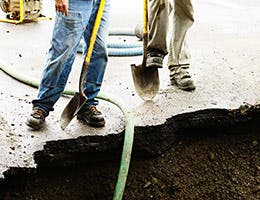
Sinkholes can seem like something out of a horror movie. For example,
there was the Florida man who was swallowed up in early 2013 when a
sinkhole opened without warning beneath his bedroom.
Sinkholes are sudden gaps in the earth’s surface that occur after
groundwater gradually dissolves rock such as limestone and carries bits
of it away, creating large pores and cracks in bedrock. Once large
cavities form underground, the land above it may suddenly settle or
collapse, creating the sinkhole.
In the United States, sinkholes tend to cause the most problems in
Florida, Texas, Alabama, Missouri, Kentucky, Tennessee and Pennsylvania,
according to the U.S. Geological Survey.
Most home insurance policies will not cover damage associated with “earth movement,” such as an earthquake or sinkhole.
Florida is the only state in which insurers are required to provide coverage for sinkhole damage
Florida insurers must include insurance for “catastrophic ground
cover collapse” — which refers to damage so severe, the home is
uninhabitable — as part of standard homeowners insurance.
In every other state, earth movement is excluded from the insurance policy.
Termite infestation
Colonies of anywhere from a few hundred to several million termites can quietly and methodically devastate your home.
Wood, paper and dead plant material that is in contact with soil near
the house provides termites with a ready source of food and an entry.
And moisture accumulated around foundations and in poorly ventilated
crawl spaces gives termites a source of water they need to survive.
Over time, termites can damage or destroy support beams and other
wood features in a house. The National Pest Management Association
estimates that termites cause $5 billion in damage in the U.S. each
year.
If these unwanted guests cause wear and tear to your home, do not expect your insurer to bail you out.
Homeowners policies do not pay for termite damage.
Homeowners can avoid structural damage with early intervention.
Find out what's happening in Cherry Hillfor free with the latest updates from Patch.
Nuclear plant accidents
The Federal Emergency Management Agency, or FEMA, says nearly 3
million Americans live within 10 miles of an active nuclear power plant.
If an accident at a nearby reactor leaves your home uninhabitable,
standard homeowners insurance will not cover the claim. But that does
not mean you will be unprotected.
A 1957 federal law called the Price-Anderson Act compensates people
in the United States for any damage or injuries resulting from a
commercial nuclear accident.
The law was called upon after the nation’s worst nuclear accident, at the Three Mile Island plant near Harrisburg, Pa., in 1979.
The insurance paid for the living expenses of families who decided to evacuate.
The Nuclear Regulatory Commission says an insurance pool of more than $12 billion is available to pay out claims.
Claims covered under Price-Anderson include:
- Bodily injury.
- Sickness.
- Disease resulting in death.
- Property damage and loss.
In addition, individuals evacuated from an affected area can expect
reimbursement for reasonable living expenses beyond what you ordinarily
pay. The coverage does not pay your mortgage, does not pay for your normal food bills.
Some acts of terrorism
The recent Boston Marathon bombings were a reminder that terror can strike at any moment.
The Insurance Information Institute says terrorist attacks using
nuclear, biological, chemical or radioactive weapons are considered
“acts of war” that are fundamentally uninsurable. Standard home
insurance policies do not specifically reference terror attacks.
However, the policy does cover the homeowner for damage due to
explosion, fire and smoke, these are the most likely types of damage a
home would suffer in a terrorist incident.
If you own a condominium or co-op, the policy you carry on your
individual unit will protect your structure and possessions from damage
related to a terrorist attack.
However, damage to common areas — including the roof, basement,
elevator, boiler and walkways — is not covered unless your board
purchases separate terrorism coverage.
Jon Barrett
Marketing and Sales Support
SERVPRO of Cherry Hill/Haddonfield
Phone: (856) 662-2772
Email: JBarrett@SP9157.com
Websites:
http://www.servprocherryhillha...
http://www.servpromtlaurelmoor...