Business & Tech
An Independent Pharmacist Persists in a Changing Environment
Tom Stehr, owner of Rosvold Pharmacy, stands his ground among megachains and mail-order houses by making sure his customers come first.
It's no surprise to any American that health coverage and medical care have changed tremendously in the last two decades.
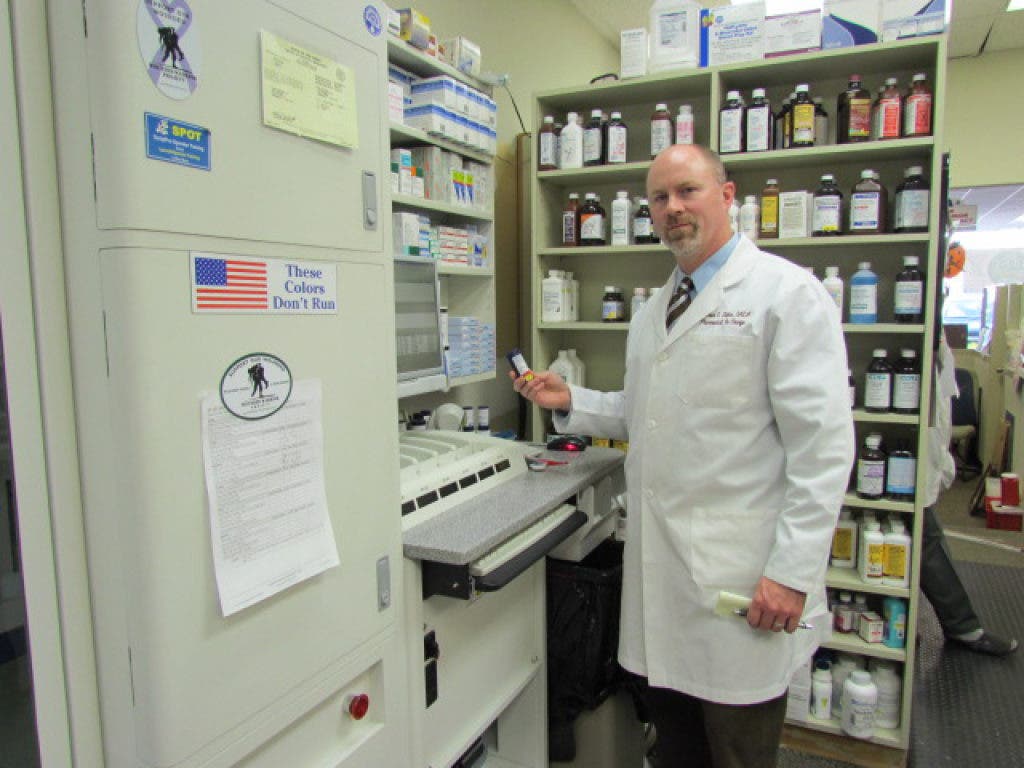
Tom Stehr, 46, who owns and operates Rosvold Pharmacy, Inc. on the corner of New Albany Road and Route 130, is a neighborhood anchor, who has stayed dedicated to his clients in an ever-changing economic and political climate.
In 1995, Stehr bought the pharmacy from Robert Rosvold when Rosvold decided to retire. The Rosvold family had opened the store 50 years earlier.
Find out what's happening in Cinnaminsonfor free with the latest updates from Patch.
After graduating from the University of the Sciences in West Philadelphia, Stehr worked for another family-owned pharmacy and for the now-defunct Thrift Drug chain for three years.
He also is an adjunct professor for the University of the Sciences and has students complete mandatory rotations behind his counter.
Find out what's happening in Cinnaminsonfor free with the latest updates from Patch.
With a CVS or Rite-Aid on many corners—not to mention the pharmacy departments of the big box stores like and —Stehr says competition has put a squeeze on the independent owners.
“The chains pull from my business. But, my major competitors today are the mail-order houses. They take away the customer who has been coming in for 30 years,” says the Springfield Township resident. "It is almost like an economic coercion—it’s very hard to strive against them.”
But Stehr works hard to retain that small-town personal service with his clients.
He says he doesn’t just fill a prescription for a client, but tries to get to know many of his customers from Cinnaminson’s 15,000 residents—which include generations of family members. He also has reliable patrons from bordering towns in Moorestown, Delran and Riverton.
“Many customers have turned into friends. Some people tell you things that they won’t tell their doctors,” Stehr says. “I try to help on a fuller scale.”
Stehr says that historically, pharmacies served as the link between health and chemical sciences. A pharmacist’s job was compounding and making medicines.
“When I’m filling a prescription, I look at the person’s profile,” Stehr says. “I might notice that a drug will have a possible side effect that my client is unaware of."
Years ago, people came and got their prescription, and “that was that.” In the present climate, Stehr spends a majority of his day on the phone because 20-30 percent of prescriptions are initially rejected. A drug won’t be covered, or the insurance company doesn’t think the therapy is warranted.
About 10 years ago, Stehr realized he was spending more hours speaking to physicians’ offices and insurance companies and less time dispensing medicines. To improve production, he invested in the pricey ScriptPro Robotic System designed to dispense the top 200 medications—like antibiotics, Lipitor, or Zyprexa—filling upwards of 50 percent of the pharmacy’s medications a day.
The costly system—the initial outlay costing $200,000— has been a sound investment. Stehr figures the robot is equal to having another technician in the pharmacy.
“I have more time to manage patient care,” Stehr says.
Stehr’s wife, Veronica, works in the store, along with five other employees.
“I have been fortunate to have really good retention among my employees,” Stehr says.
One of the more familiar faces is Thea Hellman of Cinnaminson, who used to work at long-time butcher, Hiller’s Prime Meats, before they closed.
“I picked Thea up as soon as I could. I saw how good she was with the customers at Hiller’s,” Stehr says.
Rosvold also sells medical equipment, over-the-counter medications and some homeopathic therapies.
“Nowadays, you have to carve out a niche where you can retain business,” Stehr explains.
Fifteen years ago, Stehr says there were more than 40,000 independents. Now, independents total 20,000 nationally.
As health care continues to evolve, Stehr thinks local care centers will mete out nonemergency medical care, x-rays and prescriptions in a walk-in clinic setting.
These centers—usually led by a medical director with on-site nurse practitioners—have slowly begun to pop up in major cities,
“It’s been a changing career,” Stehr says. “But also a rewarding one.”