Schools
Rainbow Rabbit Provides A Light For Bullied South Jersey Children
The anti-bullying program is making a difference in schools from Atlantic County up to Camden County.


Joe Vallee and his mother, Shirley, hope bullied children can find a bright future in the form of a Rainbow Rabbit. Rainbow Rabbit was created by Joe’s grandfather, Arthur, a former animator with Disney. The story focuses on a rabbit that no one wants to bother with because he looks different.
Trying desperately to fit in, the rabbit paints himself. When the paint wears off, though, he’s the same rabbit. That’s when he realizes he’s unique, and that being unique is special.
Arthur Vallee created this character decades after he left the animation business. Before he died in 2010, Arthur said he wanted as many young people as possible to be exposed to this character that was based on acceptance, unity, inclusion, diversity and kindness.
Find out what's happening in Cinnaminsonfor free with the latest updates from Patch.
“My grandfather wanted children to feel like they are not alone,” Joe Vallee said. “He wanted everyone to be accepted and for kids to be kind to one another. He wanted kids to know that everyone’s unique, and that’s what makes us special.”
His wish is coming true, as the Rainbow Rabbit Anti-Bullying Program is available in schools throughout South Jersey. With the help of teachers, specialists, psychologists and counselors, the program is now in school districts in Atlantic, Camden, Cape May, Gloucester, Ocean and Salem counties in New Jersey, and Delaware County in Pennsylvania.
Find out what's happening in Cinnaminsonfor free with the latest updates from Patch.
It even reaches special needs children in South Dakota, and at the Durand Academy in Woodbury. And the Vallees are looking for more. They’ve presented the program to Gov. Phil Murphy, whose office is reviewing it.
They’d like to be able to use grants to offer the $1,500 program to school districts for free, and get large corporations to take a stand against bullying.
“No one’s really doing it right now,” Shirley Vallee said. “We’d like for more people to join us so we can literally give this to anyone who can use it.”
As it stands, they give the program away to a school for free each year in October, during National Bullying Prevention Month. The school that submits the most creative essay wins the program. Essays can be emailed to info@therainbowrabbit.com to tell them why they feel they are deserving of the program.
They also perform programs at schools, where they will give away a copy of the book and a rabbit to the class.
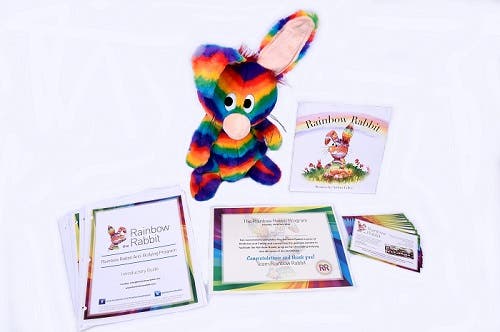
Each grade gets its own specialized lesson, which includes activities and questions that allow students to put themselves in Rainbow Rabbit’s place. Once students are exposed to it, they love. The book even got a seal of approval from Maria Shriver.
“I’m thrilled that you’ve written a book that helps teach children tolerance and acceptance of everyone despite what they may look like,” Shriver wrote in a 2008 letter to Arthur Vallee. “It’s a very important message for individuals of all ages, and I applaud your efforts — you are truly an architect of change.”
“It was emotional and inspiring to see how well the kids at In-Sync and Social responded to Rainbow Rabbit,” said Maria Slavin, the founder and president of the private practice that focuses on sensory perception and social skills. “This great story book and curriculum is excellent for teaching children empathy and acceptance, as well as teaching children who are at risk for being socially isolated, that they are not alone and that they deserve to be treated with kindness and respect. It gives them the confidence and encouragement they need to be themselves and interact with others.”
“This program is very user-friendly,” said Erin Saponara, a former anti-bullying coordinator for Manasquan Elementary School. “Students showed empathy and excitement. The guidelines provided by your company were excellent. We easily gained important feedback from students, teachers, and the ambassadors.”
“The story reminds us that we have all had moments when we didn’t fit in or belong. We found our ‘true colors’ when kind and caring friends saw our specialness…we learn to celebrate who we are rather than defend what we are not,” Msgr. Michael T. Mannion, the Director of the Office of Community Relations for the Diocese of Camden, said. “There is a part in Rainbow Rabbit’s story which says that he was so lonely, he wished that he could die. It is best not to deny the reality of these dark feelings, but know that others will help to transform them to be brighter and optimistic. It’s important to show that this particular feeling was temporary, and that it changed for the better. A rainbow has a dark side, but bright sides as well.”
The program was initially offered to students in kindergarten through fourth grade. As the program evolved and was perfected, it expanded to students in pre-K. It is no longer offered in fourth grade, although it did have an impact on fourth graders.
“I have a friend who used this story as the basis for a lesson” in her creative writing class for students ages 11-17, Joe Vallee said. “They laughed when they first saw it, but halfway through it, most of the kids were crying.”
Reaching younger children was important to them, as well. Ultimately, they'd like to be able to offer their program to as many schools as possible for free.
“It’s so important to get to children as young as possible,” Shirley Vallee said. “All the kids who have it love it. That’s the goal.”
THE MENACE OF BULLIES: PATCH ADVOCACY REPORTING PROJECT
As part of a national reporting project, Patch has been looking at society's roles and responsibilities in bullying.
Do you have a story to tell? Email us at bullies@patch.com, or share your views in the comments.
Get more local news delivered straight to your inbox. Sign up for free Patch newsletters and alerts.