Politics & Government
Borough Family Battles Unsavory Stream, Seeks Answers
With no one willing to help clean up the toxic soup that fills her backyard, 27-year-old Collingswood resident Christina Caruso doesn't know where to turn for help.




The first thing you notice about this part of Woodlynne Avenue is the strong odor that permeates the street.
It is a cloyingly foul scent; a mixture of sulfur and excrement that lingers, intensifying as you approach a nearby creek bed. The source of the waterway is not immediately observable, but it deposits waste into sewer lines that run beneath the roadway and its cracked and broken storm drains.
The creek itself is choked with garbage: plastic bags, bottles, Styrofoam containers. Nearby lawns suffer the same fate; there’s a broken Swiffer in the bushes of what appears to be an abandoned duplex.
Find out what's happening in Collingswoodfor free with the latest updates from Patch.
Christina Caruso, who has lived on the block for nearly 30 years, says she is sickened by the environmental state of her neighborhood. A Collingswood lifer who coaches rec league sports and participates in the local Women’s Club, she has no shortage of civic pride.
But Caruso says things have deteriorated to an unacceptable condition and she needs some help.
Find out what's happening in Collingswoodfor free with the latest updates from Patch.
Rain, rain, go away
When it rains on Woodlynne Avenue, the runoff deposits garbage into Caruso’s backyard and those of her neighbors. Enough of a downpour and her chain-link fence is the only thing that strains out the bigger pieces. Caruso still goes beyond her property line to clean it up because she can’t stand looking at it.
Even after the storm water recedes, the garbage it deposits in her backyard remains, making it an unsafe place for her children, Gavin, 3, and Addison, 2, to play. Caruso says her dad once discovered rainwater that had collected in the backyard contained cyanide. He showed her hypodermic needles he discovered in the trash that had floated in.
In addition to leaching contaminants into her soil, the constant stream of water has softened the ground, toppling a cement-anchored swing set. Years ago, a tree whose roots had come unearthed fell, taking part of a neighbor’s fence with it. Her elderly father, by then stricken with cancer, was told that it was his responsibility to clear it away under threat of a fine. Caruso remembers him going out with a chainsaw to manage the chore.
Caruso's father died a few years ago, and the problem has not improved. Mosquitoes breed by the thousands in the stagnant pools where the water collects, making her property an inhospitable swamp on otherwise nice days. Because the mess is such a chore to maintain, many of her neighbors have simply given their yards over to nature. The broadening thicket invites rats and other undesirables to shelter there.
“I've found drug vials on my lawn,” she says. “I make my husband clean them up so that my children don't have to see them. I’ve watched my parents spend thousands of dollars at the vet trying to keep pets alive who drank the water in our backyard.”
New pollution
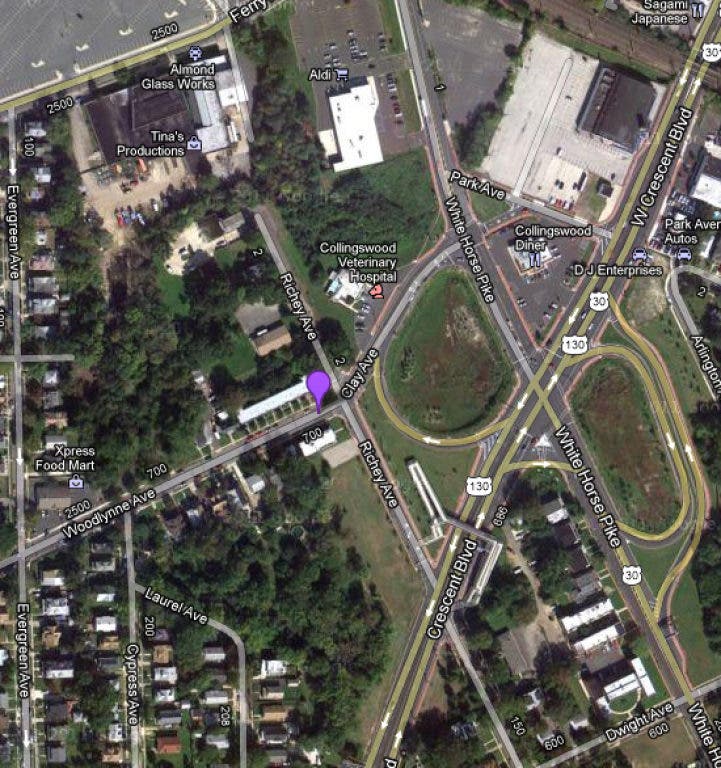
Caruso says the flooding has been a constant throughout her life, but the worst of it began when the borough demolished a block of homes on Richey Avenue about a decade ago, flattening the land there. The new topography essentially has turned her backyard into the lowest point of a basin that gathers this toxic soup.
Caruso says her family’s fights with the borough have been ongoing for years. She describes conversations with Collingswood Public Works Superintendent Carl Jubb Jr., as sympathetic, but ultimately fruitless.
Her attempts to rally support from other neighbors have been unsuccessful, due in part to the large proportion of renters on the block who don't seem to have a personal stake in the condition of the neighborhood.
"When I started going to the [borough] meetings, that's when they started taking me seriously," she says.
Caruso says that the only assistance she's gotten from the borough came in the form of a $500 community development grant that she put toward new windows.
In fact, she says, her family’s requests to clean the block up only got them a citation for a cracked driveway apron and sidewalk. Under threat of a $1,000 per day fine from the borough, she had to repair both in the middle of winter at an out-of-pocket cost of nearly $2,000.
“We only got a certain distance up from the street because the cement was cracking because it was so cold outside,” Caruso says.
Caruso says her property taxes exceed $5,000 a year. She believes she would never be able to sell her house for anything approaching its true value because of the condition of the block. All she’s asking for is a little bit of help from her local government, she says.
"I'd like to see them spend a little more time cleaning our streets," Caruso says. “A lot of stuff is neglected over here that wouldn't be on the other side of [Collingswood].”
Looking for answers
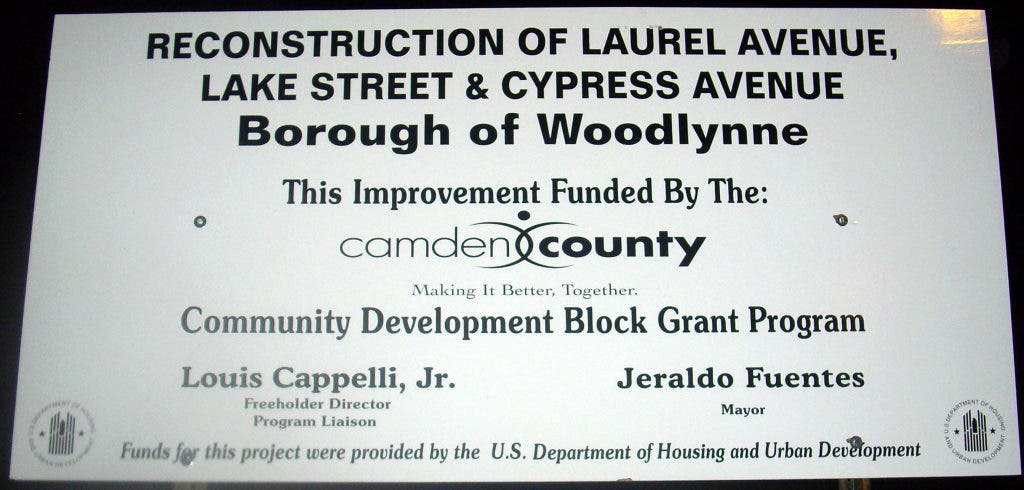
There is a big, white, wooden sign on Laurel Avenue in Woodlynne, which runs along the border of Caruso’s backyard. It labels the area an improvement zone funded by the Camden County Community Development Block Grant program.
Sadly for Caruso, the money has only gone to replace sidewalks, roads and slate curbs, says Woodlynne Mayor Jeraldo Fuentes.
“We used CDBG funding and DOT [Department of Transportation] money for Laurel, Lake Avenue and Cypress Avenue,” said Fuentes. “It’s 75 percent completed. The street was all deteriorated.”
Fuentes said he recollected that Collingswood was supposed to undertake some renovations to the small creek on Laurel Avenue, but couldn’t say whether anything had been done yet.
“Last year, they notified the residents of Woodlynne that they were going to be doing some dredging,” he said.
All Fuentes knows about the area is “when you get a big, high tide, the runoff comes into the creek area…[and] during a heavy storm, it does flood into those holding ponds [on Route 130].”
Jubb said the stream was dredged “as much as they could, maybe two years ago,” under the watch of Borough Administrator Brad Stokes. He believes even that action took some negotiations with state agencies to pull together.
“We can only do so much,” he said. “I really wasn’t involved with it.”
Andrew Kricun, executive director and chief engineer of the Camden County Municipal Authority said whatever issues Caruso has encountered are “unequivocally not a CCMUA problem.”
“All the Collingswood sewage goes to a spot at Comly and Newton, and we have a forced main down Comly that pumps toward Camden,” Kricun said.
Anecdotally, Kricun said he recalls a problem with the Camden City pumping station at the nearby Ferry Avenue Hi-Speedline station, but couldn’t say for certain whether that would be a cause in this instance.
He added that although it’s not his responsibility, the CCMUA “would be glad to help the DEP [Department of Environmental Protection] track it down.”
All this back and forth is typical, says, Caruso, who feels like she’s caught in a no-man’s-land just trying to get some answers.
Caruso says she has no knowledge of any clean-up project in the works and, in fact, is uncertain who would take responsibility for any such initiative. As a social worker, she is not unfamiliar with negotiating government systems, but she’s weary from a battle that has been ongoing since before she was alive.
“It's a struggle,” Caruso says. “You have to fight for whatever you want here."
Don't miss out on Collingswood news and events—sign up for Patch's newsletter and breaking news alerts.