Health & Fitness
The American Film Theater: A Chapter in the History of Moviegoing
The American Film Theater was a noble, two-year experiment; not quite theatrical, not fully cinematic, most of the films are worth seeing.
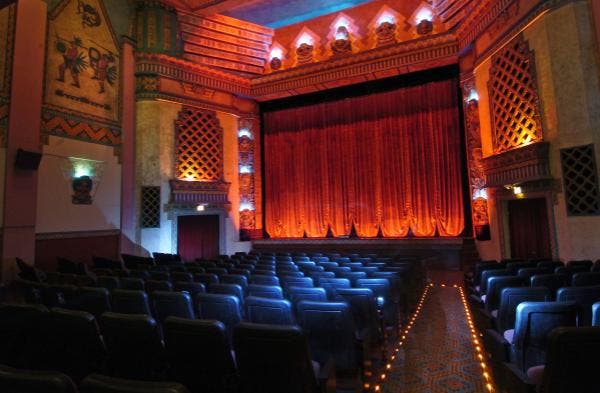

It was the year I graduated from Penn State University and the year before I entered graduate school. I was working (improbably) at a religious goods store for $125 a week. Two months into the job, my prospects were bleak.
My English degree had produced zero job leads. I was writing—very little, and usually awful, embarrassingly lame material. I had broken up with my college girlfriend. Commuting on the Red Arrow line buses from the suburbs to 69th Street, transferring to the subway; I couldn’t believe I would be doing this the rest of my life.
The American Film Theater (AFT) stands out as one of the few pleasurable experiences of my life in those days. The idea was unique in the history of movies: once a month, a new film of a master theater work would be shown for one or two days, afternoon and evening shows. Eight plays were filmed for the first season.
Find out what's happening in Collingswoodfor free with the latest updates from Patch.
It seems unimaginable that this feat could be accomplished, especially to most people today, who know nothing but instant box office hits and bombs. The project was produced by Ely Landau with financial backing from American Express. I bought season tickets.
For years, many plays and musicals have been brought to the screen with little or no worry. Tennessee Williams, one of our greatest playwrights, has collaborated on more than dozen film adaptations of his work, including The Glass Menagerie, A Streetcar Named Desire and Cat on a Hot Tin Roof.
Find out what's happening in Collingswoodfor free with the latest updates from Patch.
Recently, all of Samuel Beckett’s plays were filmed in Ireland, in the spirit of AFT, using well-known actors like John Hurt, Jeremy Irons, and John Gielgud, and directors like Atom Egoyan, David Mamet (much of whose stage work has been adapted for the screen), and Anthony Minghella.
But AFT embodied conflicting aesthetic approaches from the start. For one, film and theater are fundamentally different to watch. Despite the presence of some notable directors: John Frankenheimer (Iceman), Lindsey Anderson (In Celebration), Arthur Hiller (The Man in the Glass Booth), and Tony Richardson (A Delicate Balance), Joseph Losey (Galileo), the films amounted to filmed plays with talking head close-ups.
There was a general justification for filming the plays to preserve them forever, but it’s not the same as seeing them on stage. Because Hollywood producers saw plays merely as pre-conceived material to be filmed, that’s what they became for audiences—merely plays that were filmed. AFT thus established itself in a perpetual no man’s land: a play that was not quite fully transformed into a movie.
American Film Theater was economically geared to fill movie houses at select times, and its margin of error was very tight. Often, films played to near-empty houses in Manhattan because they were shown in the afternoon. For all the talk of their artistic merit, AFT films didn’t usually play long enough to qualify for awards. Man in the Glass Booth became the one exception when it played for a week in Los Angeles and earned Maximilian Schell Golden Globe and Academy Award nominations.
The main problem, though, was the selection of the plays. A work like Rhinoceros was carried completely by its casting. Philadelphia, Here I Come, Jacques Brel, and Lost in the Stars had no familiar faces. If a person like I, who wanted to see these films, only went to four out of fourteen, you could be sure the financial backing of American Express was not going to be enough to sustain the project very long.
* * * * * * * * * *
Until the three AFT DVD collections were released several years ago, it was nearly impossible to track down any of the series. Today, the films are available in three collections, but buying them means that you will probably purchase an unwanted film. The first has five heavy hitters, including O'Neill's The Iceman Cometh, Eugene Ionesco's Rhinoceros, Simon Gray's Butley, Genet's The Maids, and John Osbourne's Luther, an intense production with Stacy Keach in the lead.
Rhinoceros was perhaps AFT’s biggest disappointment. In 1968, Zero Mostel and Gene Wilder had made The Producers, one of the greatest comedies, and starring together in this absurdist comedy should have been a sure thing. Unfortunately, the play takes a single-minded criticism of social conformism and grows as tedious as a long SNL skit.
The second collection has my favorite play: Harold Pinter's The Homecoming, which many critics considered one of the best AFT offerings, and which I believe to be the most cinematically inspired representation of these plays on film. It is presented with most of its original cast, including Ian Holm.
This collection also includes three plays with exceptional performances: Albee's A Delicate Balance (Katherine Hepburn and Paul Schofield), David Storey's In Celebration (Alan Bates and Brian Cox) and Robert Shaw's The Man in the Glass Booth (Maximillan Schell).
Collection Three sends a shiver up my spine, as I found only Brecht's Galileo watchable among the four (the others: Lost in the Stars, Jacques Brel is Alive and Well and Living in Paris, and Philadelphia, Here I Come).
Even on DVD, however, many reviewers treated the plays as if they were simply transposed into film. In a rare gesture of integrity, the Beckett DVD includes a special feature in which a critic argues that the mere introduction of a cinematic viewpoint to a play unequivocally distorts the meaning of the drama.
Surprisingly, I found myself agreeing; yet I could not stop myself from watching all the plays and re-watching much of the AFT on DVD. I gamely accept the rationale that I (and many others) would never have seen these plays had they not been filmed; when AFT started its 1973-74 run, I saw five during the first year. The first two, Pinter’s The Homecoming and O’Neill’s The Iceman Cometh, quickly became (and have remained) my two favorite dramas.
Like much of the intended audience for AFT, however, my interest in the whole film-theater experiment flagged. I entered graduate school at Columbia University, which was not very close to the AFT venues, and I did not buy a subscription for the second year. I do not remember hearing much about those next six films.
Collingswood resident Bob Castle is an author, teacher, film critic, and playwright. In town, he is also the founder of the Collingswood Movie Club, which meets monthly in the public library for film showings and discussion.
Castle's writing has appeared in Bright Lights Film Journal, Film Comment, and The Film Journal. His plays have been performed during the Philadelphia New Play Festival, the Philadelphia Fringe Festival, and at the the Gone in 60 Seconds and "In a New York Minute" festivals.