Business & Tech
Edward Jones Teaches Entrepreneurship to Students
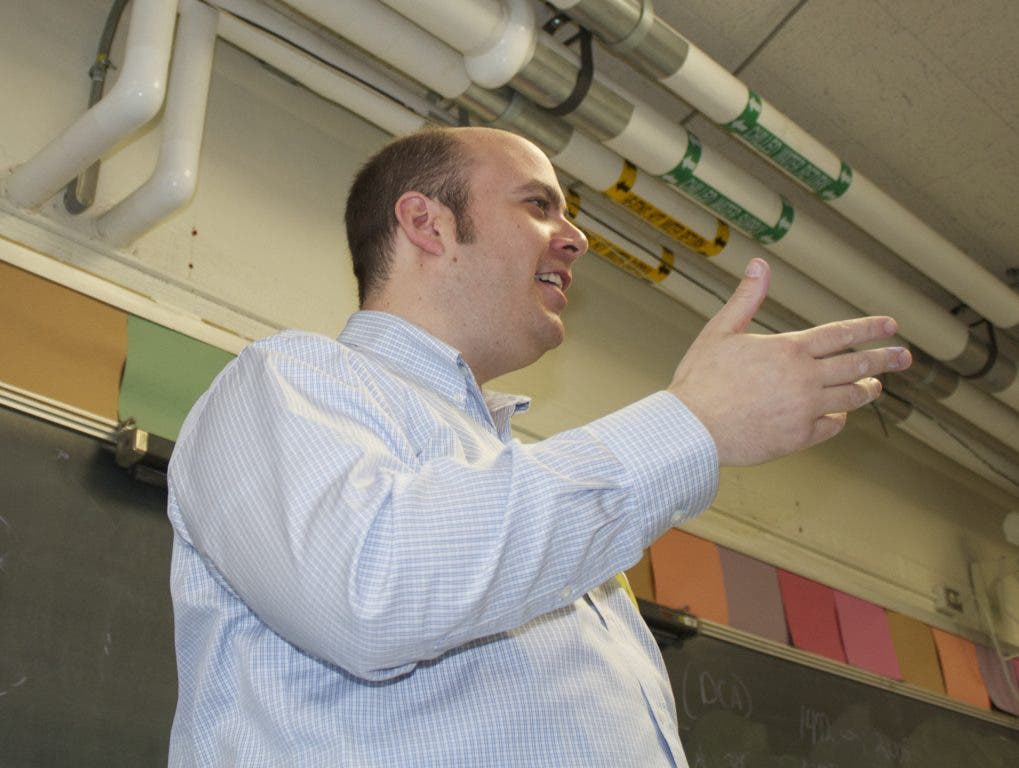
High school students Thursday were visited by Scott Gutman, who runs the Collingswood branch of Edward Jones Investments.



Collingswood High School's Entrepreneurship class held an enthusiastic financial discussion Thursday, their eagerness fueled by one critical element—doughnuts.
As Entrepreneurship teacher Rod Pierce ushered the last student into his room at 9:39 a.m. Thursday, the group realized it was no ordinary class day. A massive Dunkin' Donuts box served as evidence of the extraordinary.
At frequent intervals throughout the next hour, one sentence could be heard echoing from Pierce's classroom over and over.
Find out what's happening in Collingswoodfor free with the latest updates from Patch.
"That's right—doughnut!"
The words came from Scott Gutman—who runs the Collingswood branch of corporate entity Edward Jones Investments, on Haddon Avenue. Gutman, a financial advisor for Edward Jones, has been visiting the high school's Entrepreneurism class twice a year for the past three years.
Find out what's happening in Collingswoodfor free with the latest updates from Patch.
His visits bring students the financial wisdom of an entrepreneur. And doughnuts.
"I want to spark (student) interest when I'm discussing financial information and spouting off numbers," said Gutman. "So I started bringing doughnuts.
And students countered by bringing enthusiasm.
While Gutman lectured about 401(k)s, interest rates, credit scores and inflation Thursday, students were at attention. When he asked a question, hands shot up like firecrackers.
And whenever a student answered a question correctly, Gutman sent another sentence booming down the high school corridors.
"That's right—doughnut!"
Doughnuts work. Gutman will be the first to advocate sugar-coated financial lectures.
"Kids sometimes find inflation rates boring," said Gutman. "But doughnuts get them interested and keep their attention."
And the entire classroom spent Thursday morning eagerly talking numbers.
"Let's talk inflation. In 1980, the average house cost $68,000, and you could buy a gallon of orange juice for $1.23," said Gutman to students. "But the average rate of inflation rises 3 percent annually. At that rate, 30 years later, what effect has inflation had on the price of those items?"
Hands shot up. Guesses flew about the room. Students bit on pencils, calculating figures in their heads.
"Today, because of inflation, the average home costs $222,000 and a carton of orange juice sells for $2.99," said Gutman. "And 30 years from today, you'll all be buying that same carton of O.J. for about $7.26."
Eyes widened, jaws disconnected from mouths. Students murmured, "Oh, man. Wow, that's crazy."
And then, like clockwork.
"Which one of you guessed $200,000 as the cost of an average home today? Yes, back there, you guessed closest," he said, pointing to a student in the back. "Doughnut!"
Happily, the student gathered her prize and settled back at her desk, loving the financial lecture almost as much as her glazed doughnut with jimmies.
Gutman told students why they should pay more than the minimum balance on credit card bills. He warned that less payments over time, factored with interest rates, could result in paying almost double what the total bill costs.
The minimum payment interest rate lecture soon became a lesson, illustrating how quickly one's credit score can be damaged. And when Gutman asked if the class knew why a credit score is important to maintain, he got his answer.
"You definitely don't want to end up in debt, or have a bad credit score," said 18-year-old high school senior and Collingswood resident Anthony Monahan. "A bad score will affect your ability to buy a house, get a new car, everything."
Monahan said he wants to become an electrician in the future, and admitted that Gutman's teachings will be valuable assets to his career.
And Rod Pierce's classroom is full of students who will benefit from Gutman's words. In Entrepreneurship, Pierce's lessons detail business tactics and financial responsibility. As part of the course, Pierce's students learn to handle school store finances, until they're eventually managing the store independently by the school year's end.
"I'm essentially teaching them to run a business," said Pierce. "I'm very involved at the beginning of the year, and students slowly learn the process and end up handling everything—school store purchases, taking inventory, keeping track of money. At this point in the year, I'm only involved to make change when they need smaller bills."
And Gutman's two visits per school year only improve Entrepreneurship curriculum. As a financial adviser for Edward Jones Investments, Gutman has mastered everything from money management and retirement planning to stock and bond investments, life insurance, financial knowledge and understanding—all through local, field experience.
But Collingswood's Entrepreneurship class ended up teaching the financial guru one thing he didn't already know about finances:
Investing in a box of doughnuts makes finance taste better for everyone.
Get more local news delivered straight to your inbox. Sign up for free Patch newsletters and alerts.