Business & Tech
Collingswood's Haunted Rite
Borough officials recount unexplainable happenings from within one of the most historic structures in town: the Scottish Rite Auditorium.

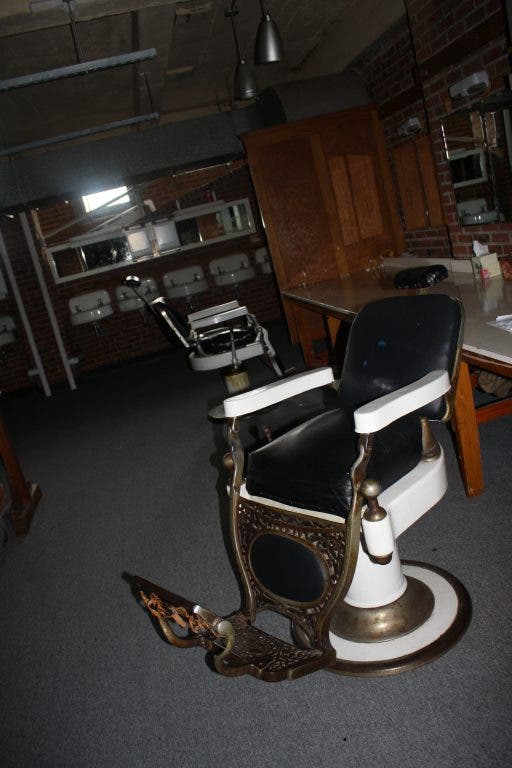


It's one of the most historic sites in Collingswood. Apparently, it's also one of the most haunted.
Borough officials shared their own unexplainable stories from within the walls of the .
Scottish Rite Auditorium Director Jerry Chambers, who was hired in 2003, said the encounters began soon after his arrival.
Find out what's happening in Collingswoodfor free with the latest updates from Patch.
"Shortly after I began working here, I would notice doors opening and closing," said Chambers. "What really got to me was this one door, which was always locked. I had the only key. One night, that door was both open and unlocked. So I got to the point where I had to figure out if these occurences were in my head or not."
A short time later, Chambers said he realized the unexplained incidents were not of his own doing.
Find out what's happening in Collingswoodfor free with the latest updates from Patch.
"One night during my first year at the Scottish Rite, I was trying to turn off the lights in the auditorium. There are three places (in the main theater) where you can turn off the lights," he said. "And that night, for whatever reason, I just couldn't get them to turn off.
"It was around 8 or 9 p.m., and I was alone, the last one in the building. I went up to the booths all the way at the top of the theater, to one of the spots where the lights can be turned off," said Chambers. "A few tries later, with no success, I began walking back down the stairs. I'm halfway down, and all the lights just turn off. I mean, it was so dark I couldn't see my hand in front of my face."
Why Hurley haunts
Enter William Hurley—the man whose family was the last to inhabit the older segment of the Scottish Rite, in the mansion residence.
"So I said out loud, 'Mr. Hurley, it's only Jerry, and I won't hurt you,'" said Chambers of the incident. "My take is, Hurley and his family were the last to live in the mansion section of the Rite, which was built pre-Civil War, in 1830. The addition (the Grand Ballroom), was built in 1931.
"A lot of noted people had something to do with the mansion. Mr. Collings, the Zane family (who owned the land), Mr. Knight (who reportedly committed suicide). At one point, the mansion was used as a nursing home, and was labeled as a sanitorium—which housed unwed mothers, who, back then, were labeled as 'insane,'" said Chambers. "But Hurley's family was the last to live here."
According to Chambers, Hurley—a devout Catholic and fourth-degree Knight of Columbus—lived in the mansion with his wife and three daughters until his death in 1928.
"Back then, being Catholics, any member of the Knights of Columbus would be excommunicated from the Catholic religion if they became a Mason," said Chambers. "When Hurley died, his wife sold the mansion property to Masons, in the 1930s. That's why (Scottish Rite Auditorium staff) believe that Mr. Hurley's ghost lingers here; because he may be angry with his wife's decision to sell his home to Masons."
'I've seen Mr. Hurley with my own eyes'
Enter David Herman, a Scottish Rite Mason whose office is currently housed in the mansion at the Scottish Rite Auditorium. According to Herman, at the time of the sale, Scottish Rite Masons were 8,000 strong, meeting in Camden City but looking for a new venue.
"I've been working here since 2002. The office I currently work out of was built in 1813. This building was bought and sold by various people and organizations over the years, but probably the most notable person to be here was William Hurley," said Herman, hands folded over historic documents resting atop his desk in the mansion.
Herman referenced the documents, which depict Hurley as a prominent businessman who owned a string of department stores around the region. Hurley was reportedly a delegate in Teddy Roosevelt's third-party movement. In 1912, Hurley invited delegates to the mansion, where Roosevelt came to address Camden City.
"Roosevelt actually stayed here, in the mansion. And until close to Roosevelt's death, the president called Hurley 'Honest William Hurley,'" said Herman. "The interesting thing here was that Teddy was a Mason, when Hurley was not."
In Hurley's day, the Scottish Rite grounds were called Dun Garvan—named after a town in Ireland where Hurley hailed from.
"I've seen Mr. Hurley with my own eyes," said Herman. "There's this large staircase in the mansion, and a stained-glass window at the top of the stairs. The window was moved from another part of the building and put atop the staircase.
"When I saw him, it was in August, and still somewhat daylight. It was about 5:30 in the afternoon, while I was working here," said Herman. "This was shortly after the had signed its (50-year) lease (to use the Mason's building for events and productions)—but the borough had not fully moved in yet, so I thought I was alone.
"I heard footsteps on the second floor," he continued. "And you cannot hide walking across the second floor in an old building like this. So I go out my office door and look up the staircase, and for a brief moment, I saw a gentleman standing next to the stained-glass window.
"I hesitated; I could see him very clearly, and he resembled the portraits I'd seen of William Hurley. And from his attire, I would say the man was a gentleman from (Hurley's) era. That's the only encounter I've had with him."
Visitors spot spirits
But other stories abound.
Chambers said one woman at the venue caught a significant number of orbs—circular objects that paranormal investigators believe indicate spirits—in a photograph.
Herman said one man was combing his hair in an old hutch mirror, noting that the reflection was worn-out, and didn't look right. Another person standing beside him realized, "That's because the person in the mirror isn't you."
A venue employee said her co-worker once noticed a man walking into Chambers' office. Upon entering, the man in question—which this employee said was clearly visible, wearing black pants and a white shirt—could not be found.
Borough Hall employee Terry Seeley, director of Collingswood Partners, said during one Collingswood Community Theatre performance, she went to use a Scottish Rite restroom. While occupying a stall, she said she heard one of the sink faucets turn on. But upon exiting the stall, Seeley realized she was the only one who'd been inside the restroom.
But regardless of what goes on inside the Scottish Rite Auditorium, it's turned many non-believers into believers.
"From my experience, spirits don't hang too much in the ballroom (which was added on to the building), because it's kind of new," said Rite Director Chambers. "The majority of sightings occur in the older section, in the mansion. The encounters are far from anything evil; they're not frightening or menacing. But at the same time, there's no denying that they happen."
Editor's Note: Special thanks to Jerry Chambers and David Herman, who made this story possible by providing historical facts, ghostly encounters, and for taking Patch on a tour of the Scottish Rite.
Get more local news delivered straight to your inbox. Sign up for free Patch newsletters and alerts.