Arts & Entertainment
I Am Collingswood: Eileen Boyle
A Collingswood resident for more than 25 years, Eileen Boyle is a business owner, volunteer and one of the architects of the local arts scene as we know it.
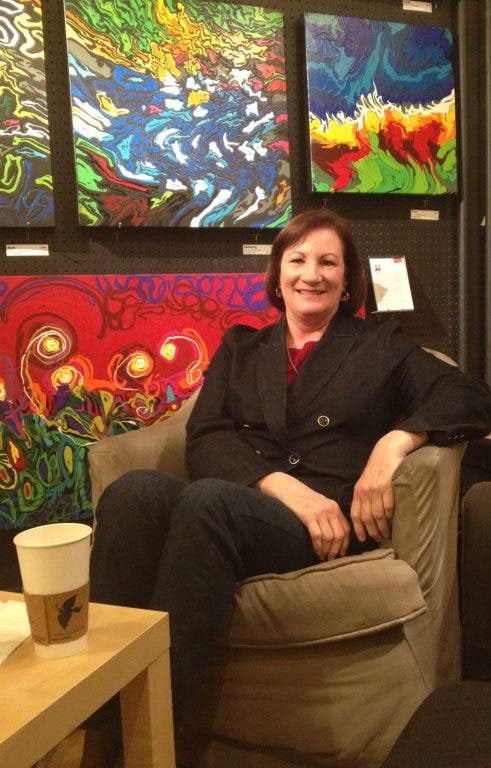
It's no wonder that "welcome change" is a mantra for long-time Collingswood resident Eileen Boyle. She's weathered the changes in her own life gracefully, including raising children after the loss of her husband and starting her own business, all while helping Collingswood transform itself into the vital, artistic community we know today.
An independent life coach and business consultant, Eileen moved her graphic arts business to Haddon Avenue in the late 1990s. Her work with Newton Colony Arts Bank helped revitalize the town, and she says Collingswood has sustained her through difficult times.
Collingswood Patch: Can you tell me about your role in the redevelopment of 729 Haddon Ave., the building that now houses El Sitio and the Pop Shop?
Find out what's happening in Collingswoodfor free with the latest updates from Patch.
Eileen Boyle: Well, it was 1999 when I made the offer, right at the beginning of 2000 when we closed on it. There was one restaurant in town, but it was a diner-y type of place. I don't think I had ever eaten there.
The only other restaurant was Vincenzo Barone's restaurant, Villa Barone, and it had just started to be a well-known Italian restaurant, because when he first moved into town, it was a pizzeria. It was nothing like it is today.
Find out what's happening in Collingswoodfor free with the latest updates from Patch.
When I bought 729 Haddon Ave., it was called the Gordon Phillips Beauty School; everybody referred to it as Gordon Phillips. It was a functioning beauty school then. Stanley Gordon was the owner of that location and two or three others, all the other locations he rented.
Unbeknownst to me, Stanley had been in the process of selling his entire beauty school business to Empire Beauty School at that time. My timing of making that offer solved one of the issues for him about having to sell that property. I think I closed on the building sometime in January 2000.
Patch: What was your reason for acquiring that property?
Boyle: The reason I even came about looking for a building to purchase in town was because I wanted to move my graphic arts company from Pennsauken over by the high school on Hylton Road, down here into town.
The main reason was because my husband had died in June of 1999 quite suddenly and our children were 7, 9 and 17 at the time and I wanted to be closer to the kids.
Even though you think Pennsauken's only 20 to 30 minutes up Route 130, when you've got grammar school children and they're having all their little functions and activities, and after school are ballet lessons and music lessons and sports things...
I was running back and forth sometimes two times a day, and then coordinating with the woman who watched the children for us. I figured it would make it so much easier to be right here in town, a few blocks in town and a few blocks from their school.
I sold the building to Dr. John Wilson in 2008. In that eight years time, I had rented space to Connie and Bill Fisher, who opened the Pop Shop, Mark Smith and Lydia Cipriani came in with the Tortilla Press, Nunzio came in with Nunzio's, and then many of these other restaurants started cropping up.
And more stores started coming in! So we like to think of that period, right around 1999 to 2003, as the renaissance of Collingswood.
Patch: In 1998 you were instrumental in forming the Newton Colony Arts Bank, which helped to bring more performing arts to our community. That organization was responsible for opening up the Scottish Rite Auditorium for public music and theater events. Can you tell me how that group got started?
Boyle: I would say I was part of the group who ultimately got Newton Colony Arts Bank going, but Newton Colony Arts Bank actually started in a coffee shop.
John Kane, Jerry Chambers, and some others were all sitting around talking, and it was coming up on the Porch Brunch and House Tour. John Kane always had the idea that if we could bring music and arts to Collingswood that it would be the ideal economic engine/driver for the town.
They were sitting and having coffee one morning, talking about what buildings to put on the house tour, and John suggested the Scottish Rite. He had been in it years before and he said it had a fantastic theater, and that even the old house on the grounds was quite magnificent, although run-down.
He got permission to go in, and not too long after that, he called me up and said, “I don't know if you'd be interested in getting involved with this group,” but anything involved with the music, and the arts and Collingswood is something I'm interested in.
Patch: Tell me about some of the events you helped organize in the early days of Newton Colony Arts Bank.
Boyle: At the time, the Westmont Theater was still functioning, so the first concerts held by the Newton Colony Arts Bank were held at the Westmont Theater.
I can remember the first concert clear as day, standing in the lobby of the theater. We had invited all kinds of people, all kinds of friends. It was a great night, because we just knew. You know when you just feel the energy? It was a magical night because it was the start.
All of us kind of got the bug, and then we ended up getting the Cloud Masonic Lodge right here on Haddon Ave. And it was musty, dark, dank, but we started holding concerts there. We had mostly local musicians, but even some people [from] as far away as Boston played there.
We used to have concerts every Thursday night over at the Cloud Masonic Lodge. Every Thursday night, I would race from work to go out and buy tons of soda and ice, and we'd lug it all up there. It was a lot of work, but it was worth it because we were determined to get this town back on track!
So we started small, but the buzz started, and before you knew it, people were talking.
Patch: How did you rise to a leadership position within Newton Colony Arts Bank?
Boyle: We knew we were onto something; then we decided we needed to formalize the group. I made the suggestion that we hold elections.
At the time, Jim Maley stood up and said, “Why even hold an election? We all know who should be president!” And I said, “No, no, no!” But anyway, I was elected president.
It was an amazing group of people. We started planning our first big event, and we rotated meeting at each other's houses. We had our first concert over at Hero's Island in Cooper River Park.
I don't know how we did it. I think that whole year, my kids didn't spend one night at home. They were always at meetings with me, bringing their homework and sitting over in the corner while we planned the event.
Patch: When and why did Newton Colony Arts Bank dissolve?
Boyle: We started [in] the early 2000s, and then 9/11 happened. So the second year, having 9/11 happen a month prior to the concert definitely put a damper on the event.
Ticket sales, of course, were not happening, and then the third year I was in the throes of so many things going on with my business. And there were a lot of challenges in starting an organization like that; a lot of politics involved, a lot of money that needed to be raised, constant fundraising.
I got the point where I was just burnt out. There was never a break, all year round. It was either working towards the May Fair, or working towards the holiday parade, or working towards the Newton Colony Arts Bank concert. My business was definitely going through changes, my kids were getting older, and I had a couple of tenant changes in the meantime. I was just burnt out.
I don't really know how it all fizzled, but at some point...you know, people's lives change, the needs change, the focus changes. We had accomplished one of the major things we wanted, which was to get the Scottish Rite underway. They had taken on Jerry Chambers on as a full-time employee over there by that time. And I think, eventually, it just got to the point where we all figured there was no point in continuing it because we all had other things to do.
But there were lasting effects. I mean, now there's the Music Festival, the Book Festival, the Shakespeare Company; those were all conversations that we had back when we started the Newton Colony Arts Bank. Everybody who came to those meetings all had different hopes, different dreams, different visions.
We did so many things in such a short period of time, and so many people came out of the woodwork in this town who had talent galore.
Patch: How can—or should—people can get involved in improving their communities?
Boyle: I think it's always best to do something. Back when my husband and I were trying to decide whether or not to stay in this town or to move, we were a little nervous [of] the direction Collingswood was headed in. We knew the crime rate was increasing; this was still back in the '90s.
I think it was Jim Maley who said, “Get involved and see what you can do.” Joan Leonard was also a good influence, helping to encourage me personally to get involved with the Horticultural Group. Gayle Reedy who is a neighbor of mine; she also was a great example to me to get involved in what you love and in what you enjoy doing.
Whether you have an hour a month, or you have a week a month to give, get involved. You'll build friendships; you'll build relationships. Now I walk around this town and there's not a place I go that I don't see somebody I know.
But that's my best advice: just do something. Something is better than nothing rather than complaining or criticizing. It's always easier to stand on the sidelines and see what needs to be done, but when you're in it...I mean, I learned so much.
Patch: As a professional life coach, what advice can you give our readers on how to live more successful and fulfilling lives?
Boyle: Welcome change. Don't dig your heels in and say, “I don't want to change.” We're always changing and if you're open to change, it's less painful.
You know, when I was widowed, it wasn't something that I'd ever dreamt of, but it changed me. For some people, something like that will change them for the worse; for me it continued a process of my gaining confidence and experience.
My husband was a very smart, very successful businessman, and I probably wouldn't have learned most of the things in business that I learned because I wouldn't have had to. I would have had him to rely on.
In the end, I think going through that really made me a better person—a better businesswoman, a better mom, a better boss. So, change is something that I'm really big on—looking at it as a positive thing; glass-half-full instead of half empty.
Another one is to always say, “I think I can,” even if you don't know how you're going to do it. One of my coaches told me once, “It's not the how, it's the why.” He always said, “You don't have to know how, you just have to know why.”
So, for me, when I wanted to move my business from Pennsauken down to Collingswood, I didn't know the first thing about how. All I knew was why: I wanted to be near my kids.
With Newton Colony Arts Bank, too, when we set the date of our first event, and we put the press releases out, we didn't have a clue how we were going to do it, we just knew why we wanted to do it. We wanted to revitalize Collingswood.
The third thing is coming together as a group, as a team; getting the support, getting the encouragement of others.
Patch: What do you love most about living in Collingswood?
Boyle: I love a small town. I grew up in a fairly large, sprawling town up in North Jersey, and then when I moved down to South Jersey and met my husband and we were trying to figure out where we wanted to live, we wanted a town where you'd know your neighbors.
The best thing about living here is the feeling of security and friendship and history. My sister just celebrated her 20th wedding anniversary yesterday, and we marveled that it's been that many years since she and her husband married. I've often said I envy my friends who've celebrated 20, 30, 40, years of marriage, because my marriage was short-lived. It was just almost 10 years when Jim died.
So I think in some strange way, living in this town gave me that sense of longevity, of belonging, of having a place where everybody knows your name. A place were, when you come home, you're really coming home.
I can remember so many times driving back from the Philadelphia Airport, or driving back from either Cape Cod where my father lives, or Michigan where my mother lives, and coming up Cuthbert late at night.
That last few blocks where you start to get where you can't sit in the car one second longer...and you get that “Ahhh” feeling when you pull up to your door—that's the feeling that this town gives me.
It's not just my house; it really comes over me whether I walk into a store or a meeting at borough hall, whatever. It's just wonderful. That's why I think, in a town like Collingwood, families will always pull it through; because we're not going to lose these little towns.
Gosh, I've been to so many weddings, so many funerals. It's hard for me to even go to Blake-Doyle because that's where my husband's services were, and his mother's, and so many of my friends and even some of my friends' children. At the same time, we're all there for each other, which is a beautiful thing.
The people here have heart, they have real, real heart.