Business & Tech
Small Business of the Week: Kenkojuku Karate
Haddon Avenue-based Kenkojuku Karate has become a Collingswood martial arts staple.

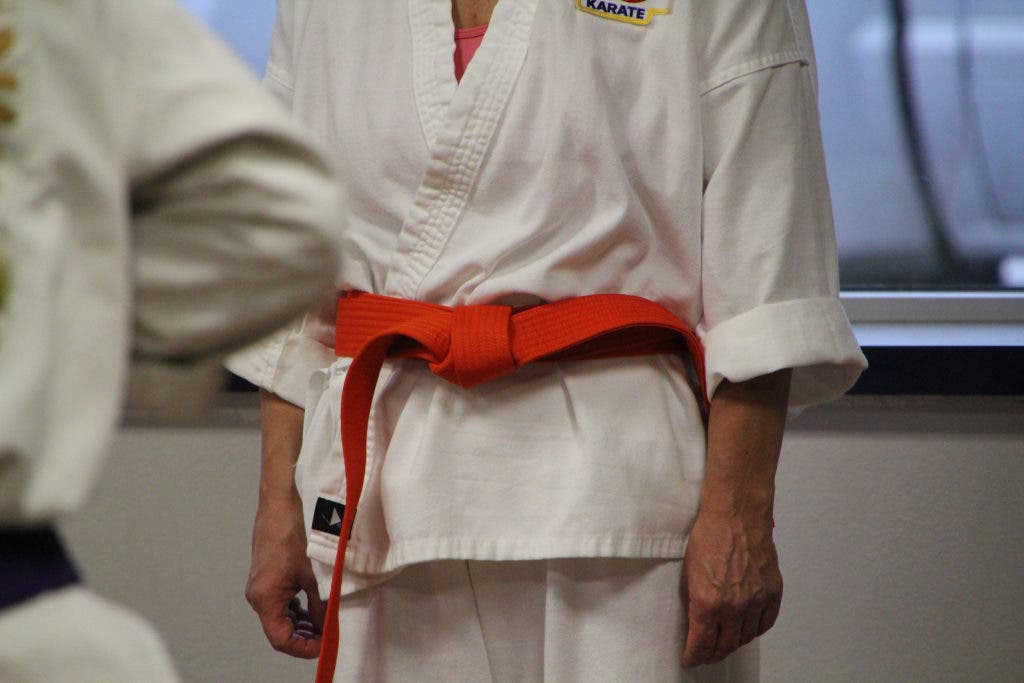
Ten years ago, Andrew Faupel founded Kenkojuku Karate of South Jersey on a dare.
As a 29-year-old dad, he’d been complaining to his wife that he was getting out of shape.
Faupel reminisced about days when martial arts had been a bigger part of his life, and often mused aloud that he ought to have started a karate school.
Find out what's happening in Collingswoodfor free with the latest updates from Patch.
One day his wife shot back—lovingly, he swears—“Why don’t you shut up and do it?”
And so he did.
Find out what's happening in Collingswoodfor free with the latest updates from Patch.
Faupel's goal was to develop a school focused on traditional karate and martial arts instruction, to adhere to certain guiding principles—specifically Dojo Kun—in karate and in life, and to deliver outstanding training services at an excellent value; all while promoting and exemplifying honesty, integrity, client satisfaction and the spirit of karate-do (which means karate as a way of life).
Today, Kenkojuku Karate of South Jersey sits at 614 Haddon Ave., in the heart of downtown Collingswood. But it took several towns before the facility arrived in Collingswood.
"I grew up in Collingswood," said Faupel. "We started the school here almost nine years ago, in the back room of Vitality Fitness. When I got started, I was 29 years old, and I'd let myself get out of shape, but I'd been doing karate for a really long time."
Materializing this vision into reality took a couple of months, said Faupel.
"We started in February of 2003, and by June or July, we had all the students wearing uniforms," he said, adding that classes had fewer than 10 students attending early on. "But a year later, we were cranking. The room was full."
That space soon became too small for Faupel's thriving business.
"We were there for two or three years, and then moved to Oaklyn for four years. We really grew (in Oaklyn)—and everywhere we've gone, we seem to outgrow the place really quickly," he said. "We've been (at 614 Haddon Ave., at a storefront in Collingswood's Lumber Yard building) for about a year, and we're pretty much outgrowing that place, too."
Faupel said he always knew the borough was a perfect place to grow his business.
"I always wanted to come back to Collingswood. It's nice to be walking down the street and hear, 'Hey, sensei!,'" he said, of the title students address him by. "It's a great group of people. Our culture is a very welcoming environment—and I've trained up and down the East Coast."
Faupel started in Shodokan karate, a traditional Okinawan art which became popular in the United States just after World War II.
"We use a written curriculum," Faupel said of the school's instruction. "The first thing on our syllabus is really to understand who is in the pictures in the front of the room, and to learn why are we bowing. There's respect here, but it's not just because we say so.
"I want acknowledgement of the history (of this art). In the beginning, it's less about moves, and more about the forms—the katas. The person really credited with being the father of modern karate always said, 'your fighting was there to improve your kata, not the other way around," said Faupel. "Once you know the forms, you dissect them, and get into the hidden techniques you see in modern martial arts today. Karate's more of a striking art in the mainstream."
Faupel said in his years as a sensei, he's encountered many issues related to using self-defense in schools.
"There was a student I had once, and he got into an altercation at school. Occasionally this happens, and the parents will tell their child, 'you'd better tell sensei,'" he said. "This particular kid was getting bullied. Other kids kept poking at him, pushing at him. My student told them to, 'stop; I'm not going to tell you again.'"
According to Faupel, refrain from violent behavior is a guiding principle at Kenkojuku Karate.
"When the other kid went to grab (my student), he executed an arm lock and a hip throw," said Faupel. "He managed to hold onto the kid—without hitting him."
And his student's adherence to martial arts ethics reflects Faupel's own pride.
"I'm most proud that I've never had to hit anybody in my life," Faupel said. "Karate is about not fighting. We don't want to fight. We train so that we can react, in the event that we have to defend ourselves."
Kenkojuku teaches students who range in age from six to 60.
"We do a little bit to supplement everything," he said. "We try to do everything. It makes you a more rounded martial artist."
While Kenkojuku doesn't have many aspects other facilities do, it has its own spark of individuality.
"I don't have the politics a lot of other places do. I don't have to count heads; it's about the passion. I don't do contracts. You don't have to buy your stuff from me."
Kenkojuku students sign up for $79 a month, with no contract—a method other facilities frown upon.
"People look at me like, 'what's wrong with you guys?' I've done this a certain way, and that's why it's taken nine years," said Faupel. "I have (students who sometimes must leave to pursue other extra-curricular activities). And the ones who come back are leaders. Karate-do means karate as a way of life.
"Yes, (karate) teaches you how to defend yourself," he added. "But karate—at its root—is teaching you how to adapt to any situation, and overcome it."
Kenkojuku Karate of South Jersey, LLC, is open five days a week, and offers 16 classes per week. Programs include Women's Self-Defense, Adult Martial Arts, Youth Karate, and a new Tiny Tigers Kids' Program for younger students aged four-and-a-half to five years old. To learn more, call Kenkojuku at 856-419-5574.
Get more local news delivered straight to your inbox. Sign up for free Patch newsletters and alerts.