Health & Fitness
Check-off Not Chekhov: The Art of Keeping Lists
How to reconcile the fussy with the fuzzy.


To-do lists help me give linear order to all the thoughts and plans that would otherwise form a tangled web in my head. I can’t catch my breath if I feel I have so much to do that I don’t know what to do. Writing down everything I have to do or want to do solidifies these things. A to-do list is like a contract I have to uphold.
Obviously, a to-do list in and of itself does not make me feel happy or empowered: it is only when I am able to check-off items on my to-do list that I am able to feel in control of my life. I get anxious if I am not able to check-off at least one item each day. (“Was I active enough today? Could I have been more productive?”)
Listing the things I need to do and want to do is not a method of organization. No. It is “listing.” Organization needs to be applied to make a good, manageable to-do list. For instance, a list can have different categories for tasks to be grouped into. As for me, I like to make separate to-do lists. (Anyone who has seen my computer’s desktop knows about the six different sticky note lists I have so I can easily keep track of what still needs to be done and what I can check-off.)
Find out what's happening in Cranfordfor free with the latest updates from Patch.
I used to pile everything on top of each other, but the bigger projects that required more time and effort and would not be checked-off for a period of time started to bury the more mundane daily and weekly tasks that could be checked-off much more readily. An imbalance between checks and no checks grew. Because more abstract projects shared a list with more routine tasks, the abstract continued to be put off for the sake of an easy check-off task. This is when I decided that separate lists would be an advantage.
The list I always check-off items on is the sticky note (by the way, the sticky notes application on my computer is a godsend) entitled, “This Week.” This is mostly a list of things I have to do. Each Sunday, I delete the past week’s list and replace it with a list of the things I need to do in the coming week. These tasks are specific, which is why they’re easy to accomplish. On one list, I never check-off anything. My “Practical Resolutions” list is a reminder of things I would like to continue doing throughout the year but are not really tasks to be completed.
Find out what's happening in Cranfordfor free with the latest updates from Patch.
My other lists contain the names of publishers and literary agents I want to query, and the abstract projects that I intend to complete over time. I always check-off the name of the publisher or literary agent I’ve queried and mark the date the query was sent. On the abstract projects list I can break down projects by adding specific bullet point tasks for each one. For instance, under the project headed “Apply for Grad school scholarships,” I made a bullet point list of the different scholarships I hope to apply for. Or under the project headed “Work on novella,” I can list “write for 20 minutes a day,” “develop this character,” etc.
One of my professors (at his weekly Thursday Club) over tea and Oreos, told me about how he compartmentalizes his reading material. He spends his time reading on the forty-five minute train ride he takes to and from campus (well, every other day he practices his Latin), and only brings a book that he has designated to be a “train book.” These are the books that do not require intense close reading and concentration or absolute silence (though he wears earplugs and sits in the quiet car, anyway). He boasts that he is able to complete sixteen books a year just with the ones he reads on the train. This is impressive, and I admire his compartmentalization skills. But I’m not sure how beneficial compartmentalization is for creativity. At least for my creativity.
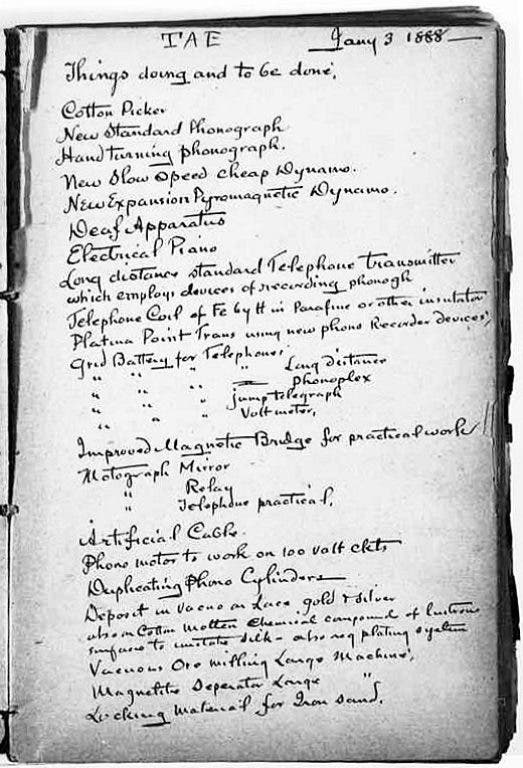
Leonardo Da Vinci, Thomas Edison, John Lennon, and Benjamin Franklin, apparently, would not agree. Although, Franklin did recognize the pitfalls of a to-do list: while a to-do list is meant to bring happiness, having too many things on a list can cause frustration and dissatisfaction. Franklin’s quoted as saying, “Let all your things have their places; let each part of your business have its time.” Basically, don’t try to do everything all at once or you will accomplish nothing.
In a blog post from February on Brainpickings.org, Maria Popova discusses the psychology of a to-do list’s success. An important strategy is to prioritize, to “reconcil[e] the long-term with the short-term, or the ‘fussy with the fuzzy.’” I feel that this is the point of my many lists: they are all prioritized in some fashion, but I feel that in doing this I have over-compartmentalized my life. I feel I have too many balls in the air, too many fingers in too many pies. I find it difficult to focus on one thing without starting to think about the six other things I want to accomplish. I suppose I haven’t mastered the to-do list or, at least, found what works for me. How can I organize my productivity without driving myself crazy?
Thomas Edison’s list is certainly no help.
I’m assuming these are all things Edison wanted to invent and that he eventually got the chance to check-off a number of them, but I’m cursed with impatience. I receive gratification in checking-off tasks.