Community Corner
Nature Scene: A Trip to Vermont Yields Insight into Climate Change
Foliage helps map climate change.

There are few topics that will polarize the masses more than that of “climate change.” It IS real. It ISN’T real. People caused it. It’s a natural phenomenon. We can reverse it. It’s nature’s will. We must act now before we reach a critical tipping point. Nature will take care of this for us. This could go on ad infinitum…and it does. So how can we ever know what is real and what is just wishful thinking? A trip to Vermont last week provided some insight into this issue.
Those of us who are heavily involved with the natural world frequently observe far more than just our primary interests. We often tend to notice the world around us and be observant of changes because they affect our interests, whether it’s wildflowers, dragonflies, trees, birds, insects or the weather.
As an avid birder, I have led many birding events and have conducted bird counts several times a year for many years. Cycles form, and their repeatable characteristics become quite obvious. One of these events that segues neatly into the topic of climate change is the annual Big Day Bird Count that I have conducted in East Brunswick for the past six years (2012 will be the seventh), and in Queens, N.Y., for many years before moving here. Occurring in the first half of May, this count used to take place just as the trees were leafing out, a convenient coincidence that aided the ability to perform solid observations. A few trees would have relatively mature leaves, but most would still have had buds or just small leaves. This was a lucky thing for those of us who conducted these annual censuses, since birds were quite easily seen as they foraged for newly emerged insects that crowded the branches on and around the trees that hosted many migrating birds. Even in Queens, part of the heat island that is the greater New York metropolitan area, we had an easy time observing birds move among the branches. There were few significant obstructions to make viewing difficult and counting species next to impossible.
Find out what's happening in East Brunswickfor free with the latest updates from Patch.
Things are quite different now. For very apparent reasons, which seem to escape some, trees are fully leafed-out during that very same week in May. Not only do just about all trees have leaves, but they are at their mid-season size by this time. It has become increasingly difficult to see and identify those small, rapidly moving and beautifully colored birds of spring. Oh, we still do it, and we’re productive. With good teams and many sets of eyes working, we manage. However, it’s not as easy as it was three decades ago. Some might question the validity of a single point of judgment, but there’s more.
Those who grow things are likely aware that our growing season (we’re in planting region 6B in this part of New Jersey) is now about a month longer than it was forty or fifty years ago. Plants can be set into the ground, without concern for frost, about two weeks earlier than our parents’ generation could do, and they grow several weeks longer into autumn, too. Several days ago, a regional TV station displayed its map that indicated the condition of foliage throughout the Northeast from “Some change” to Past peak.” In decades past, most of the map would have been brown by now (past peak), but this is no longer the case. Most of the Northeast, all the way into Maine, is either at or approaching peak. Clearly, there has been a change in the timing of our seasonal weather that has affected plant growth, and it’s called climate change.
Find out what's happening in East Brunswickfor free with the latest updates from Patch.
My recent little vacation to the Green Mountains reinforced climate change rather nicely. Years ago, ‘peak’ foliage’ time was during the first few days of October in the southern third of Vermont. Last week, we were able to observe the peak on the 12th or 13th of October. This is about a week and a half later than just 30 years ago, and this is not an insignificant number of days. It’s real and very quantifiable. Changes to our climate should not take place in so rapid a manner. It’s more than clear that something else has sped up the process, and it’s also more than likely that it’s us. That famous Pogo quotation from Earth Day in 1971 can certainly be applied here: “We have met the enemy and he is us.”
I won’t use the term “global warming” because while it’s correct in general, it is evident that there are a few places on Earth that will be (and, in fact, are) cooling down. But over all, the Earth IS warming…and it’s significantly our fault. We’ve added a great deal of momentum to what might have simply been a small change. Now the movement will be difficult to reverse.
Change can be affected to mitigate the current trend, but change must be agreed to and adhered to. When business and politics are part of the equation, these are two incredibly difficult factors to put into play. Change cannot be immediate, even if we were to put them into effect immediately. We must accept the fact that it will take time, and we must be prepared to wait for changes to take hold. It may be a generation or two until something positive is verifiable.
So from a wonderful trip to one of the most beautiful places in the world, there was a surprise, the strong proof of the changes that are beginning to affect our world in very negative ways.
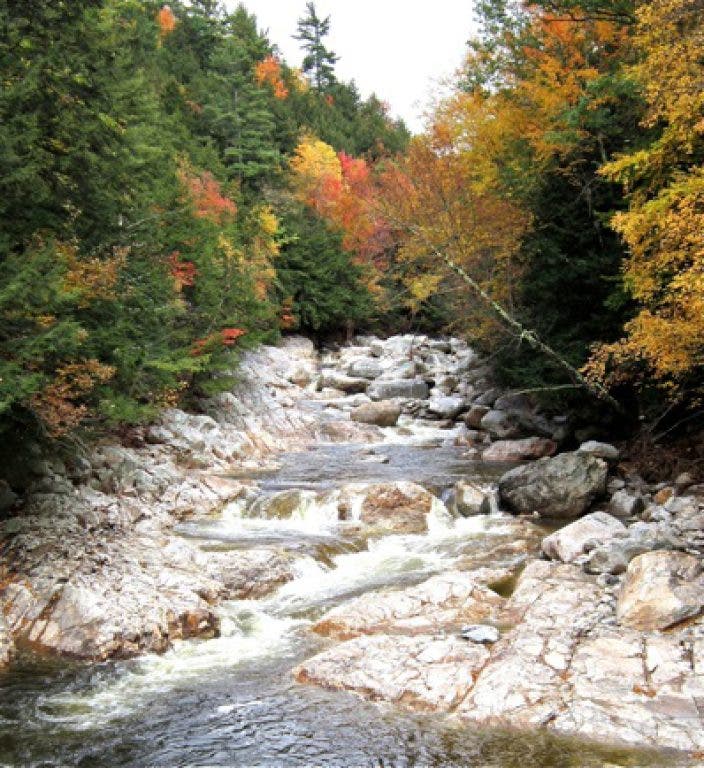
One of the many streams that flows
It’s time to act, people, or the next generations will be far more adversely affected than we have been. Shouldn’t it always be that we want things better for our children? Let’s help make it that way.
And on a much lighter note, it’s Autumn! It’s beautiful out there. While it’s still before peak color in our neck of the woods, get outside and enjoy the color and the changes, but don’t just do it from your home. Get into the mountains and bring a camera. It’s always worth remembering nature at its best.
Vermont was gorgeous with fabulous color (almost at peak).
During our vacation, it was cloudy with about 50 percent rain and 5 percent sun so photos don’t do it justice. However just being there to experience the changes, as we have done many times in past years, makes it very well worth it.
Thanks,
Rich
This column also appears regularly in Mr. Wolfert's blog, Nature Notes...a Lifelong Journey.