Schools
Students Relive the Past for Women's History Month
Janis E. Dismus Middle School "Living Wax Museum" brought together students to reenact the lives of some of history's most important women.

“Not only was I a queen, but I was indulged by great royalty,” Cleopatra could be seen reminiscing to a procession of visitors, flanked by toga-clad servants waiting on cue with grapes to feed the ancient queen.
The queen’s servants were not unwitting subjects, but rather partners in researching the history of the famous woman. And Cleopatra was the costumed Dani Ashley Sosa, an eight grader participating in Janis E. Dismus Middle School “Living Wax Museum,” which immersed the school in women’s history month with student impersonations of the world’s female trailblazers.
Students worked in pairs of three for the past month to research and write prepared speeches for an audience that roamed the makeshift museum in the school’s gymnasium Thursday.
Find out what's happening in Englewood-Englewood Cliffsfor free with the latest updates from Patch.
When visitors pressed an “activate” button at the foot of each living exhibit, the historical reenactors came to life to tell their subjects’ biographies.
But the project was not confined to world history classes; each area of the curriculum played a role in preparing the students to become their characters, said English teacher Samantha Sheridan.
Find out what's happening in Englewood-Englewood Cliffsfor free with the latest updates from Patch.
“Each group learned about women from different walks of life,” she explained. “Some are scientists, some are mathematicians, and some are politicians.”
With the list of famous women from history split between their classes, the student teams went beyond dates and biographical facts to understand their character’s role in shaping history.
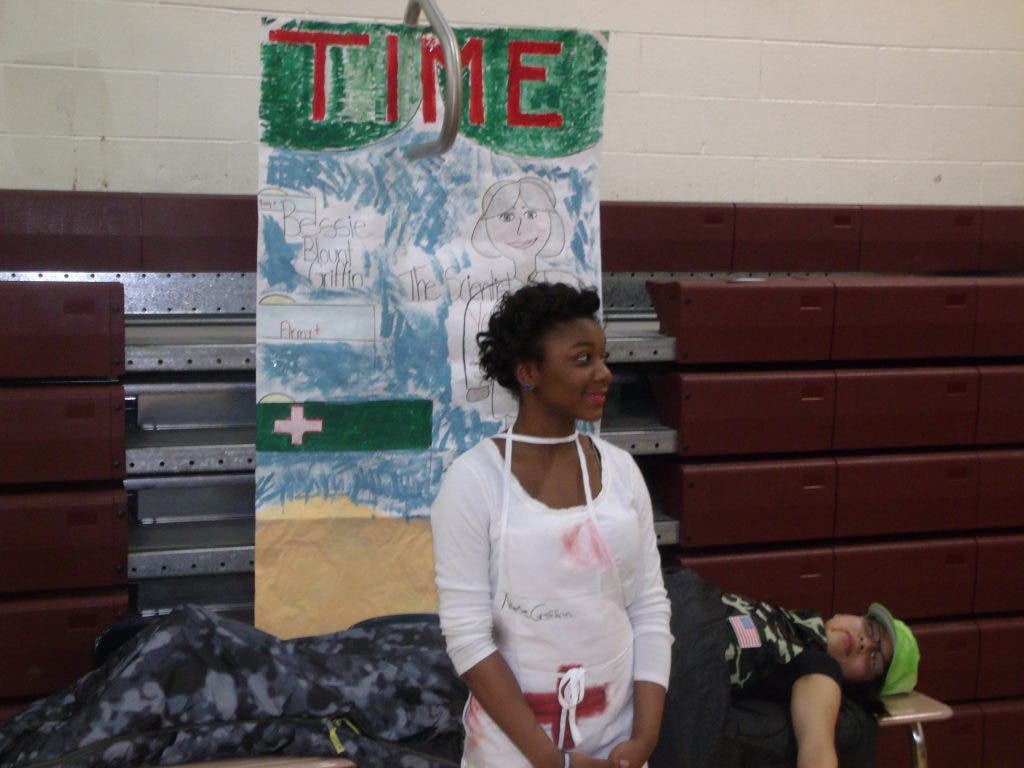
That was the case for Jida Williams, who portrayed Bessie Blount Griffin, the little-known inventor of a medical device that fed amputees during the Second World War. She and her group had to learn the science behind the invention, and not just the biography of its creator.
“We had to look up how the device worked, how it delivered food, so we could explain it better,” Williams said.
“One group learned about binomials,” Sheridan said, referring to the mathematical theory incorporated into the research of the students that studied Hypatia of Alexandria, the third century scholar and first known female mathematician. “It exceeded our expectations. They learned things we didn’t think they would.”
While uncovering the origins of mathematical theories and inventions may not have been the primary focus of the women’s history project, math teacher Jeffrey Forman said, it was an added bonus that students gained an appreciation for the context and individual women behind innovations in math, science, and literature.
“They need to know the idea behind the concept, where it came from,” he said.
But in the big picture, studying and—if just for a day—becoming history’s most innovative women pointed the young historians toward role models, and built confidence along the way.
“Some of the kids you see performing aren’t necessarily performers, but they all got involved,” Forman added. “The lesson is you don’t need to be embarrassed about being smart.”