Schools
High School Mandates Concussion Testing
FLHS athletes will receive state-of-the-art pre-season computerized neurological testing that should improve concussion diagnosis and treatment


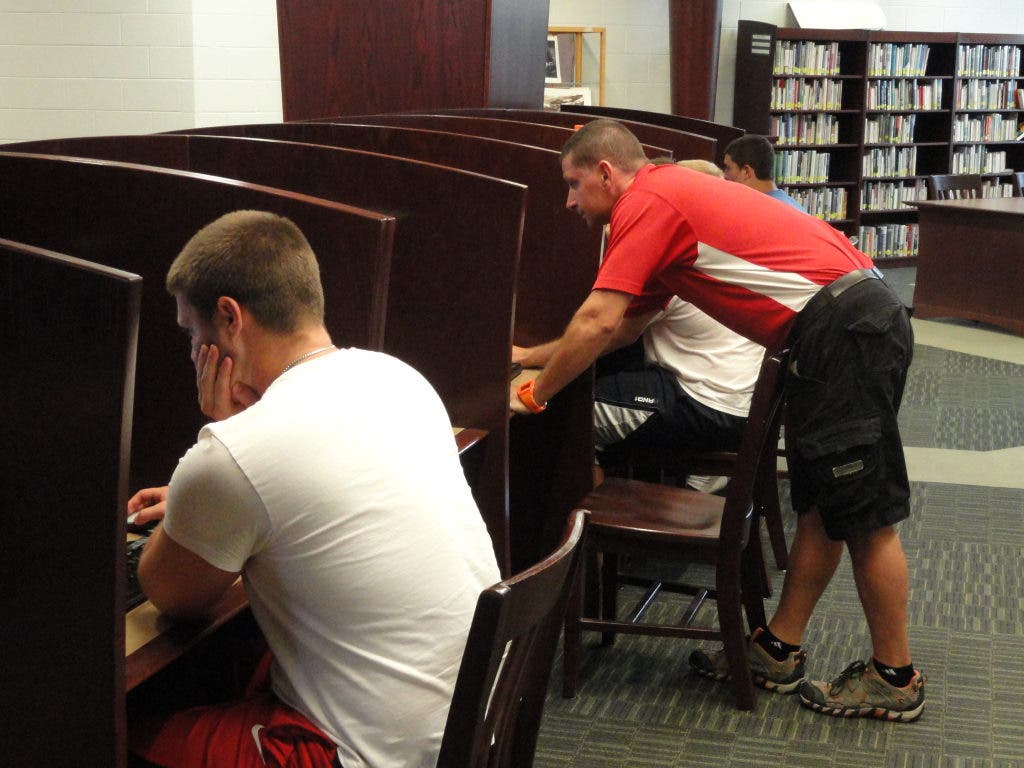


Fair Lawn High School athletic trainer Jason LoCicero is no stranger to concussions.
He wrote his undergraduate thesis on head injuries, spent four years working with and learning from renowned local concussion expert Dr. Thomas Bottiglieri and, maybe most crucially, has suffered more than a dozen concussions himself.
He knows firsthand the symptoms, the recovery process and even the urge to play through a head injury.
Find out what's happening in Fair Lawn-Saddle Brookfor free with the latest updates from Patch.
Playing through or returning to play too soon from a concussion is a decision doctors advise athletes, parents and coaches never to make.
Taking a second blow to the head before fully recovering from the first can trigger a potentially fatal condition called second-impact syndrome, where the brain swells rapidly and uncontrollably.
Find out what's happening in Fair Lawn-Saddle Brookfor free with the latest updates from Patch.
Despite the serious consequences, many athletes over-eager to return to the game have been known to take this catastrophic risk.
LoCicero is no exception.
He said his most recent concussion occurred about a year ago, while wakeboarding. The board popped off and caught him in the chin after he hit a wake.
Asymptomatic and undeterred, he got back up and tried to keep going. But his body wasn’t having it. LoCicero chuckled as he remembered how his legs turned to jelly and he face planted.
“I knew I got hit in the head with a big hard board. I knew I probably had a concussion. But being an athlete, I wanted to push myself,” he said. “So I know what these kids are going through. I know how they feel. I understand them coming to me, and saying, ‘No, no, no. I’m fine. I’m fine.’
“It doesn’t upset me, “ he continued, “but its hard to get that education into a 16, 17, 18-year-old kid who just wants to play. I mean I’m 40 and I’m still doing stupid things like trying to get up on my wakeboard after getting hit in the head. Because that’s the competitive edge that athletes have.”
While LoCicero knows better today, he said that growing up coaches, players and even doctors summarily dismissed concussions as just “getting your bell rung,” a transient injury to be shaken off and played through.
But as medical evidence illustrating the potentially catastrophic effects of concussions has piled up in recent years, doctors, and recently legislators, have wised-up to the potential immediate and long-term harm that concussions can cause athletes.
In December, Gov. Chris Christie signed into law a comprehensive concussion safety mandate that requires all schools to implement a strict policy for handling concussions.
In addition to stressing concussion awareness and a more gradual return to play for athletes who have suffered concussions, the law also recommends that schools perform preseason neurological testing so that a concussed athlete’s cognitive skills can be compared to a pre-concussion baseline.
ImPACT, which stands for Immediate Post-Concussion Assessment and Cognitive Testing, is the oldest and most widely used neurocognitive assessment system on the market today.
To get a baseline, athletes take a 20-minute computerized test – almost like an educational video game -- that provides a quantitative measurement of their attention span, memory and reaction time.
Having the ImPACT reading is important because it demystifies the return-to-play process that previously had been subjective.
“[The reading] is a quantitative measurement, where you’re not just saying, ‘Well he’s dizzy, he has a headache, he has all the symptoms, but I don’t have anything else to tell you,’” LoCicero said. “It just gives you that one extra piece that helps the kids understand, that helps the parents understand, and your coaches understand.”
ImPACT’s impressive list of clients includes all four major American professional sports leagues, hundreds of colleges, a handful of U.S Olympic teams and as of this school year, Fair Lawn High School.
Dr. William Thimmel, a chiropractic orthopedist with a practice in Fair Lawn, was instrumental in bringing the ImPACT system to FLHS. He donated 600 tests to the school this year.
Thimmel said he first learned about the ImPACT program a few years ago when his daughter, a student in the Pequannock School District, suffered a concussion playing lacrosse.
“When my daughter came home and said that she wasn’t allowed to return to play until she passed this test, I was quite interested,” Thimmel said. “Because I knew the way that physicians had been examining anybody for concussions was always very subjective.”
Thimmel, who served on the Fair Lawn Board of Education for nine years and sent five children through the Fair Lawn school system before moving to Pequannock, made it his mission to get the ImPACT system implemented in Fair Lawn schools.
His offer to donate the first year of tests eased the school board’s decision to enact ImPACT at the high school. After this year, the Fair Lawn Parents Committee for Athletics will likely provide the funding to keep the program going, FLPC president Susan St. John said.
If deemed a success, the testing, which can be administered to children as young as 10, could also eventually creep into Fair Lawn’s community athletic leagues.
Beginning two weeks before school started this year, all prospective FLHS fall athletes went through a baseline testing process, one sport at a time.
Any athlete who winds up suffering a concussion this year will be required to take the ImPACT test again. That athlete won’t be allowed to play until their post-concussion score lines up with their pre-concussion score.
How closely the scores must match is up to the discretion of Dr. Thimmel, the test’s interpreter.
“Say their original score was a 90,” LoCicero said, “if they get up to 86, 87, 88 percent, that’s a normal range. If they’re still at 70, 60, that’s when you’re really looking at it with concern.”
Ranges can vary greatly between students, which is another reason why having a baseline for every student is so valuable.
Without a baseline, ImPACT scores must be compared to a national average – something FLHS had done occasionally in the past -- to make an evaluation. This works in some cases, but it also might misdiagnose a child with learning disabilities who would score lower than the average, concussed or not.
Establishing a personal baseline eliminates that problem.
It also serves to pacify impatient parents, coaches and players who want to speed up the return to action. Arguing over a physician's opinion of an athlete's condition is one thing, but fighting an objective measurement which reveals that an athlete is still cognitively impaired and could be in grave danger if put back on the field is quite another.
At FLHS, LoCicero said that baselines would be taken in every athlete’s freshman and junior years, as well as the year after an athlete suffers a concussion. The player’s latest score becomes their new baseline.
Get more local news delivered straight to your inbox. Sign up for free Patch newsletters and alerts.