Schools
Stockton Celebrates Four Decades of Teaching
Alumni, politicians, professors and school staff gathered to celebrate the college's anniversary.
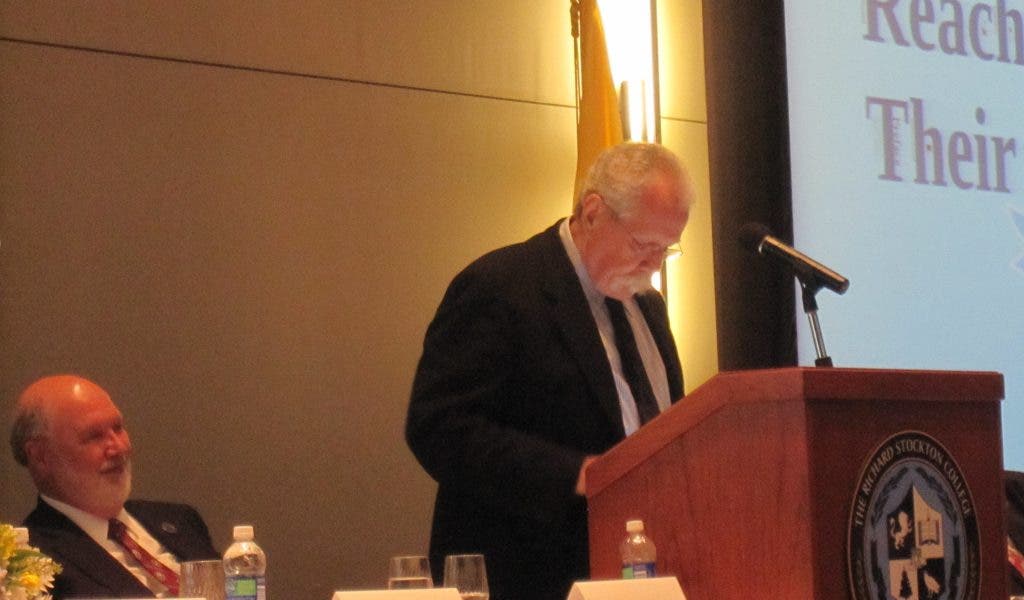


held one of its most historic celebrations since its inception for a 40th anniversary celebration that included the unveiling of a new book about Stockton by two of its professors.
The Wednesday, Sept. 21 celebration also included a screening of a film by an Academy and Emmy award-winning director who once taught at the school as a visiting professor and, of course, wine and hors d'oeuvres.
The event, “40 Years of Excellence,” featured speeches by Stockton President , New Jersey Secretary of Higher Education Rochelle Hendricks, and the authors of the book Dr. Kenneth Tompkins and Dr. Robert Gregg.
One speaker, Dr. Harvey Kesselman, has one of the longest and most varied relationships with the school. He is currently the provost and executive vice president of the school and was among the first enrolled at the college in 1971.
In 1979, he graduated and went to work for the college in numerous roles. He has changed jobs many times, but has stuck with the school since the beginning.
“Sink your roots where they can grow,” said Kesselman. “Those of us present at Stockton’s beginning took those words, this imperative statement at face value. Stockton appealed to me because it was created for young people just like me, first generation college students; if you worked hard and pulled yourself up, the sky was the limit.”
It turns out there is a term for those who started teaching or studying at Stockton at its inception: Mayflower Faculty, for teachers, and Mayflower Students, for pupils. The reason is simple: 40 years ago, the school was run out of a dilapidated hotel on the boardwalk in Atlantic City called the Mayflower.
“As I look around now, I see a campus that 40 years ago would have amazed me,” said Kesselman.
Stockton’s progress during the last four decades is exactly what Wednesday evening's celebration, in a newly renovated was all about.
“The greatest achievements are the result of many people working together over a long period of time,” said Saatkamp during his opening remarks. During those remarks, to honor the founding president of the college, Richard E. Bjork, Saatkamp announced that the school’s library would be renamed for him.
Saatkamp also spoke about the ideas that sparked the creation of Reaching 40: The Stockton Volume. At first, he said, he thought the book might be “the official history of Stockton,” but after discussing the idea with colleagues they opted instead to include varied perspectives on the school, an effort to fairly represent the many opinions of the school’s faculty and alumni.
In the end, the book was completed as a collection of essays by members of the Stockton community, including prominent alumni and professors. Much of the information was drawn from the college’s historical archives, from which Tompkins and Gregg found many of their sources.
The completion of the book, as Gregg told it, was an arduous task, albeit a worthwhile one. Tompkins joined the project after Gregg, but by the end, Gregg wanted him listed as the lead editor.
“To punish him for being a thorn in my side, I asked him to co-edit the book, and he accepted right then and there,” Gregg said. “I could not have pulled this together without him.”
Tompkins has taught literature at the school since it opened.
“I continue to find I’m astounded at how good the students are” despite their struggles, Tompkins said. “Complex lives, children, illness, they keep pushing away. The students I teach are engaged.”
This level of engagement, and the overarching goal of an education that is useful, of students and faculty that are useful, is something that Tompkins says he has seen consistently since Stockton’s beginning.
Reaching 40: The Stockton Volume is available for purchase from Stockton’s website.