Community Corner
1 Of 3 Gloucester Twp. Households Struggle To Make Ends Meet, New Report Says
For a significant portion of the township, those hardships preceded the COVID-19 pandemic.


GLOUCESTER TOWNSHIP, NJ — A significant number of Gloucester Township residents have struggled to make ends meet in recent years, according to new data. And for many, those challenges preceded the economic turbulence of the pandemic.
About 33 percent of township households had trouble affording the basics during the COVID-19 crisis, according to a report released last April by nonprofit United Way of Northern New Jersey.
United Way quantifies financial difficulties by determining a locale's rate of "ALICE" households, which stands for Asset Limited, Income Constrained, Employed. United Way of Northern New Jersey coined the phrase in 2009 to represent those living paycheck to paycheck.
Find out what's happening in Gloucester Townshipfor free with the latest updates from Patch.
"ALICE" households make more than the poverty line but less than what's necessary to afford basics in their area. United Way of Northern New Jersey contends that ALICE families — many of which had "essential workers" who helped their communities through the COVID crisis — are overlooked and undercounted by traditional poverty measures.
From 2017-21, Gloucester Township had a median-household income of $88,699 — slightly below New Jersey's median-household income of $89,703 and higher than the national figure of $70,784. But United Way's report shows the prevalence of financial struggles throughout the nation, regardless of whether a locale has widespread poverty.
Find out what's happening in Gloucester Townshipfor free with the latest updates from Patch.
In 2018, 31 percent of Gloucester Township households struggled to make ends meet, including 8 percent below the poverty line, according to United Way's data. Those rates grew in 2021 — the pandemic's first full calendar year — when 33 percent of the township made less than the "ALICE threshold," including 9 percent in poverty.
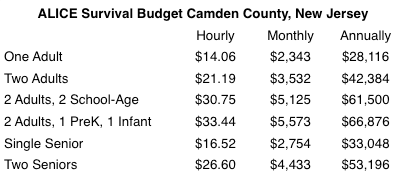
The ALICE threshold — an estimate of earnings needed to afford basic necessities — varies by area and living situation. A Camden County adult living alone needs to earn $14.06 hourly or $28,116 annually to make ends meet, whereas a two-adult household with an infant and a preschooler requires earnings of $33.44 an hour and $66,876 per year to stay afloat in the county, the report says.
Statewide, the number of households experiencing financial hardship grew by 14 percent — an increase of 157,000 households — between 2019 and 2021. By that point, 1.3 million New Jersey households struggled to afford basics, including 368,639 in poverty, according to United Way.
But United Way of Northern New Jersey says the COVID-related economic crisis would've been more difficult if not for a combination of pandemic supports and rising wages.
"It could have been so much worse for these families, whose struggle to feed their families, afford health care and access quality education was often hidden in plain sight until the pandemic," said Kiran Handa Gaudioso, the nonprofit's CEO. "Equipped with this ALICE data, we can do even better to develop effective policies and track our progress toward reducing financial hardship in New Jersey."
The cost of living has risen, as well. According to the report, the basic cost to live and work in New Jersey rose by 16 percent for a single adult to $33,984 and by 13 percent for a senior citizen to $38,328.
Costs increased 10 percent for a family of four with an infant and a preschooler. But the Child Tax Credit and Child Dependent Care Tax Credit helped soften the blow, bringing the "survival budget" down to $82,176, the report says. Without those credits, United Way says the budget would've reached as high as $98,000.
The report comes from United Way of Northern New Jersey and its research arm, United For ALICE. View the full report here.
Get more local news delivered straight to your inbox. Sign up for free Patch newsletters and alerts.