
If you’re interested in art and you live in Hoboken, you’ve probably encountered the work of Ricardo Roig, a young artist who moved here in 2009 after college, and who made a splash at the 2010 fall Arts & Music Festival. He brought a large number of paintings of iconic Hoboken scenes to the festival and promptly sold nearly all of them. An admirer of the Impressionist painters, Roig says Hoboken became his muse, in part because its architecture reminded him of the Belle Epoque street scenes and interiors featured in their paintings.
“I find that the city’s architecture and atmosphere make a strong impression on people, and they respond to seeing Hoboken in a new way through my work,” Roig said. “That’s why I make art, to have that dialogue with people, not just for myself.”
He developed his eye for Hoboken’s historic details while waiting tables at the beautifully restored Elysian Café, where he worked while completing a teaching certificate at Kean University. Since that first Arts & Music festival, Roig has invested a lot of energy in the city’s cultural community, participating in the Artists Studio Tour and other festivals, and placing his works in local galleries and frame stores, including Lana Santorelli Gallery, and Tresorie Custom Frames. He’s visible around town with his easel, and he also donates work to local fund-raising events and actively promotes the arts at every opportunity. He’s also active online; visit his website at www.ricardoroig.com.
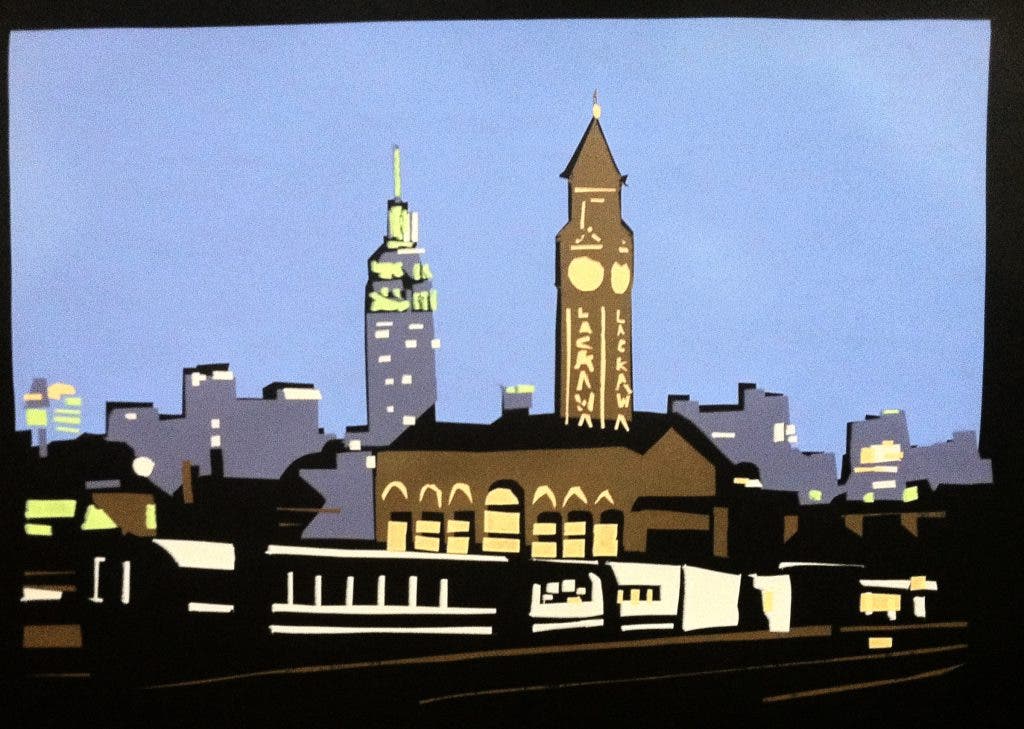
Roig now supports himself through his art and as a substitute art teacher in area schools. Though known primarily for his oil paintings, he’s recently started to produce screen prints using hand-cut paper stencils. The Museum will hang about 10 – 12 of these new works in an Upper Gallery show titled Hoboken in Print: Hand-Cut Stencil Screen Prints by Ricardo Roig, starting July 29, on view through Sept. 9. Meet the artist at the free opening reception from 2 – 5 p.m. on July 29.
He learned the printmaking technique during an elective course he took while completing his teaching certificate. Knowing that the Impressionists were heavily influenced by their encounter with Japanese woodblock prints, he wanted to understand how the process works. What he likes about the medium is the vibrant, graphic and fun energy captured in the images.
Like the Impressionists, he likes to play with lights and darks and use the color of the paper as a layer. “Cutting paper makes you aware of the process of destroying while creating,” Roig says, “and the relationship between positive and negative elements.”
It’s painstaking, Roig says, but he finds it rewarding. “First you draw, and paint your image onto paper. Using an Exacto knife, I cut shapes out of the paper, creating a stencil. Attaching this paper to a silk screen, I then squeegee my colors and ink through to acid-free archival paper. Layering these stencils upon one another, the puzzle is pieced together and the image or print is created.”
-Melissa Abernathy, Hoboken Historical Museum
The exhibit is supported by a block grant from the State/County Partnership program for the Arts, administered by the Hudson County Division of Cultural and Heritage Affairs.