Community Corner
The Day a Local Bar Became a Command Post
Texas Arizona was a critical part of the relief effort after the 9/11 attacks.
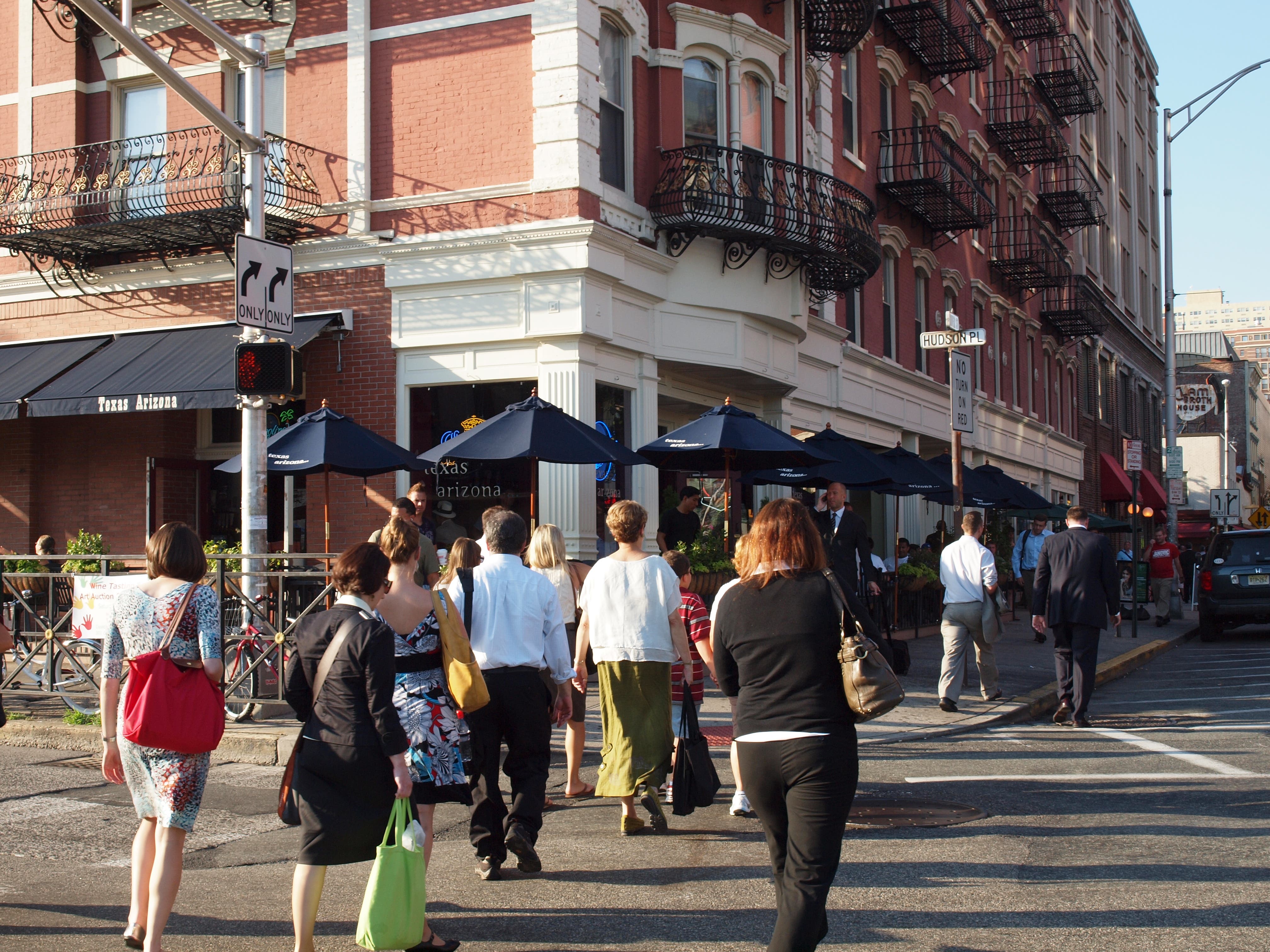


On the corner where Hudson Place meets River Street is a bar that's changed hands a few times over the past three decades but has been called Texas Arizona for about 18 years. Spanning two storefronts, the bar has a molded wood facade painted white and interrupted only by large windows and a pair of glass doors. Inside, there's a bar with 24 taps, a kitchen serving up Southwestern cuisine, lots of exposed brick, and a stained glass ceiling that had been painted over for years and was accidently discovered when the owner at the time attempted to tear it down.
Locals considered the bar trendy after it was renovated the last time, about 10 years ago. Now, it blends in with the other bars in the still up-and-coming city, except for the fact that it is right across the street from the PATH station and people can't help but pass it on their way to anywhere else in Hoboken. That's also exactly why it was chosen to be the city's command central on Sept. 11, 2001.
No one can seem to remember who opened the bar's doors and welcomed in almost every department in town on the day two planes hit the World Trade Center. Tommy Molta, the president of the Hoboken Volunteer Ambulance Corps and a captain in the city's fire department, said it might have been someone from the cleaning crew, but he's not sure.
Find out what's happening in Hobokenfor free with the latest updates from Patch.
Molta had just been appointed deputy coordinator of the city's office of emergency management two months before and, as part of his new responsibilities, had a meeting at the police station that morning. It was a gorgeous day, said Molta, about 85 degrees. He remembered parking his car at 8:45 a.m. and, as he climbed the station stairs, hearing a roar that made him turn his head. He assumed it came from the construction site where the Wiley building now stands. "It sounded like a container got dropped off a truck too hard," he said. After asking for Jimmy Fitzsimmons, then a lieutenant, now a captain in the police department, Molta waited near the radio room. "A f---ing plane just hit the World Trade Center," said a voice coming from one of the speakers. Before Molta could ask if he'd heard that right, everyone at the station started yelling the same message.
Molta ran with police officers to take a look across the Hudson River. When he saw the smoke and gaping hole in the North Tower, he was sure Hoboken would receive patients soon. In 1993, when the World Trade Center was bombed, Hoboken treated about 165 people who came from the city on PATH trains. Hudson Place was the staging area then, so Molta thought of the same location for this new disaster. "We need these cars cleared out," Molta said he told police, referring to the vehicles near the PATH station. "I need to get ambulances in here."
Find out what's happening in Hobokenfor free with the latest updates from Patch.
Police officers started securing the area, calling for tow trucks and telling anyone sitting in a vehicle to move on. Molta had only four responders on duty that morning, and with limited walkie-talkies at the time, had to start a phone chain to get more help at the scene.
Then, the second plane hit, and everyone realized what had been seen as an accident was instead intentional.
"This went from a terrible accident to we're under attack," said Molta. "The police department was starting to get information that multiple planes had been hijacked. Nobody knew where they were going."
Getting through to anyone on a cell phone and even a landline became nearly impossible. The confusion gave way to rumors that spread on the streets within seconds of the first utterance. Someone heard bodies would soon be arriving in Hoboken. Another person heard patients with missing arms and legs would need help. And another heard bombs might make their way to the Mile Square.
The ambulance corps and police and fire departments went into major operations at that point. "That's when somebody went over and said, 'Listen, we need an area where we can regroup and have meetings,'" said Molta. "'This is going to be a long event. This is going to occupy multiple operational periods, and we need a place where we can all sit down together, put our heads together."
That place was Texas Arizona.
Before it was Texas Arizona, it was Harry's Texas Arizona, starting sometime in the '80s. And before that, it was the American Hotel, said Molta, a flophouse where vagrants exchanged their pension or Social Security checks for a room upstairs and board at the bar. The hotel was destroyed in a fire in 1981, about a month after a fire at 67 Park Ave. forced survivors to temporarily move into the hotel. It was a terrible twist of fate, said Molta, and the fire department once again made many rescues, but two people died. After the flames were put out, the upper four floors needed to be gutted, but the bar didn't sustain much damage.
The bar's current owners, brothers Jim and Brian McCue, bought it just six or seven months before the 9/11 attacks. Jim McCue, who works as a bond trader in town, near the corner of Second Street and Washington, said the previous owners had offered it to him because he already spent so much time there. "What do I know better than trading bonds?" he asked. "Hanging out here. This is it." McCue had been a Hoboken resident for 13 years and Texas Arizona, as it had been named when he acquired it, was his haunt.
McCue said the first thing he did was get rid of the Western décor, the sombreros that hung on the walls, and the fake cactuses that littered the floor. There was even a log wooden fence that had to go. "It looked like a corral," said McCue. And for a while, he added, the bar also had living room furniture that looked French to him. "That went too," he said.
McCue wasn't there when someone offered up his bar for the command post. He was still at work, answering phone calls, and making deals. Many people, including his clients, he said, didn't realize that what had happened wasn't an accident. But, at some point, he managed to leave his desk and get to the rooftop with a few colleagues to see the commotion across the river. When they saw a second plane flying close, said McCue, they thought it was coming to drop water on the North Tower. "I know it sounds ridiculous," said McCue, "but that's what it looked like that day. Then, we were like, 'Holy s--t, it just hit the other building.'"
The phones in the office stopped ringing, or if they rang, he said, nobody picked them up. McCue left for the bar soon after. "Right here," he said, recently sitting at one of the tables outside his bar and gesturing to the intersection of Hudson and River, "was absolutely shut down. It was a sea of EMS."
Pretty much everyone who was not emergency medical personnel, a police officer, or firefighter was asked to leave–and that included the owner of the bar. "It was explained to everybody," he said. "Get out of here, unless you have something to add. If you're a doctor, you can stay. Jimmy McCue, you can go."
Two police officers stood guard at the entrance of the bar, and somebody wrote "Command Post" in thin black ink on a large white sheet of paper and taped it over the outline of a cowboy boot on the window facing River Street, where a line of about 65 ambulances began to form within an hour of the first plane crash to take patients to hospitals with available beds.
"Everything that was going on in Hoboken, the same thing was going on in Liberty State Park, in Lincoln Harbor in Weehawken," said Molta. Neighboring towns didn't have extra resources to give up, so emergency medical technicians and paramedics came from municipalities far away from the banks of the Hudson to help. "Some of the towns," said Molta, "I never even heard of."
Molta and his crew took care of the first two patients, two women who had come up from one of the last PATH trains to run that morning. From the chest down, said Molta, they had second and third degree burns. They had been standing in the lobby of the North Tower when flaming jet fuel blew the doors off a nearby elevator and covered them with fire. Their injuries were too serious to treat properly with only the equipment in the ambulance, so they were immediately transported to an area hospital's burn unit.
Outside Texas Arizona was what Molta described as "controlled chaos," but inside the bar, it was "calm, very, very calm, very controlled." All the tables were pushed together to make one long platform for all the heads of the departments–police, fire, public safety, emergency management–and the mayor to sit around, giving updates and discussing next moves. So the bar would be quiet enough for everyone to concentrate, said Molta, he moved the EMS radios to a small bus parked outside, where lifetime member Jimmy Artle worked the initial 14 hours, "only coming in to pee once."
Not only did the bar provide a vantage point of the action–the Hoboken Bus Terminal, where there was a makeshift hospital, and the Erie Lackawanna Railroad and Ferry Terminal, where people were arriving from the city–but it also gave workers a place to go to the bathroom, make phone calls, and watch the news on its many TVs. It was also a place for deliveries: clothes and towels for people who were being rinsed off at the decontamination site the fire department was running, medical supplies, food, and water.
The entire operation lasted all morning, all afternoon, and all night. More than 10,000 people were decontaminated at the ferry station, 2,212 patients were treated at the bus terminal, 179 were transported by ambulance, and meetings were held every two hours at the bar. Everything was dissembled by noon the next day.
"Somebody going to work at the World Trade Center shouldn't have had to worry about getting hit by a plane," said Molta. "But, the camaraderie that came out of this… all the different services, civilian volunteers…. It was such an outpouring of help. It was such a tragic event, but it was almost wonderful to see all these people working together."
He said he never thought, in all his years as an EMT and firefighter, that he'd ever see command central in a bar. "But, you know," he said, "that goes back to the old saying: any port in a storm." That day, it really didn't matter. Before 9/11, said Molta, he had never stepped foot in Texas Arizona, but he was grateful it had been there.