Neighbor News
Indian Hill Students Explore the Stars Inside the School's Digital Planetarium
Planetarium enhances student learning.

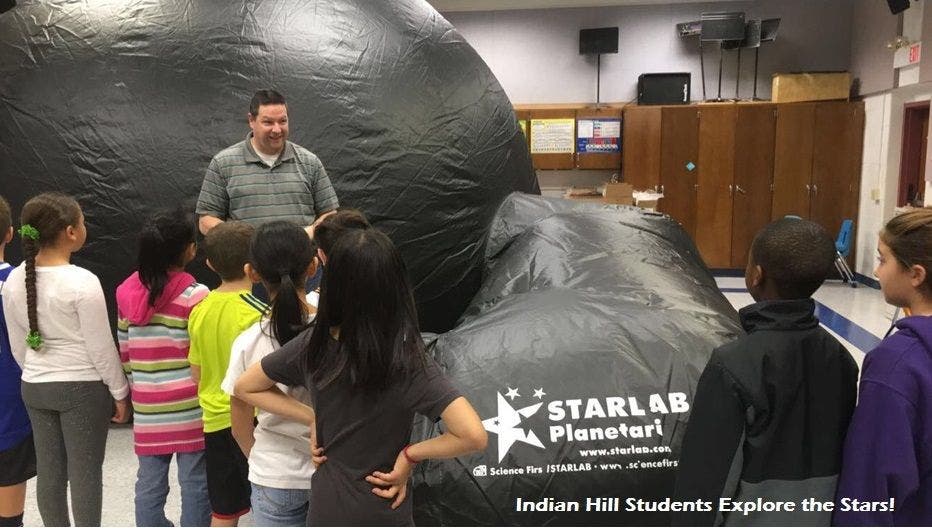
Thanks to a gift from the Indian Hill Parent Liaison Group and the Village School Parent School Association, 5th grade science teacher Tom Woods helps students at Indian Hill School (IHS) identify and understand just what they might see under a starry sky on any given night in Holmdel.
Having its own Star Lab Mini-Planetarium (which holds about thirty students at a time) for the last two years has allowed the school to use the lab in greater depth than when one was rented previously. Each year, Mr. Woods assembles the lab so that he can teach every fourth and fifth grade class how to find the Orion constellation by looking for the bright stars in and around it. The Star Lab generates student engagement and questioning that allows for rich student dialogue and a more concrete understanding of such topics such as seasonal appearance of stars in the night sky.
Woods has developed significant expertise over the fifteen years he has been using such labs. His presentation for fourth grade consists of explaining the moon phases and responding to such student inquiries as “why doesn’t the earth have a lot of craters but the moon does?” The work inside the lab helps to develop students’ understanding of the galaxy and solar system. He answers students’ questions like the one about the craters, the near and far sides of the moon, the size of the galaxy and what holds it together, what a day/year is in length on each planet, how many birthdays you would have on other planets, and what a leap year looks like since during such a year the calendar doesn’t match the solar system cycle.
Find out what's happening in Holmdel-Hazletfor free with the latest updates from Patch.
In fifth grade, Mr. Woods focuses on telling stories about Greek and Native American mythology and helps students identify the constellations that match the names of mythological characters. This becomes a great foundation for one of the Literacy units students also study in that grade. To end the program students learn about the life cycles of stars, the distance some stars are from us, and new methods being used by astronomers to find planets outside of our solar system.
According to Supervisor of Science and Mathematics, “The Star Lab provides a unique way to keep our students curious about natural phenomena.” “We want them to be 'thinking like scientists,' and developing their curiosity and sense of wonder and presenting them with authentic experiences such as this is one way to do that,” she added.