Health & Fitness
Why are Women More Susceptible to ACL Tears?
There has been discussion on why women are more susceptible to ACL tears. We will examine a main anatomic difference between men and women that is a contributing factor: the Q-Angle and wider pelvis.

In recent years, there has been discussion on why women and
young girls are more susceptible to ACL tears. There are many theories on the
reasons why, but today we will examine a main anatomic difference between men and women that is a contributing factor: the Q-Angle and wider pelvis.
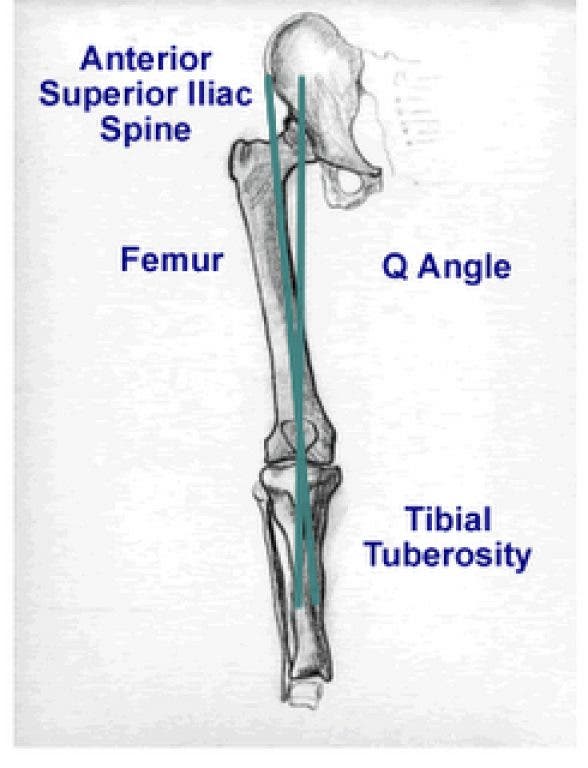
The Q-angle is the angle at which the femur (upper leg bone) meets the tibia (lower leg bone). The Q-angle is determined by three areas of the human anatomy – the Anterior Superior Iliac Spine (ASIS), the center of the kneecap (patella) and the tibia tubercle. The Q-angle is basically a line drawn from the ASIS down to the center of the kneecap to the tibia tubercle (see picture).
The Q-angle in women is greater because women are anatomically built with a wider pelvis than men. A normal Q-angle in men is 14 degrees, while
women have a normal angle of 17 degrees. The greater the angle, the more at risk the person is for knee injuries, including ACL tears.
The fact that the q-angle is more pronounced in women than men leads to more stress on the knee joint and makes it less stable when put under stress. For this reason, when a woman participates in sports involving jumping, running or pivoting, she is naturally more likely to suffer an ACL tear.
What can we do to prevent ACL tears in women?
Recently, emphasis is being placed on neuromuscular training programs. Neuromuscular training teaches the body better biomechanic movements to improve the control of the dynamic knee stabilizers (the ACL and major ligaments that surround the knee). Exercises that are included in a
neuromuscular training program include stretching, plyometrics and strength
training. The goal of these programs is to teach athletes how to land, pivot and control the knee without placing as much force on the ACL. One program was
developed by the Santa Monica Sports Medicine Research Foundation and is known as the PEP Program: Prevent Injury and Enhance Performance. To learn more about this program, please visit http://smsmf.org/files/PEP_Program_04122011.pdf.
If you suspect that you have an ACL tear or other orthopedic injury, it is important to see an Orthopedic Surgeon.