Arts & Entertainment
How to Build a Rain Barrel
Eco-friendly workshop at library attracts many Livingston residents and people from nearby towns. They learned how to make their own rain barrel.
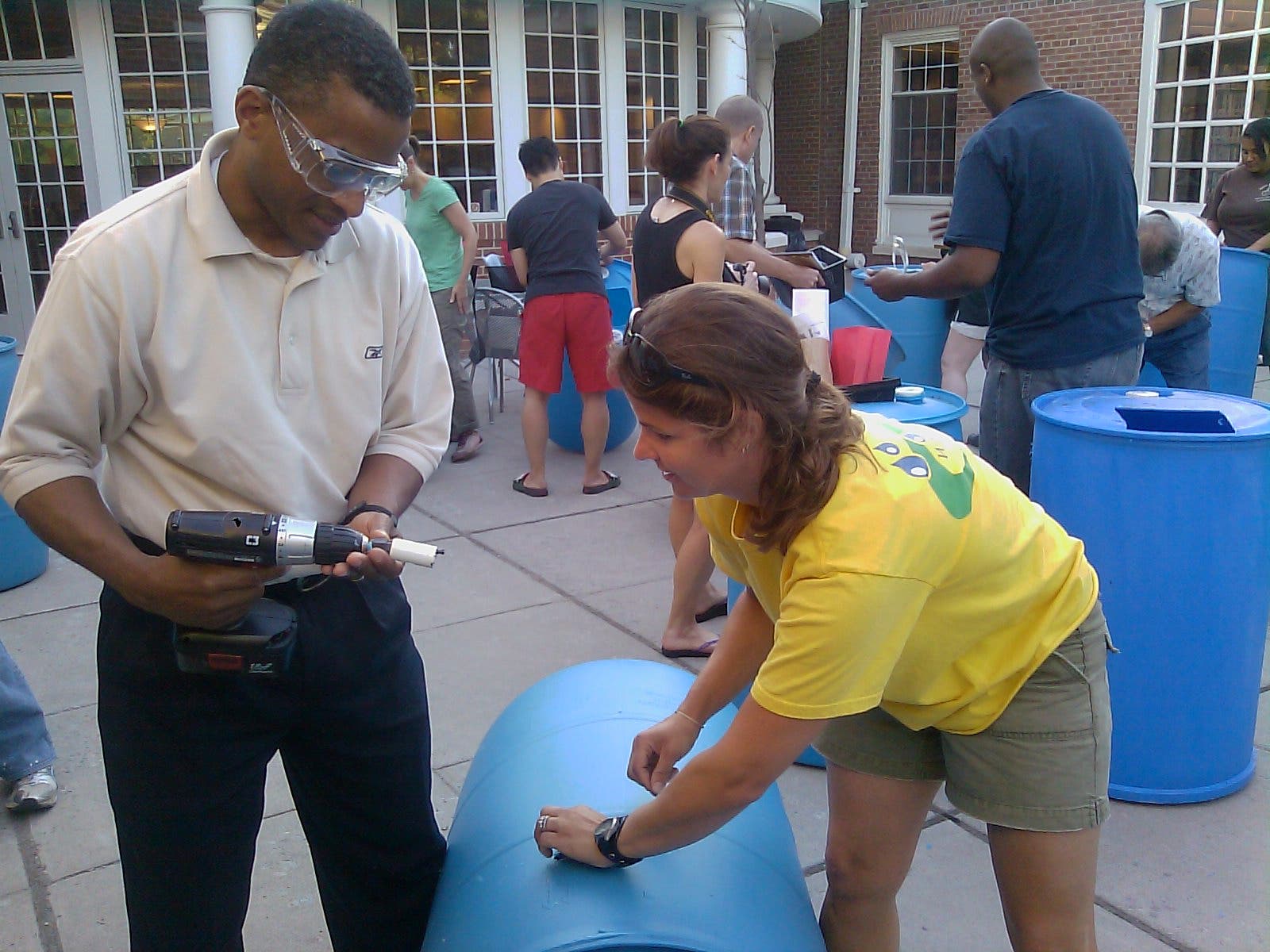


Twenty-six thousand gallons a year, that's how much water can be saved with a single 55-gallon rain barrel.
On Tuesday night around 35 people walked out of the Livingston Public Library having made 45 rain barrels at a workshop hosted by the Rutgers New Jersey Agricultural Experiment Station.
That's a lot of water.
Find out what's happening in Livingstonfor free with the latest updates from Patch.
"I know this will help a lot environmentally," said Joseph Earley, 41, a librarian who lives in New Providence who built a rain barrel.
Adam Osborn, 25, who works for the AmeriCorps New Jersey Watershed Ambassadors program, gave a presentation on rain barrels. He gave instruction on how to build them and explained their practical uses.
Find out what's happening in Livingstonfor free with the latest updates from Patch.
Rain barrels are anchored to collect storm water that pours off roofs and down gutters on homes. Water collected can then be used to water lawns and gardens via a spigot drilled near the barrels' bottoms.
Osborn said he expected less than 25 people to attend the workshop on making rain barrels. He was shocked by the number that turned out.
"People are maybe getting a little more conscious of the environment," he said. "Or with the economy want to save a couple bucks."
Renee Resky, who is on the Livingston Environmental Commission and has been working to spread the word on ways to conserve water, said she came to the workshop in part because building a rain barrel there cost only $45, as opposed to more than $100 if she were she to buy brand new materials and build on her own.
"I also wanted to practice what I preach," she said. "It's great to see so many people interested."
Rain barrel builders filled the patio outside the library. Some straddled the big blue barrels, which were donated by Ocean Spray and were once used to hold cranberry juice, in order to drill holes in them for spigots.
Becky Kim, 38, a librarian who lives in Montclair, said she built a rain barrel because she and her husband just bought a house and wanted a better way to water their lawn.
"The lawn is bigger than expected," she said. "And we will have a vegetable garden."
Her husband, Ben Kim, 35, who works in television said that he was familiar with rain barrels.
"We're environmentally conscious," he said.
Rain barrels keep some storm water from flowing down streets, into storm drains and eventually into rivers; the barrels also prevent the water from picking up pollutants, like oil and fertilizers, en route to rivers. The barrels also collect pure rainwater, so not only do they help plants thrive, they can keep a lawn healthier in times of drought, Osborn said.
Nick Mandala, 32, of Livingston who made three rain barrels, said he researched the barrels on the Internet before coming to the workshop. He was moved to research water conservation for environmental reasons.
"I wanted to be sure that I'm not part of the problem," he said, "I'm part of the solution."
Cinnie Cole, 56, who works for the Nature Conservancy and lives in Closter, said since she and her husband recently moved into a new house they began searching for ways to reduce and reuse, such as composting and using rain barrels.
"We're gardening and we wanted to start using some of the runoff from the roof for our garden," she said.
Her husband, Marty Cutler, 62, a musician and journalist, was looking forward to hauling the barrel home.
"We're excited," he said. "We know just where it's going to go."
For more information on rain barrels visit http://water.rutgers.edu/