Weather
Last Chance To See 'Christmas Comet' From NJ For Next 80,000 Years
This weekend, particularly Friday after sunset, may be the best chance to see the icy comet for 80,000 years.


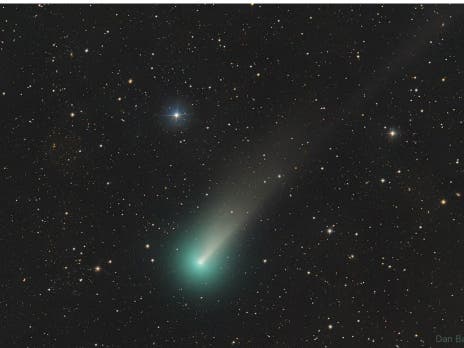
NEW JERSEY — Friday night after sunset may be the best chance to see the "Christmas Comet" this year before it starts fading into the night sky — although viewers may be able to catch it in the days after, experts say.
The ball of ice has been making its way through the solar system for 35,000 years but was only discovered last January by astronomer Gregory Leonard.
Because of the timing of its close approach to Earth, Comet Leonard has been called the “Christmas Comet.”
Find out what's happening in Livingstonfor free with the latest updates from Patch.
It was closest to Earth this past Sunday, Dec. 12, astronomers said, but you may still be able to spot it this weekend — though the longer you wait, the more difficult Comet Leonard will be to see before it leaves the solar system.
Accuweather said that it may be brightest on Friday night, Dec. 17, before it fades.
Find out what's happening in Livingstonfor free with the latest updates from Patch.
"Friday, Dec. 17, will be a good opportunity to spot the comet as it will appear directly below Venus after sunset," Accuweather said. "The fuzzy green comet will continue to glow below and to the left of Venus through the weekend before eventually shifting directly to the left of Venus by Christmas."
Keep in mind that comets are “notoriously difficult to predict in terms of brightness and visibility,” according to NASA. They’re brightest when they’re nearest to the sun, and its glare makes them difficult to see."
Weather plays a critical role, too. Clear skies are optimal.
Astronomers say Comet Leonard (C/2021 A1) could be as spectacular as comet Neowise was in 2020, and skywatchers may be able to see it best with small telescopes or binoculars.
“There’s a chance it could be bright enough to see with the unaided eye,” NASA said in a discussion about spectacles in the December sky, “but again, with comets, you really never know.”
NASA noted that starting this week it "switches over to being an evening object ... for just a little while after the Sun sets — as it begins its long haul outward from the Sun again, progressively fading in brightness.”
Gregory J. Leonard discovered the comet that now bears his name on Jan. 3, 2021, from the Mount Lemmon Infrared Observatory, located in the Santa Catalina Mountains about 17 miles from Tucson, Arizona.
Leonard, a senior research specialist at the observatory, saw a tail —which astronomers say is a promising sign that we’re in for a treat as the comet moves ever closer to Earth and the sun.
Even while it was discovered last year, the icy ball has been making its way to our planet’s solar system since the Paleolithic era.
It started the journey 35,000 years ago, when it was at the far end of its elongated elliptical orbit, called the aphelion, some 325 billion miles from the sun, “enveloped in an almost unimaginably cold environment, hovering just a fraction of a degree above absolute zero, the temperature at which all molecular motion stops,” according to Space.com.
“Now, Comet Leonard is in the home stretch of what likely will be its very last visit to the sun, and its conglomeration of icy gases like methane, ammonia and water vapor is reacting to the increasing warmth ofthe sun.”
The comet will make its closest approach to the sun around Jan. 3. It will be about 56 million miles away at that point.
You can sign up for free Patch breaking news alerts in your town, or to get a free daily newsletter each morning at 6 a.m. with local news.
Sign up with your zip code here and you'll get an email asking for your preferences.
Get a free 6 a.m. newsletter with news in your New Jersey town: https://patch.com/subscribe
Get more local news delivered straight to your inbox. Sign up for free Patch newsletters and alerts.