Schools
Meet Teacher Dr. Nuni-Lyn Walsh
LHS Teacher Shares Her Life Story and Path to Science Research

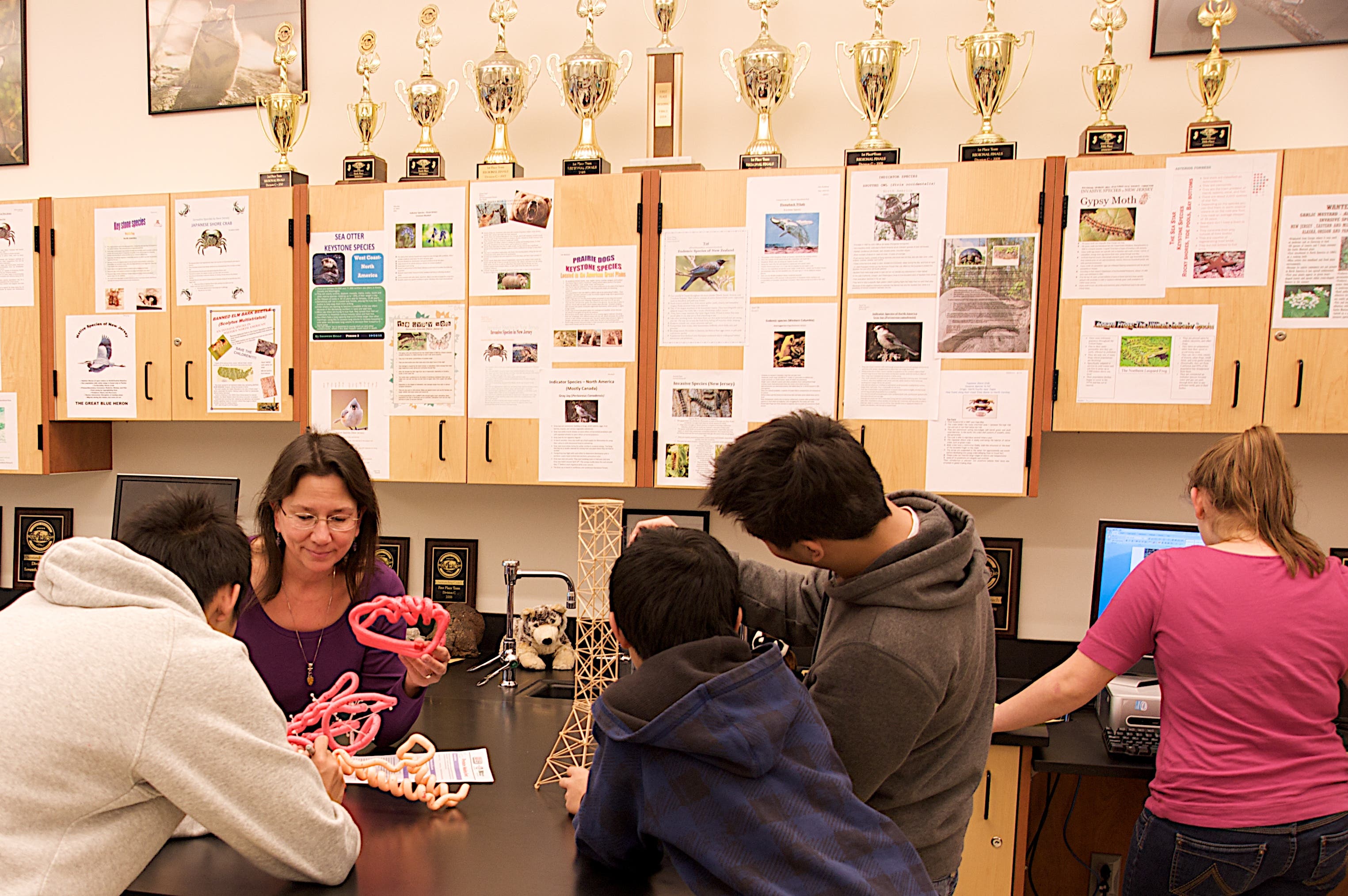
Dr. Nuni-Lyn Walsh is among the teachers with doctorate degrees working in Livingston Schools. As part of EduNation, the Patch examination of our schools, we asked Dr. Walsh to tell us about the path that led her to the top of the class at Livingston High School.
Dr. Walsh wrote to Livingston Patch about her adventures:
I have had and continue to have what I consider to be an amazing life. So many pathways have led me to where I am now.
I presently teach AP Environmental Science and co-teach Science Research. The AP course is a college level science for which students may opt to take a national exam in May and, with a passing grade, receive college credit. Science Research is a three-year program in which students immerse themselves in a science topic of their choosing, work under the supervision of a research mentor to complete a manageable project, write a final research paper, and present their research at a various competitions as well as at the annual LHS Science Research Symposium in May.
Find out what's happening in Livingstonfor free with the latest updates from Patch.
I am also the coach for the LHS Science Olympiad team, in which pairs of students compete in 25 different science and technology events. Students compete in the individual events, and a compilation of these events results in a team ranking.
I can identify major influences in many aspects of my life, but four major periods in my life were formative in shaping how I approach teaching. One was what I have come to realize was an unusual childhood, the second was a wise choice I made as an undergraduate, the third was a job I held for a couple of years in San Diego, and the last was the incredible experience of doctoral research. All of these experiences have filled me with real-world stories and examples for almost every topic I discuss.
My parents:
My childhood was filled with lessons in comprehension, mainly due to necessity because my family was far from wealthy. My father taught me how to tune-up a car engine, rebuild a carburetor, and change a tire. He encouraged me to make stilts from 2x4 pieces of wood, kites from balsa and newspaper, skateboards from old roller skates, and mini-bikes from old lawnmower engines and welded pipes. We built scaffolds and painted the house, mortared bricks into little garden walls, raised bees for honey, and grew zucchini and tomatoes in the backyard.
My mother taught me to cook, knit, crochet, sew, play the piano, bodysurf, hula dance, and sing in the Hawaiian language. I had never been on an airplane or in a hotel, but I had been on many road trips and in many campgrounds. When we camped, I learned wilderness skills, such as identifying animal tracks, building campfires, and digging snow caves. All of these skills, taken for granted at the time, have shaped my reasoning abilities. In my mind's eye, I see everything in three dimensions and envision processes connecting one thing to another. I like to create a teaching story for anything that I understand, using imagery, props, language, and examples, so that another person can remember it in the same way.
University of California, San Diego:
I received a B.A. in Chemistry at UCSD. At the beginning of my junior year, I decided to opt into an Earth Science specialization, for which I could forego six chemistry undergrad classes by taking six earth science graduate courses at the Scripps Institute of Oceanography (SIO). It was at SIO when I knew I would become an earth scientist.
Find out what's happening in Livingstonfor free with the latest updates from Patch.
Outside of specific classes I was taking on the UCSD campus, I spent most of my junior and senior years on the SIO campus (in fact, for a good part of this period I lived in a nearby campground for $5 per night), surrounded by legendary research in earth and environmental science. Al Gore later became one of my idols, not because he had any position at SIO, but because of his passion that was kindled by one of the legends of SIO, Roger Revelle.
Revelle was a researcher at SIO when he co-authored in 1957 the first paper that described human activities as a major cause of increasing atmospheric carbon dioxide, and predicted climate change as an eventual result of these activities. Revelle left for Harvard in 1963, and that is where he became a professor and mentor to Al Gore.
Also around that time, another Scripps professor, Charles Keeling, began taking direct measurement of atmospheric carbon dioxide levels at a station on top of Mauna Loa. The graph of this data that shows increasing carbon dioxide to date is known as the Keeling Curve, which is a main feature in Al Gore's presentations that he gives on his global travels. Revelle returned to UCSD in 1976, and I was fortunate to receive personal recognition from him at my graduation in 1986, when he learned that I had specialized in earth science. Only a handful of UCSD students at the time were adding that specialization to their undergraduate degree.
Employment as an Environmental Chemist:
Following a master's degree at California State University, Long Beach, I was offered employment and I had the opportunity to choose between working as a Forensic Chemist in the Long Beach area or as an Environmental Chemist in the San Diego area. I chose to work for the City of San Diego, performing field sampling and laboratory analysis of industrial wastewater to ensure that the various city industries were complying with pollutant limits as specified by the Environmental Protection Agency.
I was exposed to real-life applications of everything I had learned and was able to use a full laboratory suite of analytical technology to measure concentrations of pollutants such as heavy metals, organic compounds, bacteria, acids and bases, and radioactive particles.
University of Washington, Seattle, WA
Ph.D. Geological Sciences; Dissertation: Systematic Geochemical and Eruptive Relations in the Late Stage Evolution of Volcanoes from the Hawaiian Plume
I had to finance my own college education from undergrad through doctoral. Some funding came through grants and loans, but I also took advantage of the opportunity every year to reduce my tuition by working for the science department or particular professors. This involved participating in fieldwork in addition to my own field studies.
My field experiences during this time were like something out of a National Geographic expedition and I try to incorporate stories into teaching. For example, I've studied the volcanic eruptive styles of both Kilauea in Hawaii and Mt. St. Helens in Washington.
While taking molten samples on Kilauea, I was trapped by a lava flow and had to run across the lava to escape. Students have seen movies where a person sinks into lava, but it is actually rather dense. The heat is intense though. If I had stopped to look around, I would have very quickly gone up in flames. Mt. St. Helens blasted out its lava in a massive eruption of ash particles. From the top of St. Helens you can see Spirit Lake clogged with ash and logs, and fallen tree trunks in the blast zone all lying in the same direction. In the distance, you can see the peaks of other volcanoes -- Adams, Rainier, Hood -- all geologically related to one another.
I use pictures from both of those trips to teach about eruption styles and volcanic hazards. I've been on research ship cruises, one in which a submersible was used to collect seafloor samples from 12,000 feet underwater. I still have styrofoam cups that were tied to the outside of the submersible, causing them to shrink down to miniature size, that I use to teach about the extreme pressures of seafloor habitats.
I have many experiences with wildlife and habitat degradation that I share with students at relevant times throughout the year. I have heard whale songs underwater off of the island of Maui, measured the pH of acidic water flowing out of abandoned mines in Nevada, dissected grizzly bear droppings in Alaska that looked and smelled like giant piles of blueberries, and watched biologists on Molokai hand pollinate flowers that are no longer able to be pollinated naturally because the moth that facilitated it has gone extinct.
Whereas my field experiences help to bring life to my classroom teaching, experiencing the daily grind of doctoral research is my strongest asset in contributing to the Science Research program. I bring experience from extensive laboratory work, grant writing, collaboration on published abstracts and papers, and numerous oral research presentations at professional conferences.
With three teachers in this excellent program, we are able to collaborate regularly and produce activities that provide students with practice in research methods, science writing, and presentation methods, which we hope will maximize the benefits of their research experience with their mentor and their project.
Do you know a teacher Livingston Patch should profile? Let us know.
Get more local news delivered straight to your inbox. Sign up for free Patch newsletters and alerts.