Politics & Government
SCOTUS Ruling Is ‘Sad Day’ For New Jersey Families, Unions Say
"For too long, unions have propped themselves up with money skimmed out of paychecks despite workers' objections," a NJ GOP lawmaker said.


Should a labor union be able to collect fees from a worker who doesn't want to kick in? The U.S. Supreme Court’s answer to that question, passed down Wednesday, is expected to change the way unions operate across the nation, including in New Jersey.
On June 27, the U.S. Supreme Court (SCOTUS) ruled on Janus v. AFSCME, declaring that public-sector unions and states that collect fees from non-consenting employees are violating the First Amendment. (Read the full opinion here)
In addition to New Jersey, 21 other states, the District of Columbia and Puerto Rico have fair-share provisions, which require workers in a unionized workplace to either join or contribute to the group's "nonpartisan" activities.
Find out what's happening in Livingstonfor free with the latest updates from Patch.
The sharply divided court was split 5-4 in the case, with Justice Samuel Alito delivering the majority opinion.
- See related article: States, Unions Can't Collect Fees From Non-Members, Supreme Court Rules
Across the state, members of New Jersey’s largest labor unions denounced the SCOTUS decision.
Find out what's happening in Livingstonfor free with the latest updates from Patch.
The union involved in the case, American Federation of State, County and Municipal Employees (AFSCME), represents more than 1.6 million working and retired public sector workers across the U.S., including more than 30,000 retired and current members in New Jersey.
AFSCME New Jersey Council 63 Executive Director Steve Tully released the following statement:
“We are disappointed by the Supreme Court’s decision today but, unfortunately, not surprised. This decision is yet another example of how billionaires rig the system against working people. Despite this unfair decision, nothing changes the fact that America needs unions now more than ever. AFSCME New Jersey is more resolved than ever to fight for our members and the communities they serve.”
Several other labor unions with heavy Garden State presences agreed with AFSCME New Jersey.
“The SCOTUS decision on the Janus v. AFSCME case marks a sad day for all working families, but won't stop us from standing strong together,” wrote representatives with the Communications Workers of America (CWA) District 1, which represents more than 70,000 working families in New Jersey.
“This decision is yet another example of how billionaires rig the system against working people, but [our] members won’t let the extremists behind this case divide us,” said Kevin Brown, vice president of SEIU 32BJ, which represents more than 12,000 service industry employees in the state.
Tania Capobianco, a security officer and SEIU 32BJ member from New Jersey, said that the SCOTUS decision won’t undermine her union’s resolve to fight for the right to organize.
“All workers should have the opportunity to join in union and achieve the American Dream, just as my grandfather Sanseverino did for my family decades ago,” Capobianco said. “No court case will stop us.”
The New Jersey Education Association (NJEA), which represents more than 200,000 active and retired school employees in the Garden State, said that the ruling will tilt the balance of power in workplaces even further toward employers.
“The wealthy and powerful have always wanted to weaken unions, because we, the people who make up unions, refuse to be intimidated by them,” declared NJEA Vice President Sean Spiller, a town council member in Montclair. “But unions have never needed the permission of courts or legislators to do what we’ve joined together to do.”
Some of the most powerful officials in the state – including several Democratic party members who have received large campaign contributions from organized labor – also blasted the SCOTUS ruling.
Wednesday statements from New Jersey officials included:
- Gov. Phil Murphy – “This disappointing decision does not in any way diminish our administration’s commitment to protecting the right of public sector employees to organize. We stand firm with our labor unions and labor organizations to advocate and protect members’ rights as we did with the ‘Workplace Democracy Enhancement Act’ I signed in May. Supporting strong unions is a critical part of making New Jersey’s economy work for everyone.”
- Attorney General Gurbir Grewal – “The very first amicus brief I signed as Attorney General was one in support of workers’ rights in Janus v. AFSCME. I was proud to stand with labor on this crucial issue and remain so today. In New Jersey, we’re charting a path to protect workers even as the federal government turns away from them. At the Attorney General’s Office, we will use our legal authorities to continue vigorous enforcement of state laws that protect workers’ rights to organize and to engage in collective bargaining. Nothing about today’s decision changes that.”
- Labor Commissioner Rob Asaro-Angelo – “This decision is a travesty for working men and women everywhere, particularly here in New Jersey, where workers’ right to organize is protected by our state Constitution. The decision undermines the ability of working people around the country to receive the respect and appreciation they deserve. Despite this ruling, the Department of Labor and Workforce Development is committed to working with our sister government agencies to protect workers' rights, secure their safety, and ensure the dignity that work provides.”
- U.S. Senator Robert Menendez – “With this ruling, the Supreme Court has sided against our teachers and nurses, our police officers and firefighters, and all hardworking Americans who have chosen public service careers. As devastating as this 5-4 ruling is, no court case will change the fact that unions play a key role in helping public employees to organize and act collectively to improve their work conditions and their relationships with their employers. We should make it easier for hardworking people to join unions and organize to defend their rights, not harder.”
- U.S. Senator Cory Booker – “Today’s Supreme Court ruling is an outright attack on the rights of working men and women everywhere. By ruling in favor of so-called ‘right to work’ laws —which have their origins in the Jim Crow era—this decision marks yet another distressing victory for the corporate interests and billionaires that have sought to dilute worker power for decades.”
- U.S. Representative Donald Payne Jr. (NJ) – “The Janus decision is a blow to working-class people across the United States. The power of people joining together collectively to protect their working conditions makes America stronger.”
- U.S. Representative Bill Pascrell Jr. (NJ) – “This decision, part of corporate interests’ decades-long war to destroy organized labor, was delivered courtesy of a stolen Supreme Court seat and a presidential campaign built on lies. Donald Trump campaigned that the system against American workers is rigged. Unions create fair treatment for American workers and higher wages for their families. Now his Supreme Court has worsened prospects for workers in service to radical ideological and political power.”
However, some business leaders and GOP leaders in New Jersey praised the SCOTUS decision and said it will benefit the Garden State and nation as a whole.
“This decision restores free speech and freedom of association to every public school teacher and government worker across New Jersey,” said Assemblywoman Amy Handlin (R-Monmouth). “For far too long, unions have propped themselves up with money skimmed out of paychecks despite the workers’ objections.”
“This is a victory for rank-and-file teachers,” said Assemblyman Robert Auth (R-Bergen). “Big unions have concentrated on procuring power and excessively paying its leadership while neglecting teachers in the classrooms. The NJEA’s executive director was paid $1.2 million thanks to dues as high as eleven-hundred dollars imposed on full-time teachers.”
After the top court's decision, New Jersey’s 475,000 state and local public workers could opt out of their unions – taking money and political clout with them, Auth and Handlin said.
Writing about the Janus v. AFSCME case last month, Americans for Prosperity Policy Director Akash Chougule asserted:
“Unions want you to believe Janus and the hundreds of thousands of other public-union members who want to leave will get a ‘free ride,’ enjoying the collective-bargaining benefits of union membership without paying dues. But these would be, by definition, workers who do not want the union to represent them; they’re forced riders, not free riders, required to fund political speech against their will… Having lost the private sector, unions are now circling the wagons around government employees. But, as the unions themselves admit, hundreds of thousands of those employees don’t want to be hemmed in.”
UNDERSTANDING JANUS V. AFSCME: “NO FREE RIDES”
Why would a union be allowed to take fees from a worker who never wanted to join in the first place? It all comes down to the concept of a “free ride,” according to ThinkProgress.org:
“In the states where they exist, so-called right-to-work rules make it illegal for unions to require ‘agency fees’ (payments that cover the expense of bargaining on behalf of non-union members) from the non-members covered by contracts they negotiate. To unions and their allies, the fees help prevent what they call a classic ‘free-rider problem,’ in which people benefit from a costly system without any incentive to pay into it. Without agency fees, non-union members of unionized shops can still benefit from the higher wages and benefits guaranteed by collective bargaining contracts — but they’re not required to keep those efforts financially afloat.”
But on Wednesday, the SCOTUS cast doubt on the validity of the practice, stating that forcing people to “support” or “subsidize” viewpoints they find objectionable violates the First Amendment.
Speaking for the majority, Justice Alito wrote that the free rider argument doesn’t hold water, and that serving as a workplace’s “exclusive representative” has benefits such as a “privileged place in negotiations” and the ability to have dues directly deducted from an employee’s wages.
“It is simply not true that unions will refuse to serve as the exclusive representative of all employees in the unit if they are not given agency fees,” Alito opined. “Unions represent millions of public employees in jurisdictions that do not permit agency fees. No union is ever compelled to seek that designation. On the contrary, designation as exclusive representative is avidly sought.”
Alito provided an ominous warning about the coming crunch for affected unions’ coffers.
“We recognize that the loss of payments from nonmembers may cause unions to experience unpleasant transition costs in the short term, and may require unions to make adjustments in order to attract and retain members. But we must weigh these disadvantages against the considerable windfall that unions have received… for the past 41 years. It is hard to estimate how many billions of dollars have been taken from nonmembers and transferred to public-sector unions in violation of the First Amendment. Those unconstitutional exactions cannot be allowed to continue indefinitely.”
Supreme Court rules in favor of non-union workers who are now, as an example, able to support a candidate of his or her choice without having those who control the Union deciding for them. Big loss for the coffers of the Democrats!
— Donald J. Trump (@realDonaldTrump) June 27, 2018
The SCOTUS majority viewpoint was not accepted by one of the largest and oldest labor organizations in the nation, the AFL-CIO.
“Unions are required by law to represent and negotiate on the behalf of all workers in a bargaining unit, regardless of whether the individuals they represent are dues-paying members. In this case, a bare majority of the court, conceded to the dark web of corporations and billionaires to prevent public-sector unions from collecting fair share fees from workers they represent who choose not to join the union.”
The AFL-CIO states:
“The fact is no one is ever forced to join a union and no one is forced to pay anything to support the political activity designed to advance the rights of working people. This already is the law of the land. But the court's decision, until it is overturned, abandons decades of commonsense precedent.”
Read the AFL-CIO’s take on the importance of the Janus v. AFSCME decision here.
Learn more about posting announcements or events to your local Patch site here. Send local news tips and correction requests to eric.kiefer@patch.com
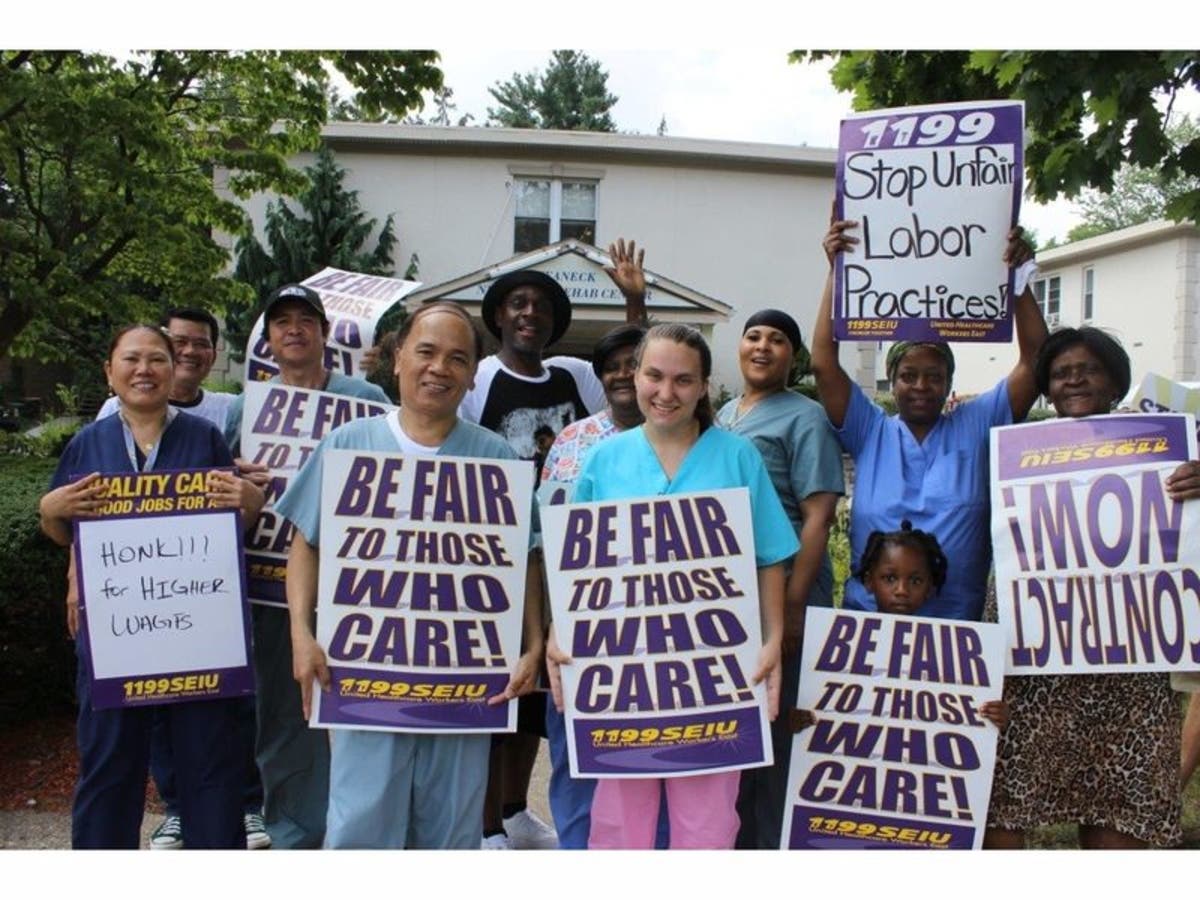
File Photo: 1199SEIU United Healthcare Workers East, rally in Teaneck
Get more local news delivered straight to your inbox. Sign up for free Patch newsletters and alerts.