Arts & Entertainment
Keeping It Real: Public Radio Personality Julie Burstein Discusses Art in Tinton Falls
The WNYC radio personality discussed her new book 'Spark: How Creativity Works' at the Monmouth Festival of the Arts on April 12.


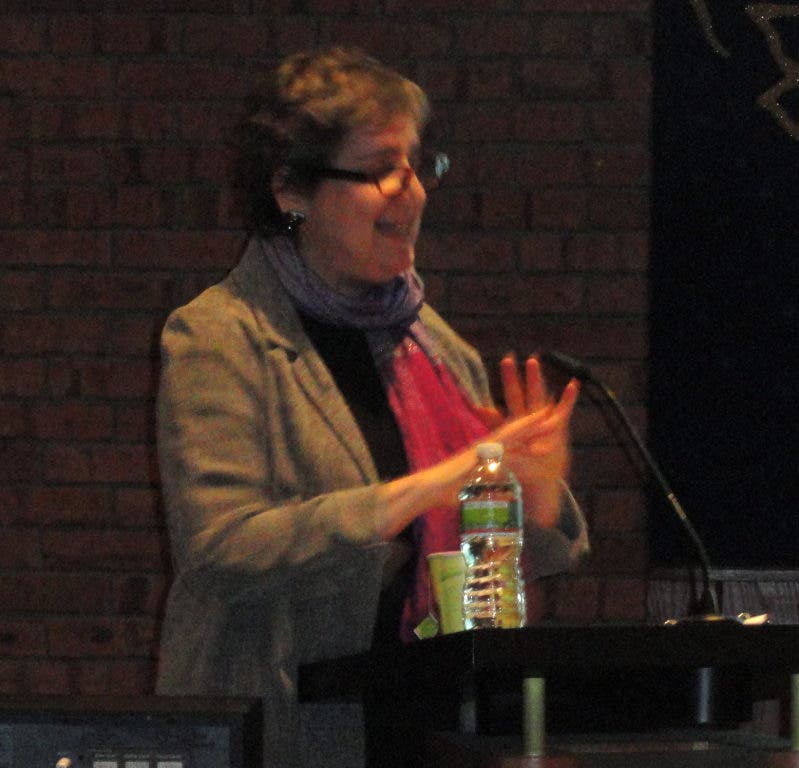


Public radio personality Julie Burstein plucked the notion of art and artists down from its usually lofty spot in our perception and brought it to a more tangible level for her audience at the Monmouth Reform Temple on Tuesday.
Burstein, who can be heard on WNYC and is the creator of the long-running radio program Studio 360, spoke on April 12 about her new book Spark: How Creativity Works as part of the Monmouth Festival of the Arts in Tinton Falls.
Showing her own inventiveness, Burstein used audio clips from the program along with photographs to illustrate how artists use the regular and everyday experiences common to us all to create work to which we can all relate.
Find out what's happening in Long Branch-Eatontownfor free with the latest updates from Patch.
“The key about art is the way it connects with life,” she told the audience gathered in the temple’s sanctuary as part of the 41st annual juried art show.
Burstein drew from the approximately 1,000 artist interviews over the course of her nine years with Studio 360, which focuses on pop culture and the arts, and used their “truthful and courageous stories” to illustrate creative inspiration.
Find out what's happening in Long Branch-Eatontownfor free with the latest updates from Patch.
She joked that she would share with the audience at the end the secrets to creativity and sure enough, she pulled together the different artists and their creative paths she had spoken of during the discussion and drew from their experiences five tenets she has observed in highly creative people.
Stay Open to Experiences Around You
“So many stories in Spark speak to a need to stop and look,” said Burstein.
She played a clip from an interview with the documentary film director Mira Nair who discussed growing up in India and attending shows put on by a traveling folk theater each year.
“Millions of people saw (those shows) but the artist was open to what other people took for granted,” observed Burstein.
And like a legion of other frustrated parents, the mother of two has been frustrated by her own children’s disconnection to their surroundings. “Put down the DS and look out the window,” Burstein said she has had to demand of them on more than one occasion.
When You’re Stuck, Take a Break
The artist Richard Serra suffered from the “4:00 problem,” when the creative flow would dry up each day, explained Burstein. To get around it, he and his assistant, the then-unknown Philip Glass, would leave the New York City studio and hop on the subway for a ride and then resume work in the studio, refreshed from the outing.
Burstein quoted a comment made by the artist Chuck Close, “Inspiration is for amateurs, the rest of us show up to work.”
Sometimes Challenges Give You What You Need
Poet Donald Hall said in his Studio 360 interview that writing sustained him after the death of his wife, fellow poet Jane Kenyon.
Burstein spoke of the “paradox of poetry” and how while Hall’s work during that period focused on death and loss, the product was ultimately healing.
Physical limitations can also create those paradoxical challenges, according to Burstein. The Pulitzer-prize winning author Richard Ford suffers from dyslexia, which made reading “excruciating.” But it forced him to read slowly and helped him to “write sentences,” Burstein said.
“Dyslexia wasn’t something to get through and overcome,” she observed, “the disability became a source of strength and led him to discover the power of language.”
Embrace Passionate Obstinacy
Soon after the fall of the World Trade Center, photographer Joel Meyerowitz stood looking at the ruins and raised the camera to look through the viewfinder and was quickly told by a police officer that pictures weren’t allowed. “It’s a crime scene,” Meyerowitz said in an interview.
The New York photographer became determined to document the clearing of the destruction for not only the artistic merit but also for the historical value of the work.
The photos ultimately were exhibited by the U.S. State Department in more than 20 countries published as the book Aftermath in 2006.
“Artists pick up the pieces for us when the world is broken,” said Burstein of what she called Meyerowitz’s “passionate obstinacy.”
Look for Someone Who Loves You and Your Work
David Plowden is known for his powerful photographs of small towns and rural landscapes but in the beginning, he was overwhelmed by his subjects.
Burstein told the story of Plowden receiving a camera as a gift when he was 11 years old and deciding to take a picture of the local train pulling into the station later that afternoon. When the moment arrived, however, he began to shake and handed the camera over to his mother, who took the picture instead.
But the next time he went to take the same shot, he was much steadier, and said in his interview that he still had that picture.
Burstein said that she hoped sharing the stories of almost 40 of the last century’s most creative minds would serve as a “catalyst to engage in the world in a whole new way.”
“Each of us must find our own path to creativity,” she said, “but sharing helps us learn.”
Get more local news delivered straight to your inbox. Sign up for free Patch newsletters and alerts.