Politics & Government
Trust Fund Coordinator Honors Two Historic Long Valley Locations
Middle Valley Community Center and Obadiah LaTourette Grist and Saw Mill honored at freeholders meeting.

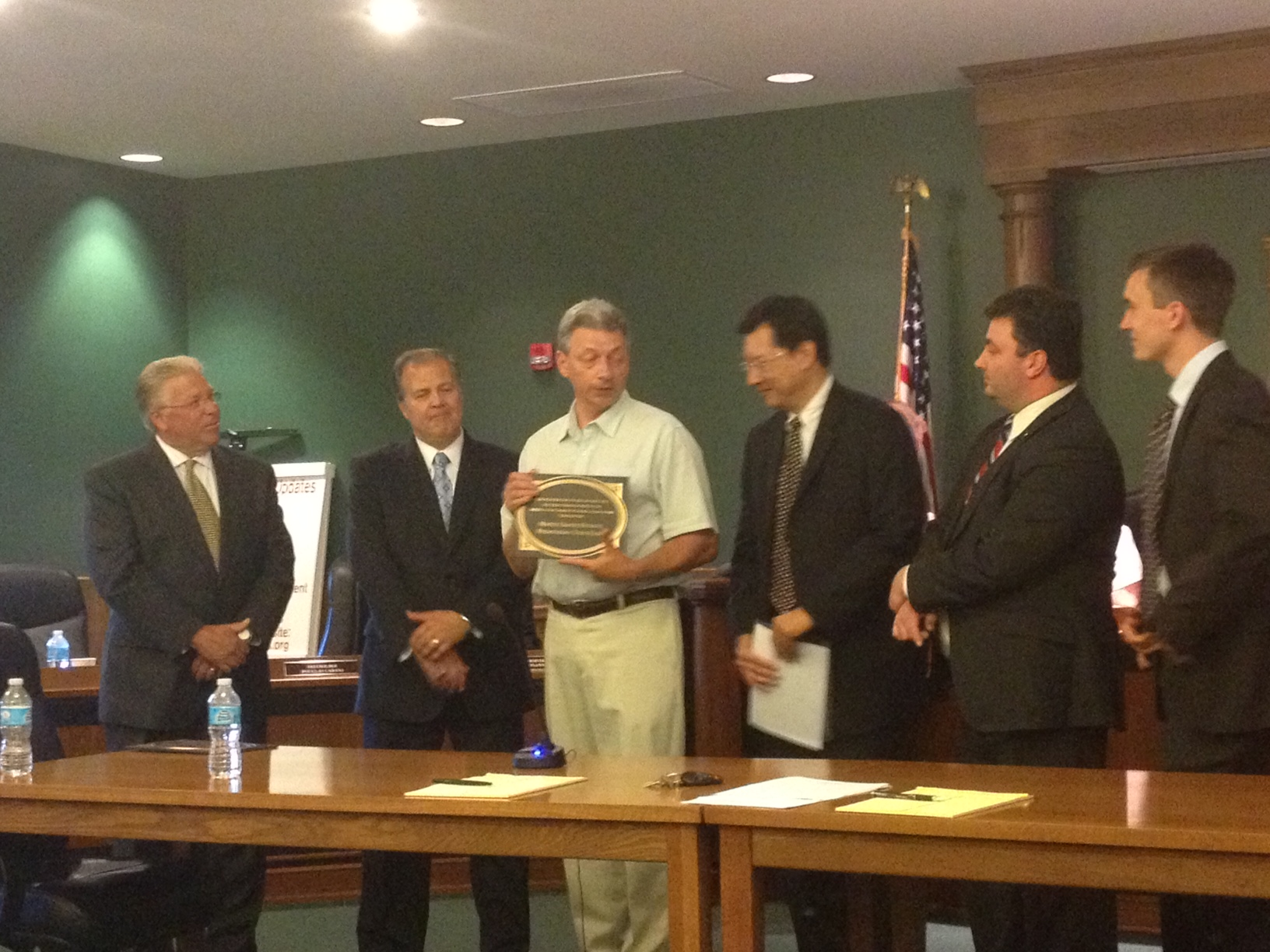


Plaques to recognize restoration efforts on two Long Valley historical locations were presented Wednesday night at the Washington Township municipal building.
A part of the Morris County Board of Chosen Freeholders meeting (held in Washington Township), the presentation saw the county’s Historic Preservation Trust Fund program coordinator, Ray Chang, bestow plaques to representatives from the Middle Valley Community Center (MVCC) and the Washington Township Land Trust of Morris County.
Both locations, described below, are listed on the Register of State and National Historic Places, and each has an 18th century origin.
The Middle Valley Community Center
Find out what's happening in Long Valleyfor free with the latest updates from Patch.
First, Chang presented a plaque to the Middle Valley Community Center, a building that sought financial support for restorations beginning in 2002 and is a part of the Middle Valley Historic District, an overlay zone of Washington Township.
In December 2002, according to their website, an application was filed to the Morris County Heritage Commission for a grant that would involve a building assessment report. The community center was granted $2,500 in January 2003 for an assessment that would cost $3,500, hence requiring MVCC to pay the remaining balance.
Find out what's happening in Long Valleyfor free with the latest updates from Patch.
That report was a revealing indicator of infrastructural problems that the building had, outlined by a dire concern for the Bell Tower that sat atop the roof.
In July 2004, according to their website, MVCC was awarded a grant worth $82,368, out of the Morris County Historic Preservation Trust Fund. The project’s total cost, however, would be $102,960, forcing MVCC to pay $20,592 in an 80/20 agreement.
By 2007, the grant restoration work was completed. According to the MVCC website, however, the history of the community center is much more comprehensive.
From Post Office to Schoolhouse
In 1792, David Miller opened the building as a general store. By 1802, he had incorporated a post office into the store; by 1836, his son David took over the business.
In 1847, Miller sold the store to John C. Welsh, who then sold it to Elias Bartles in 1863, at a time when the country was sharply engaged in its Civil War. By 1868, William S. Naughright partnered with Elias Bartles, but was left with the business as Bartles left two years later.
In 1871, a man by the name of Jacob Welsh partnered with Naughright to run the general store, and he created Welsh Farm, a dairy business for the local German Valley, as it was once called.
In 1891, the store was bought from Welsh for $500, and the Middle Valley Hall Association was formed. It would also serve as a gathering spot for the Ladies Home Union Society of Middle Valley in 1903, and the next year it had a bell tower added to its exterior.
After a fire destroyed the Middle Valley School in 1926, the building then served as a school for grades one through five, and it would become a community center 49 years later in 1975.
In 1990, it was added to the Register of State and National Historic Places, and the restoration work would begin 13 years later.
‘Older than the U.S.’, The Obadiah LaTourette Mill
The July 24 meeting’s second plaque recipient was the Washington Land Trust of Morris County, for their restoration efforts on the Obadiah LaTourette Grist and Saw Mill.
According to Chang, grant restoration work (amounting to $60,000) included structural framing, and work to beams, joists, windows, doors and façade.
Gregg Forsbrey, the Vice President of the Washington Township Land Trust, accepted the plaque and briefly spoke to the mill’s extensive background.
“The mill was created in the 1750s, so it’s older than the United States,” he said. “Yet still, we’re working on it! I appreciate all the help we’ve had. Many people have put in thousands of hours. In 1991, when the Land Trust bought the property, it was deemed ‘condemned,’ but now it stands as a symbol for the township.”
Lifeline for German Valley
Philip Weise, who turned the mill into a prosperous operation after its creation in 1750, made the business crucial to the economy of the former ‘German Valley’ and the surrounding agricultural area, according to the Land Trust’s website.
It produced flour and animal feed, and even had a sawmill located behind it during the 1800s.
The mill was powered by two water wheels, though that was changed in the 1870s to turbine power. Obadiah LaTourette was responsible for that alteration, and the business continued onto the 1940s.
Today, machinery still sits inside the mill, and tours or offered on the grounds, which now bears the brunt of 263 years of existence.
Get more local news delivered straight to your inbox. Sign up for free Patch newsletters and alerts.