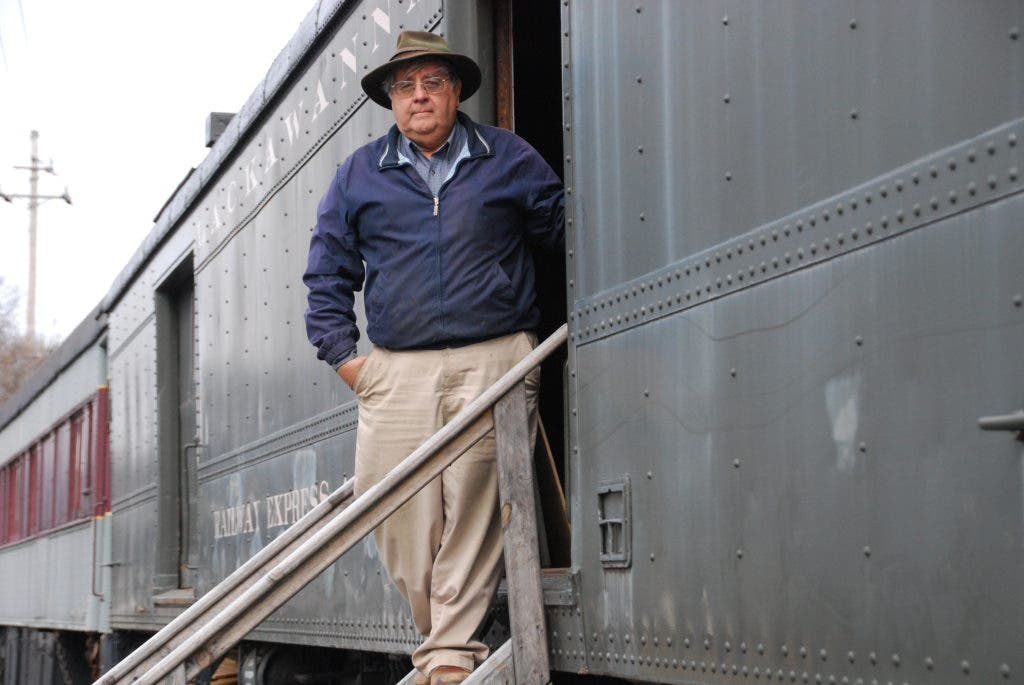
From the early nineteenth century, the histories of Madison and New Jersey railroading have been tightly intertwined. The Madison Historical Society will explore this relationship of town and train on Tuesday, March 20 in a panel discussion led by Madison contractor, preservationist,
media recorder, and railroad enthusiast Carmine Toto, Jr.
The meeting will take place in the Chase Room of the Madison Public Library and will begin with the availability of light refreshments at 7 p.m. The formal meeting and panel discussion will follow at 7:15 p.m.
It was in 1837 that the Morris and Essex Railroad first came to Madison. The arrival of the railroad impacted the village of Madison in a number of ways. The availability of reliable transportation between the town and the east caused Madison to quickly grow from a small rural community into a “commuter suburb” – the country home to those who worked in cities like Orange, Newark, and New York. As F. J. Esposito observed in his book, "The Madison Heritage Trail", when the station at the corner
of Waverly Place and Kings Road was first opened in 1855, at least 50 residents were already regular commuters.
Beginning with William Gibbons in 1836, estates established by Alfred Treadwell, Frank Lathrop, Robert Ballantine, Hamilton and Florence Vanderbilt Twombly, D. Willis James, began to populate what became known as the “Millionaire’s Row” along Madison Avenue. Society president, Susan Simon, and MHS volunteer and recently named Madison Historian Kay Leary will discuss a number of these families and their Madison estates.
The railroad also made Madison’s rose industry possible by providing rapid and economical transportation from the village’s rose-growing estates to markets in New York City. The first greenhouses were erected by Alfred Treadwell on his estate in 1856. His lead was followed by Judge Lathrop, who was the first to market his product in New York. Cathie Coultas, Society vice-present and granddaughter of Joseph Ruzicka, a onetime partner of Louis Noe, and ultimately, the largest rose grower in New Jersey, will describe the relationship between the railroad and Madison’s rose-growing industry.
Residents who would like to get a preview of topics to be discussed at the March 20 meeting are invited to view the Society’s “Trains and Madison” display in the Madison Library reference room. The display, prepared by member Chris Schorr, includes a number of antique model trains and a historical timeline.
The Madison Historical Society’s role is to assemble, record, and preserve all matters of historical interest concerning Madison and its residents. Formed in 1922 to preserve the old Bottle Hill Tavern, the Society has organized a significant collection of historic documents, maps and photographs over the intervening years. These are housed at the Local History Center at the Madison Public Library.
For more information about the Society or to inquire about membership, call (973)377-0722, ext. 8 or visit the
Society’s website at www.madisonhistoricalsociety.org.