My Maplewood
By Jim Van Orden, Richardson, TX, 2012
Find out what's happening in Maplewoodfor free with the latest updates from Patch.
(Part four in a four-part series chronicling a boy’s memories of Maplewood.)
Find out what's happening in Maplewoodfor free with the latest updates from Patch.
Fins, Spins and Dealers
By the time I was five or six years old I could identify every car on Maplewood’s streets. And by age 11, I knew what was under each hood, their length and width, weight and how fast they achieved 60 miles per hour. In other words, I was a certified car nut (and still am).
Maplewood was a car nut’s heaven and in 1956, my 12th year, I also knew the town’s “car row” like the back of my hand. The mile-long stretch along Springfield Avenue was lined with new and used car dealers. From Studebakers to DeSotos and Henry Js to Kaiser Manhattans, just about every manufacturer was represented.
To get the jump on friends, I rode my bicycle to showrooms in early October to sneak peeks at new models before they were introduced. Wrapped tightly in protective covers, cars were trucked from Detroit to showrooms in the dark of night. Dealers placed them on showroom floors and kept them out of sight by covering plate glass windows with Glass Wax. Sometimes they were sloppy, however, and didn’t block the bottom inch or two of a window. It was fun to get down on the sidewalk and gawk through small openings, upside down, at enormous fins and decorative chrome panels that turn heads today.
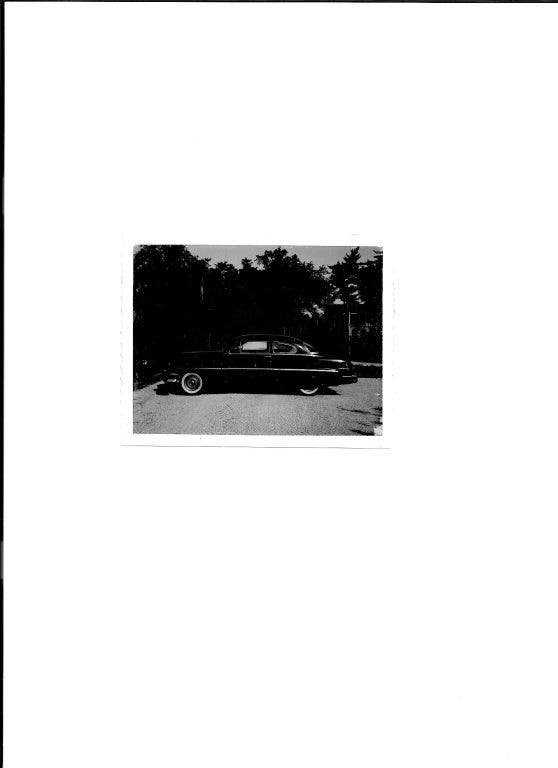
Until about 1955, Maplewood cars were boring. Like my father’s 1953 black Chevrolet with its anemic six-cylinder engine. Or my neighbor’s 1950 green Buick with three portholes. Its exhaust had a wheezing sound reminiscent of Mom’s Hoover vacuum cleaner. I could beat the car from zero to the end of the driveway on my bicycle.
A big dose of automobile excitement hit Maplewood the day my cousin, Jim Suydam, powered up our gravel driveway in 1953. He sat bolt upright at the wheel of a 1932 Duesenberg, a car noted for its high price and enormously powerful eight-cylinder, double overhead camshaft engine. It was the car of Hollywood stars and moguls. He, too, was a car nut and laughed when I jumped on the running board and asked for a ride. “Let me first say hi to your Mom and unpack my suitcase,” he said.
Mom ordered me—three times—to come inside and have dinner. I couldn’t take my eyes off the fancy dashboard with all its gauges, the red leather seats, three-foot-long gearshift lever, wire wheels, wide straps that held down a hood as long as our front door was tall, and spare tires that flanked the front fenders. “You’ll never ride in that car if you don’t come in right now,” she warned with that certain tone.
Later, the big engine started with a roar as we backed into Tuscan Road. Thirty-two valves announced their presence with a gentle tapping that was music to my ears. My cousin shifted into first gear and slowly moved away. I wondered if he would ever go faster than 30 miles per hour. The car towered above everything except trucks as we drove into South Orange and tackled the big hill that led to South Mountain Reservation. Without warning at a traffic light, Cousin Jim put the pedal to the metal and left new cars in his wake as we blasted up the steep grade. My head snapped back and my heart beat as fast as the engine was spinning. I was hooked.
Fortunately, Maplewood’s car scene got more exciting as fins soared skyward and the horsepower race kicked into gear. One day, a friend asked if I wanted to car shop with him and his father. I wondered if I had died and gone to heaven.
We first drove to the Buick dealer and looked at monstrous, chromed visions of opulence in the showroom. The father seemed satisfied, but I asked if he had seen the fins on my favorite cars of the period, the 1957 DeSotos and Chryslers? Their “Forward Look” designs were complimented by hemi engines putting out more than 300 horsepower. Curious, he drove us to the DeSoto dealer and there, sitting in the showroom, was my “dream car,” a white-and-gold 345-horsepower “Adventurer.” This was a super car of its day.
“Don’t like it…it’s got only two doors,” was Daddy Warbuck’s response. “Oh, no, he can’t mean it?” I asked myself. I couldn’t let him leave the showroom without driving the car. But his mind was set on “something more conservative, like a Chrysler.” A quick drive and we stood in front of the most powerful car in America, the 375-horsepower Chrysler 300-C. I drooled and practically screamed “Let’s do a test drive!” The 300-C wasn’t available, however, but we drove a 325-horsepower New Yorker. I was disappointed because I couldn’t hear the hemi while sitting in the back. At least I could watch the salesman push cool dash-mounted transmission buttons.
Chryslers were ruled out unceremoniously and we continued on to the Lincoln dealer. I didn’t like Lincolns because they had “only” 300 horsepower. But they did have a few redeeming features such as the largest fins in the industry, their sharp tips resembling girls I knew who wore pointed bras, and four vertically-mounted headlights called “Quadra-Lites.” It was obvious my friend’s father had fallen in love with the 18-foot, massively-finned behemoth that resembled the comic book drawings of the “Batmobile.”
“I’ll take it,” he told the salesman, and he plunked down cash without hesitation or a test drive. The deal was consummated as quickly as the ink dried on the bill of sale. No waiting in those days if you paid cash. He did have to wait, however, for a build order to be mailed to Detroit. After about a month, the Lincoln was delivered and I was invited to the inaugural drive.
As I jumped into the rear seat and we left the dealer’s lot, I had images of the 300-horsepower Lincoln spinning wheels and snapping my head back. But everything in Maplewood was a short drive. And most roads had a 25-mile-per-hour speed limit. “Floor it, please,” I silently implored. “Just give it a little throttle so I can hear the engine.”
“Must be careful not to stress the motor during break-in,” the father said with gravity as we plodded along at 20 miles per hour. I sank down in the back seat in disgust. And we were home before I could even think another thought.
Good Morning, Maplewood, How Are You?
It was comforting listening to the “puffer-belly” pull into Maplewood Station at 6 a.m. My bedroom was filled with indescribable sounds.
It was around 1948 or ‘49 and the “milk run” came into town once a week with wheels and brakes screeching, boiler belching and steam hissing. And after it was unloaded, it started slowly and built up speed with every chug and turn of its massive wheels. As I lay in bed, I could still hear the engine a mile away as it left Maplewood on its way to Millburn. I didn’t know it then, but even though the Erie-Lackawanna stopped steam engine runs in the late-1930s, that engine was one of the last puffer-bellies to ply the tracks.
I knew my father could hear it, too. He had already shaved and was dressing in his go-to-New York City suit, vest and tie. He and I waved goodbye as I stood at the window after breakfast and watched him begin his walk to the station. Sometimes, when he was late, Mom gave him a ride and I went along. With great commotion, its brakes grinding in a high-pitched squeal, the brown electric train with “Erie-Lackawanna Railroad” written in gold letters on each car, pulled alongside us. Dad mounted the steps and took his usual seat for the journey to Hoboken and the ferry ride across the East River. Mom and I often met him when the train returned at six p.m. Under his arm was the Newark Evening News and I couldn’t wait to read the “Phantom” and “Lil’ Abner” comic strips. His four-hour daily commute was a 25-year ritual.
His father made the same journey. He started riding on Erie-Lackawanna trains around 1905, the year my father was born. I never knew Grandpa, who died before my birth, but Dad told me stories about his adventures on the rail line. In some respects, Grandpa’s commute was more interesting than Dad’s. He lived in Chatham, New Jersey, and his dentistry practice was in Brooklyn. His daily ride was longer and he always had a cigar in his mouth. His 20-cigar-a-day habit was augmented by tobacco he chewed. The railroad provided a parlor car where he and other men drank and bet their salaries during hotly-contested poker games.
My Erie-Lackawanna experience began with a cheer. The classroom exploded with excitement when Mrs. Cooley, our second-grade teacher at Tuscan Elementary School, announced a class trip to Hoboken to see a famous luxury train called the “Phoebe Snow.” Named by railroad executives after a fictional beauty, the gleaming silver train had a reputation for opulence, champagne and finely appointed parlor cars. It was the last of a dying breed of great trains that crossed America during the railroad industry’s heyday.
Thirty little kids—boys wearing neckties and girls adorned in long dresses—piled into the brown electric, many for their first train ride. The trip to Hoboken took us through stations with exotic-sounding names such as “Brick Church” and “Orange.” Wide-open windows blew all manner of smells and dust into our virgin nostrils. Uniformed conductors walked the aisles collecting fares and tickets. I was fascinated by their hand-operated coin dispensers. Without even looking, they clicked levers that disgorged pennies, nickels, dimes and quarters from the bottom. Holes were punched in mysterious places on my ticket. And deep, resonant voices boomed the names of upcoming stations in incomprehensible verbalizations sounding totally unlike anything I read on station signs.
Train rides to Hoboken became routine as the years progressed. I often traveled to New York City with friends and family to visit Times Square, 42nd Street, Radio City Music Hall and various museums. Classic-looking Maplewood Station, built in 1902, always had intriguing Broadway posters on display. My imagination ran wild trying to understand the gaudy and risqué images on billboards advertising “Guys And Dolls,” “West Side Story,” “Carousel,” “South Pacific” and others. Eventually, I got to see them all.
The Erie-Lackawanna took me to college in Pennsylvania, too. It was an exciting overnight ride that started in Maplewood and involved a transfer at the Summit station. The scenes along the Delaware River were spectacular, particularly at the Water Gap where enormous cliffs loomed over us. The train turned west after crossing into New York State and rumbled through dozens of cities, such as Binghamton and Elmira, as well as sleepy towns whose presence was marked only by clanging bells, closed cross-gates and patient farmers waiting in old pick-up trucks. The train cars were always egg-boiling hot or freezing cold. I smoked my first cigarette in one of those cars.
About the time Dad retired, I picked him up at Maplewood Station. He seemed detached and unemotional. I wondered how he really felt. My last journey on the Erie-Lackawanna, ironically, was my daughters’ first ride on the old rail line. It was 1977 and they were three and five years old as we rode on the same tracks my grandpa traveled on his first ride in 1905. The brown electrics were retired and replaced less than a half-decade later. Not my memories, however.
Squirrels In The Attic
Squirrels may have out-numbered Maplewood’s residents. They were everywhere, particularly where there were large oak trees. The oaks dropped enormous acorns, some almost as large as chestnuts, perfect squirrel food. And the squirrels made nests of sticks, leaves and grass not only in the highest branches but in attics.
Dad, who hated squirrels with a passion, was lucky because we never had them in our attic. That was because we had “Puss-N-Boots,” a 16-pound male cat that was so ferocious neighbors’ dogs seldom entered our property. But there’s always a trade-off in life. “Puss” was notorious for killing squirrels and, to show his great respect for Dad, hauling their carcasses to second-floor closets where he deposited them among our shoes. This never made Mom too happy.
It seemed most of my friends had squirrels in their attics. We’d hear them running inside walls and ceilings as we watched “American Bandstand” or “Highway Patrol.” And I remember friends’ fathers talking about placing poison in attic crawl spaces. Of course, such tactics were never used because dead squirrels buried deep within walls couldn’t be located. And they smelled worse than the Meadowlands after three days.
My Maplewood friends and I grew up in houses that were remarkably similar despite design differences. They all had large attics and basements. The former usually had leaky roofs; the latter flooded during heavy rains. Dad’s softly muttered complaints could almost be heard in the kitchen above on occasions when he walked through basement water wearing galoshes. Water aside, I was particularly fond of our basement, which had a mix of odors that included mold, coal, oil, laundry detergents and paint.
My first “workshop” was a space under the basement stairs where I set up a table and chair at age four. It became my “hideout,” too, when I didn’t want to be found. Dad had a big workbench and shelves next to Mom’s double sinks. Mom scrubbed clothing on a metal washboard in one sink and squeezed everything through a ringer in the other. Clotheslines were strung the length of the basement. It’s amazing no one died from strangulation.
The loud roar of coal pouring down the basement chute was something to experience. After the Woolley Coal Company truck dropped its load, a thin layer of black dust covered everything. The coal fed the fire in the furnace. (A few years later, Dad switched to a more efficient oil-burning furnace.) And the furnace was linked to something else Maplewood houses had in common: large radiators in every room.
Wrapped tightly in my blankets as “Grandfather,” our ancient living room clock, struck five times, I’d hear Dad walk quietly to the first floor and proceed to the basement. He’d place two or three lumps of coal in the furnace and return. Like a ghost, he’d enter my bedroom and open the radiator valve. Fifteen minutes after he opened valves in every room, radiator pipes started a gentle thumping that got louder as water heated. Soon, water flowed through the radiators and reached valves that whistled as they released pressure. What beautiful wake-up music.
Winter nights were cold and window shutters, which adorned most Maplewood houses, banged annoyingly against wood or brick in storms. Dad’s October “ritual” was to place a ladder against the house and take down summer window screens. These were replaced with storm windows that leaked and allowed cold air to enter. In late spring, he’d take down the storm windows and put up the summer screens. They always had holes that allowed mosquitoes to find their way into our house.
Summer nights were particularly challenging. The buzzing of mosquitoes in my ears, not to mention their stings, drove me crazy. I wonder how many hours were spent looking for—and killing—mosquitoes before turning off lights? No one I knew had air conditioning, of course, and large fans had to be aimed directly at one’s face to reduce sweating. Sleep eventually took over…until the mosquito I didn’t kill got me.
Maplewood’s houses didn’t need locks, either. No one ever secured windows or doors. I met neighbors at age four when I walked into their houses and surprised them. That’s how I saw my first television program, “Howdy-Doody,” in late 1948. Curious to find out why children were laughing inside, I wandered into their living room and sat down, wide-eyed, in front of the TV. The mother of the house returned me to Mom after the program ended and before dinner. Our families became good friends.
Mom and Dad didn’t want a TV. Our ancient wood radio, a living room fixture from my earliest days, had big dials that connected us with stations across the nation and the world. Laughter marked many an evening as we listened to “Fibber Magee and Molly,” “The Great Gildersleeve,” “My Little Margie,” “Our Miss Brooks” and other favorites. I couldn’t wait to close my bedroom door, turn on my tiny Dumont radio and listen to “The Lone Ranger” or “The Silver Eagle.” We had only one telephone, a black rotary-dial unit that may have been made in the 1930s. Our phone number was “South Orange (76)-2-1376.” There were no area codes. Finally, in 1957, Dad bought a 14-inch TV from my oldest brother. It had “rabbit ears,” adjustable antennae on the TV that we turned in various directions to pick up stations from New York City and Newark. They were replaced a year later by a chimney-mounted antenna. No one dreamed a hand-held device eventually would eliminate the dozens of round trips we made each evening to change channels.
As cars in Maplewood got larger, house garages seemed to shrink. The big-finned behemoths of the 1950s were several feet longer than our single-car garages. Space inside houses got smaller, too, as refrigerators, ovens and washing machines doubled in size. Where would we put the new dish washer, Mom wondered as she surveyed our ten-by-ten-foot kitchen? Ten-inch TV screens gave way to 21-inch color sets built into enormous cabinet consoles housing stereophonic phonographs, radios and speakers. Times were a-changing.
I walked slowly and stood in each room when Dad sold the Maplewood house in 1981. Memories of Mom, who had passed a year earlier, were everywhere, as were those of my older brothers. I could still see Dad’s ghost turning on my radiator valve and hear the pipes thumping. The old house now had multiple—and very secure—door locks. Sealed windows and air conditioning, as well as better insulation, made the house more comfortable and eliminated street noises. It was definitely a better, safer house. But somehow it had lost its “soul.” Maplewood wasn’t the same, either.
# # #
(Thank you for allowing me to share my boyhood memories of Maplewood with you. If you enjoyed “My Maplewood,” please let me know. Also, I’ve written other stories about living in Maplewood. Be glad to post them if there’s interest. My email is jvanorden@tx.rr.com.)
© Copyright, Jim Van Orden, 2012, all rights reserved.