Health & Fitness
Sayreville Man Shares His Journey Back From Brain Injury
In 2014, when he was 28, a tree fell on Dan Buhler at an Edison job. As March is Brain Injury Awareness Month, he is now sharing his story:


SAYREVILLE, NJ — It was the spring of 2014.
Dan Buhler, Jr. remembers the Edison property where he was working that day: He is an environmental consultant and he was investigating the property’s former use as an old landfill. As part of his field work, test pits were being excavated to observe the soil below, and a contractor was on site clearing trees from the designated work areas.
Then, all went dark.
Find out what's happening in Matawan-Aberdeenfor free with the latest updates from Patch.
Buhler would later learn that a domino of falling trees sent one careening toward him, striking the back of his head with enormous force. Buhler, just 28 at the time, suffered severe head injuries, including a fractured skull and damage to his right occipital lobe. He was wearing a hard hat, which saved his life. But he had also suffered a serious brain injury.
A helicopter took Buhler to Robert Wood Johnson University Hospital in New Brunswick, a level 1 trauma center. Several days later, as he started to emerge from a coma, he was transferred to the Center for Brain Injuries at Hackensack Meridian JFK Johnson Rehabilitation Institute in Edison to begin the long journey back to the life he once knew.
Find out what's happening in Matawan-Aberdeenfor free with the latest updates from Patch.
This March, Buhler is sharing his story during Brain Injury Awareness Month to thank the people who cared for him and to inspire others with brain injuries.
He had to learn to walk, talk — and even swallow — all over again.
For Buhler, each step forward has been a triumph of his own perseverance — and the support of his team of specialized physicians, nurses, and therapists at the Center for Brain Injuries.
“They all provide the support system around you,” Buhler says. “You have a lot of work ahead, and you must practice skills again and again. My recovery was not instantaneous. It was continuous.”
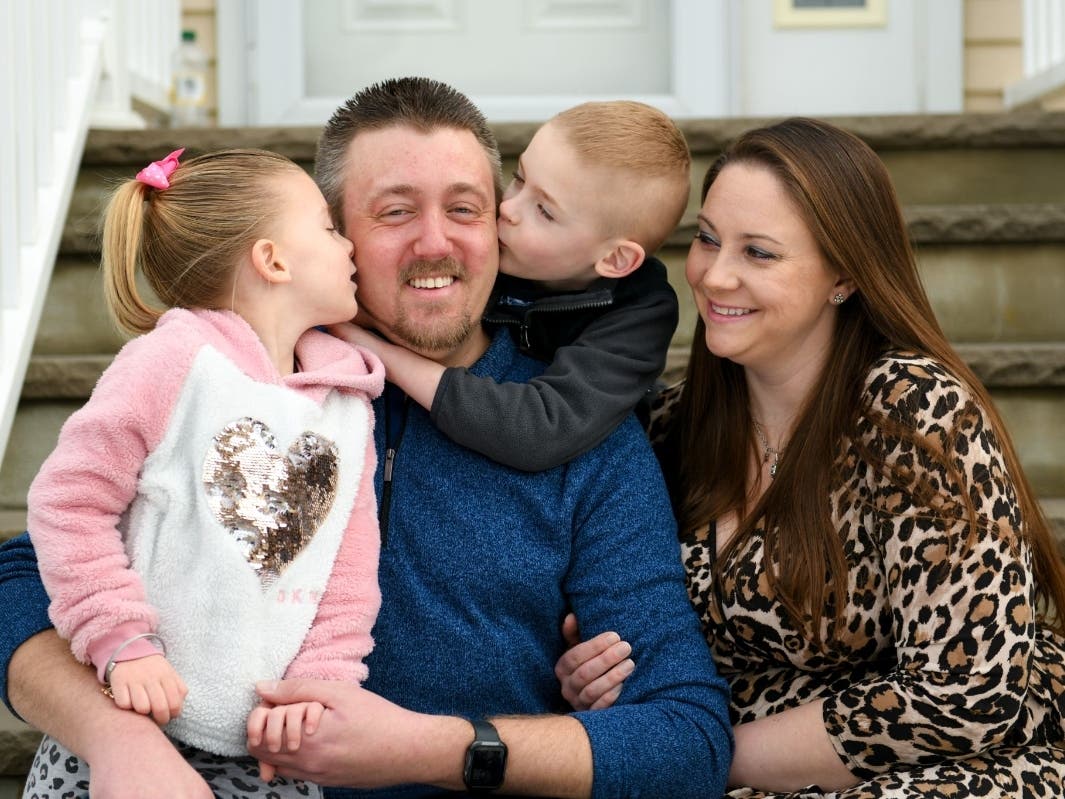
Today, nearly eight years after his injury, Buhler is back to work as a senior project manager at a large geotechnical and environmental consulting firm and married to Andra, the woman who was his girlfriend when the accident happened. The couple are parents to four-year-old twins, Zachary and Zaylee.
“I remember when I saw Dan after the accident,” Andra Buhler recalls. “He had scrapes all over his face, a breathing tube. He could squeeze my hand but was otherwise not very responsive.”
He could not see properly. Andra Buhler did not know what the future held for her boyfriend of just four months.
“We’re so thankful for Dan’s recovery,” she says. The couple married in November of 2015.
Buhler is one of more than 5.3 million children and adults in the United States living with a serious brain injury, according to the Brain Injury Association of America. He continues to keep in touch with and receive care from Brian D. Greenwald, M.D., Medical Director of the Center for Brain Injuries in Edison.
“Dan was severely injured when he came to us. And it was wonderful to see him keep getting better and move through our continuum of care,” Dr. Greenwald said. “Now he is back to work, married and a father. He’s enjoying wonderful things in his life. That’s what we want for all of our patients.”
Buhler still has occasional symptoms and takes medication regularly, which sometimes needs adjusting. He uses the techniques he learned in rehabilitation to keep him focused, such as making lists and using calendars. He works harder than he did prior to the accident to keep organized. Sometimes he struggles to get his message across, so he might send an email prior to a meeting or important phone call to help clarify his talking points ahead of time.
Because of his accident, he also suffers from a nervous system disorder known as Pseudobulbar affect, or PBA, which is a condition characterized by episodes of sudden uncontrollable and inappropriate laughing or crying.
“The kids might do something wrong, and they will look at me for a reaction. I might give in laughing instead of disciplining, and I’ll wind up having to leave the room and let my wife step in,” he says.
Buhler has found support from others living with brain injury. He was there last year when a group of brain injury survivors met at JFK Johnson with Tracy Morgan, the actor and comedian who was injured in a car accident on the New Jersey Turnpike, also in 2014. Morgan also received his care at JFK Johnson and continues to support the Center for Brain Injuries.
“Meeting Tracy was a cool experience,” Buhler says. “So was talking with the other people with brain injuries who came to meet him. … Brain injury rehabilitation does not end when you leave the hospital, so it’s nice to know you always have the support system here when you need it.”
This article was contributed to Patch by Hackensack Meridian Health.
Get more local news delivered straight to your inbox. Sign up for free Patch newsletters and alerts.