Schools
Middletown North Graduate Works In Weather Balloon Research
A graduate of Middletown High School North spent this past summer working on a heat island research project for the city of Trenton.


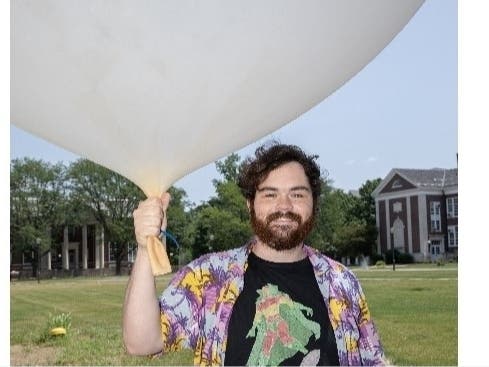
EWING TOWNSHIP, NJ — A graduate of Middletown High School North spent this past summer working on a heat island research project for the city of Trenton.
The student is Sam Ehret, who is currently getting his degree in physics at The College of New Jersey.
“It was especially satisfying for me because I was able to see my work out in the real world and I had the opportunity to learn about the community surrounding (the college),” said Ehret ’25. "I don’t think I would have had that chance if it wasn’t for this project.”
Find out what's happening in Middletownfor free with the latest updates from Patch.
Nate Magee, a physics professor at the College of New Jersey, and his group of student researchers used a weather balloon this past summer to collect important data in the skies above Trenton on the impact of the intense heat.
Professor Magee's project is called “Collaborative Trenton-Mercer Heat Island and Air Quality Project" and students have been studying the urban heat island in Trenton to collect information about temperature and air quality, and how they impact residents' health.
Find out what's happening in Middletownfor free with the latest updates from Patch.
“One of the things we’ve recognized is that the temperature in urban environments is significantly warmer (than in surrounding areas), especially on hot summer days,” said Magee. “It can easily be 10 degrees hotter than the surrounding areas, and the air quality is usually worse, as well."
Using a high-resolution, thermal, infrared camera attached to a weather balloon, Magee and his team send up temperature measuring and positioning instruments in an insulated package tethered to the bottom of the balloon. The equipment then provides a “map” of the temperature to establish details about the scale of the neighborhood and how the heat is affecting the area.
Magee and his team are also installing air sensors in the ground at some Trenton-area schools to help provide accurate, real-time information about the temperature and air quality in the city.
That is because the real-time temperature in Trenton can be difficult to capture when the main National Weather Service data for Trenton is gathered from Trenton-Mercer airport, which is in the middle of a grass field.
“The heat island effect is a local phenomenon,” Magee said. “Neighborhoods that have a lot of trees and grass and parks can be several degrees cooler than those with more concrete, asphalt and roofs on buildings. We are hopeful that urban planners will consider and emphasize these factors where there is an opportunity, plant more trees.”
The data collected by the balloon will be used as part of a larger project that includes a public dashboard to provide residents with information, data, and guidance as to how to stay safe and healthy during the increasing summer heat.
“My hope is that this project will inform, educate and raise awareness of the dangers of extreme heat,” said Magee.
The heat island project is a part of a larger interdisciplinary collaboration addressing environment-focused justice, health and education issues in Trenton. Faculty and students from the TCNJ School of Education, journalism program and public health program have collaborated on these interconnected issues for the last two years. Community partners include the New Jersey Department of Environmental Protection, The Trenton Health Team and the Trenton Public School District.
Get more local news delivered straight to your inbox. Sign up for free Patch newsletters and alerts.