Community Corner
Spring Sighting: Osprey Are Among Us
This beautiful bird of prey, back in our area for another nesting season, is an ecological success story.




Graelyn Brashear wrote the following column:
Spring is a season of returning species, and for many birdwatchers, the homecoming of the osprey is a particularly happy occasion.
What it is:
Find out what's happening in Middletownfor free with the latest updates from Patch.
The osprey, Pandion haliaetus, is large raptor, or bird of prey, that relies almost completely on fish for food. It’s a big bird — its wingspan can reach almost six feet — that I think manages to look stately and scrappy at the same time.
Its back and wings are brownish black, its belly and breast are white, and its white head sports a black eye stripe like a bandit mask.
Find out what's happening in Middletownfor free with the latest updates from Patch.
A helpful identification point is the way the bird holds its wings when soaring. Unlike those of other raptors, the osprey’s wing tips point backward slightly, almost as if its wings have a joint in the middle of the leading edge (this is most noticeable in the third of our photos here).
Osprey are fish hunting machines. They have keen eyesight that allow them to spot their prey below the surface of the water from more than 100 feet up in the air. They’ll then perform a fluttering hover, tuck into a deadly dive and snag a slippery fish with big, uniquely adapted talons.
Where to find it:
Osprey are one of the world’s most widespread bird species. There are subspecies on every continent besides Antarctica. It’s a highly adaptable bird, settling down to feed and nest near fresh and brackish bodies of water.
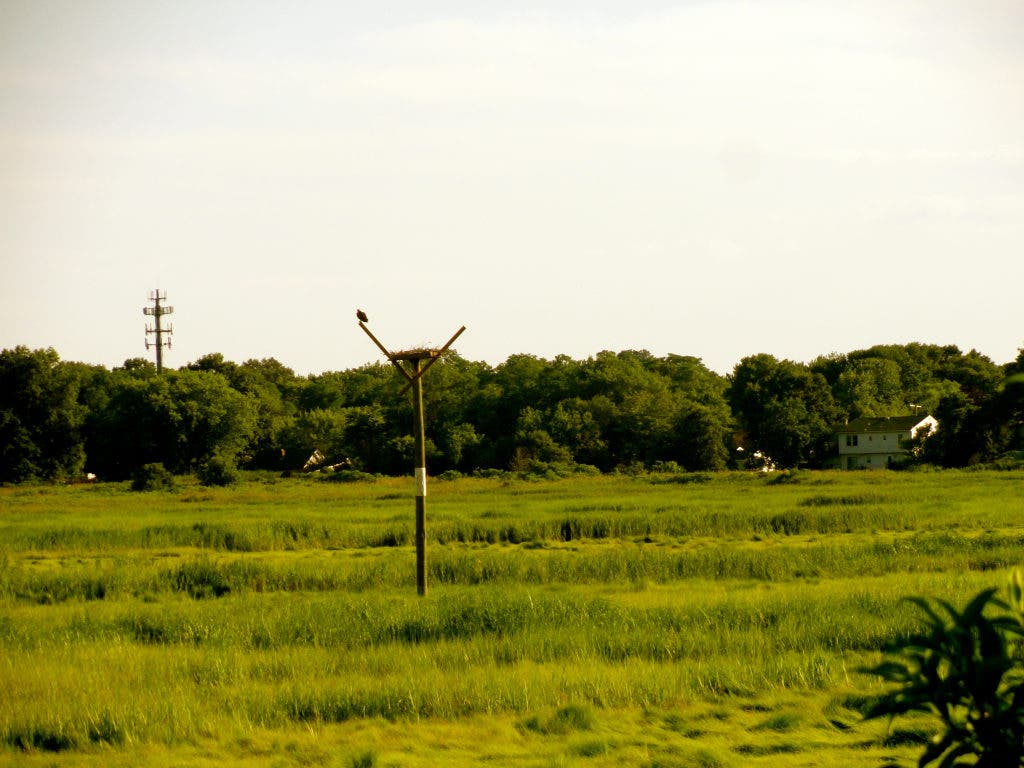
A cruise along New Jersey’s tidal waters in late spring and summer will offer plenty of osprey sightings. They frequently build nests on platforms built just for them in wetland areas. Those platforms are dot Sandy Hook and the marshes of the Belford and Port Monmouth sections of Middletown.
Why bother:
Here’s the thing about the osprey: We almost lost it.
Like other birds of prey, its position at the top of the food chain made it highly susceptible to dangerous accumulations of toxins, including the pesticide DDT, which was widely used in the U.S. following World War II.
The mosquito-killing substance wreaked havoc on the body chemistry of our big predator birds, resulting in thin eggshells that broke when adults tried to incubate them. The crashing decline of the osprey was so dramatic that many ecologists speculated extinction would soon follow. By the mid-1970s, only about 50 nesting pairs remained in New Jersey.
But while human actions led to the near loss of the species, they also contributed to its triumphant survival. In part due to biologist Rachel Carson’s seminal work on the deadly ecological effects of the pesticide, Silent Spring, DDT use was banned in the U.S. in 1972.
Since then, major efforts to encourage nesting by building platforms in wetlands and along waterways have paid off. Osprey are once again a common sight in our state.
Get more local news delivered straight to your inbox. Sign up for free Patch newsletters and alerts.