Politics & Government
Rep. Chris Smith Speaks About The Dangers Of Human Trafficking
Speaking last week in Atlantic City, Smith talks about his International Megan's Law, Jeffrey Epstein and 'Smallville' actress Allison Mack.


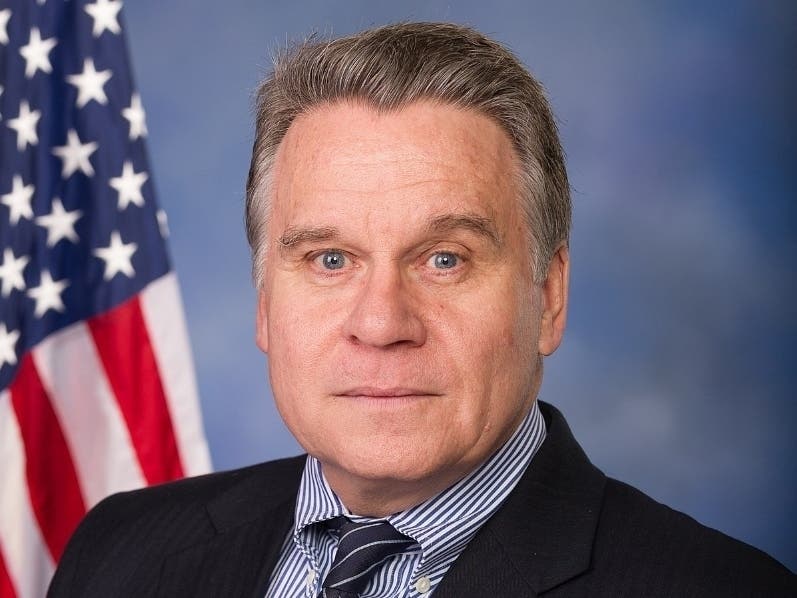
Speaking at at the Borgata hotel in Atlantic City during the week before Thanksgiving, Rep. Chris Smith, R-NJ 4, delivered the following speech to hundreds of prosecutors at the County Prosecutors Association of New Jersey.
In the speech, Smith warned about the dangers of human trafficking, a public safety risk he says he has been warning people about for decades. But it is only recently that lawmakers and the general public has started to realize how serious it is, he says.
Smith is the long-serving Republican congressman for the fourth congressional district, which covers nearly all of Monmouth County, including towns such as Holmdel, part of Middletown, Colts Neck, Rumson, Manalapan, Freehold, Red Bank and Wall Township. The fourth district also reaches into Jackson and Lakewood in Ocean County and Hamilton and Robbinsville in Mercer County. After the 2018 midterms last fall, Smith emerged as New Jersey's only Republican congressman to keep his seat.
Find out what's happening in Middletownfor free with the latest updates from Patch.
About ten years ago, Smith attracted nationwide fame after he helped Holmdel resident David Goldman get his abducted son back from Brazil.
Here are excerpts of Smith's Nov. 24 speech below:
Find out what's happening in Middletownfor free with the latest updates from Patch.
"When I first introduced the Trafficking Victims’ Protection Act (TVPA), more than twenty years ago, the legislation was met with a wall of skepticism and opposition — dismissed by many as a solution in search of a problem. Several members of Congress turned me down when I asked them to cosponsor the bill. For most people at that time — including lawmakers — the term trafficking applied almost exclusively to drugs and weapons, not human beings.
Reports of vulnerable persons — especially women and children — being reduced to commodities for sale were often met with surprise, incredulity or indifference.
My legislation — the Trafficking Victims Protection Act signed into law in the year 2000, created a new whole-of-government domestic and international strategy and established numerous new programs to protect victims, prosecute traffickers and to the extent possible prevent it in the first place — the three Ps.
(Over the years, I’ve authored four additional laws to combat human trafficking—including in 2003, 2005, 2016, and 2019.)
Of particular interest to you as prosecutors, the Trafficking Victims Protection Act included a number of “sea change” criminal code reforms including treating as a victim — and not a perpetrator of a crime — anyone exploited by a commercial sex act who had not attained the age of 18 and anyone older where there was an element of force, fraud or coercion.
The TVPA radically reformed the US criminal code to authorize asset confiscation and jail sentences of up to life imprisonment.
Thousands of human traffickers have been prosecuted and jailed pursuant to the Trafficking Victims Protection Act, including all charges brought against Jeffrey Epstein and the infamous convictions involving the "Smallville" actress Allison Mack and another recent case in Monmouth County.
That said, believing that federal law needed parallel state and local statues to effectuate an effective prosecution strategy, my law included new Dept. of Justice programs to assist states in crafting laws and authorized the creation of new anti-human trafficking task forces — today there are 57 task forces throughout the country.
Obviously, you know about — and work to implement — Megan’s Law, which protects children domestically. In 2008, I first introduced International Megan’s Law. It passed the House in 2010, 2014, 2016 — and, thankfully, finally cleared the United States Senate and was signed into law in 2016 — eights years later!
As you may recall, Megan Kanka was from my hometown of Hamilton was just 7 years old when she was kidnapped, raped and brutally murdered in 1994. Her assailant lived across the street. Unbeknownst to her family and other residents in the neighborhood, he was a convicted repeat child sex offender.
Megan’s heartbroken-to-this day-parents — Maureen and Richard Kanka — have been amazingly effective, courageous and heroic in successfully pushing every state in the union including New Jersey to enact Megan’s Law.
Why International Megan’s Law? We know from law enforcement, academia and media documentation that Americans on the U.S. sex offender registries are frequently caught sexually abusing children in Asia, Central and South America, Europe, and, frankly, everywhere. The inherent secrecy of international travel enables child exploitation.
A deeply disturbing 2010 report by the Government Accountability Office (GAO) found that at least 4,500 U.S. passports were issued to registered sex offenders in fiscal year 2008 alone. Typically, a passport is valid for 10 years, meaning some or many of the tens of thousands of registered sex offenders possessing passports may be on the prowl internationally looking to exploit and abuse.
Now, under International Megan’s Law, convicted child sex offenders who travel abroad must provide notice to the U.S. Government — via the Angel Watch Center — prior to departure of all planned destinations. Failure to do so carries a significant jail term commensurate with a convicted child sex abuser not reporting to local law enforcement. Upon receipt of the travel itinerary, the U.S. government informs the destination country or countries of those plans.
The destination country or countries are then empowered with actionable information to render the traveler inadmissible.
The law is working as intended. In just over two years, the U.S. government has notified foreign governments of the planned travel of 10,541 covered sex offenders to their countries. As of July —3,681 individuals who were convicted of sex crimes against children were denied entry by these nations.
Finally, last January, President Trump signed my fifth anti-human trafficking bill into law — The Frederick Douglass Trafficking Victims Prevention and Protection Act.
That law provides:
• Over $430 million for numerous programs and initiatives;
• Shelter, interventions, and reintegration for trafficking victims;
• Facilitation of trafficking-free supply chains in U.S. commerce;
• Training of U.S. government procurement officials on how to mitigate buying goods and services associated with sex or labor trafficking
• Preference in federal government travel bookings for those airlines that have a viable situational awareness protocol in place to detect and report suspected trafficking occurrences.
Of particular importance, the new Frederick Douglass Act also authorizes the Secretary of Health and Human Services to award grants to local educational agencies, in partnership with a nonprofit, nongovernmental agency, to establish, expand, and support programs:
• To educate school staff to recognize and respond to signs of sex and labor trafficking;
• To provide age-appropriate information to students on how to avoid becoming victims of sex and labor trafficking.
Trafficking victims are hiding in plain sight. Victims are our neighbors. As prosecutors, you’ve accomplished great things. More, however, must be done to protect the weakest and most vulnerable from this cruelty.
Get more local news delivered straight to your inbox. Sign up for free Patch newsletters and alerts.