
I went to the Newark School of Fine and Industrial Arts on the G.I. bill in the mid-1970’s. What it may have lacked in physical décor, it more than made up for in the expertise of the instructors and the enthusiasm of the students; our imaginations festooned the walls. Run by the Newark public school system, it closed its doors in 1997, due to a budget crisis.
We were taught by a wonderful staff of professional artists and designers, most of whom not only taught but were also active in their fields of endeavor.
The oldest teacher, and most memorable, was a woman named Mildred K. No one knew exactly how old she was - in her late seventies at least. “I can remember those World War One veterans and their hip flasks!” she would intone in her vibrant but old woman voice, lecturing us on former students. In a life drawing class, I once asked for her opinion of a pencil sketch I had done of the model. I was in an odd mood that morning, and the picture was done in a very stylized way.
Find out what's happening in Middletownfor free with the latest updates from Patch.
“OH! Cheap! Cheap! Comic book art!” she whined. Despite her prejudice against any popular culture past 1930, I did learn quite a few techniques from her that served me well in my career; but she was still quite a character. Every Monday morning, after reading to the class the obituaries from Sunday’s Newark Star-Ledger, she’d walk off to the other classes to collect for an animal shelter she helped support.
She still lived in her little cottage in Newark, surrounded by public housing on three sides; the last, lone link to a Newark far away in the past. As I said, she was old when I attended school. You can imagine my surprise when, ten years later, I recognized her voice on a radio call-in show. It was definitely Miss K. The host even referred to her by her nickname – “Queenie” – and listened politely to her outrageous opinions.
Find out what's happening in Middletownfor free with the latest updates from Patch.
The students were a mix of very talented people. There was the disco king who could caricature like Mort Drucker. He spent most of the time out in the hall, skipping class; taking his wonderful gift for granted. At the other end of the spectrum was an extremely talented little guy who could replicate a Rembrandt and you wouldn’t be able to tell the difference. But he was a bit arrogant about his ability, and didn't speak to too many people.
On the other hand, there was a quiet guy in the class the year behind mine, who could draw in pen, brush and ink photo-realistically. His name was Bill S., and he was as modest as he was talented. After he graduated, he was quickly picked up by Marvel Comics, where he started drawing Moon Knight, and even did an ALF comic cover - a semi-abstract painting, no less. He’s since gone on to do the storyboards for movies like The Green Mile and The Grinch.
One of the most memorable characters was a student we nicknamed, “Time-bomb”. Time-bomb was a year ahead of my class. He wore his hair long, rarely spoke, wore a leather jacket – even on the hottest days – and seemed to walk in slow motion. He had a perpetual grin on his face, his eyelids were always at half-mast, and he would surreptitiously take a slug from a hip flask he kept in his back pocket.
"Time-bomb’s" claim to fame was that he had been fired from his summer job as a Good Humor ice cream man. One day, halfway through his route, he took a notion to “drive down the shore.” While touring through some Jersey Shore towns, a cop pulled his ice cream truck over for speeding. The cop called his boss to report him, and the boss told Time-bomb he was fired and he should return with his truck to headquarters and hand in his uniform.
“So, I drove my truck into the ocean, ringing the bells the whole time,” he told us. The art world has known few such moments.
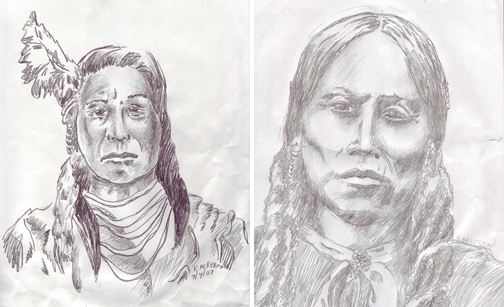
One of the pieces I did in art school that I was really proud of was a gauche portrait of Chief Joseph of the Nez Perce. I've been interested in the history of Native Americans in the Old West since reading Bury My Heart at Wounded Knee, by Dee Brown, many years ago. The painting is long gone, but recently - along with a pencil study of Quanah Parker of the Quahadi Comanches - I did a pencil study of Chief Joseph, using the same photo for reference that I had used so long ago; I may attempt another portrait.
Another piece I liked – also long gone – was a clay piece I did in a sculpture class. It was a facemask of a scowling middle-aged man with a crew cut and a Charlie Chaplain moustache. Out of the corner of his mouth was a short cigar butt.
After it had been baked in the kiln, I painted it with acrylics and decided to give it to the artist who had designed the character. The next time our photography teacher sent us into Manhattan - via the PATH – to take pictures, I brought with me the facemask, wrapped in twine and brown paper. I walked uptown to a building near the New York Times building, took the elevator to the proper floor, and knocked on Steve Ditko’s studio door.
The co-creator of Spider-man was gracious and was happy to learn that I was an art student and that he had been one of my main inspirations. I handed him the package. He cut the twine with an x-acto knife and unwrapped the paper. He said, “Tsk!” and shook his head, but he was smiling as if he was face to face with an old friend he hadn’t seen in a while.
He chuckled as he handed the face of J. Jonah Jameson (the newspaper publisher character in “Spider-man”) back to me and said something like, “Pretty good.”
“It’s yours,” I told him. But, he wouldn’t take it.
“I don’t draw that strip anymore; I have no use for it,” he told me firmly but politely.
I kept it and used it as a paperweight on my desk for many years until one day gravity got the better of it. It was always a happy reminder of the day I had first met one of my heroes.