Arts & Entertainment
B'nai Israel Historical Art on Display in New York
"Modern Art, Sacred Space: Motherwell, Ferber and Gottleib" is featured at the Jewish Museum.


A little bit of Millburn's Jewish tradition is hanging in a New York museum.
Art work from Congregation B'nai Israel is on display at The Jewish Museum through August 1. The pieces on display include Herbert Ferber's sculpture of a burning bush, a piece of public art which hung outside on the face of the synagogue for over a half-century, and Adolph Gottlieb's original Torah Ark Curtain, which is part of the museum's permanent collection. Also on display is "The Wall of the Temple" by Robert Motherwell, which was commissioned for B'nai Israel by architect Percival Goodman.
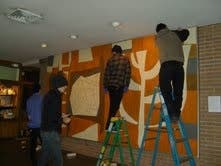
"One year ago, I watched as the Motherwell mural was de-installed from our Millburn Avenue lobby where it had resided for almost 60 years," said Jane Young, synagogue executive director. "As I watched that process, I imagined what a wonderful occasion it would be for our community when it was refurbished and ready to be exhibited in The Jewish Museum. Now that the time has arrived, the pride that the CBI congregants and I feel is so much greater than could ever have imagined."
Find out what's happening in Millburn-Short Hillsfor free with the latest updates from Patch.
Young said the Dedalus Foundation provided the funds to refurbish the Motherwell mural and the congregation is thankful to the museum for providing the opportunity to hang the artwork there.
In the early 1950s when the B'nai Israel board commissioned architect Percival Goodman to design a new building it was participating in a seminal movement in synagogue design. Today it's fairly common to see a "modern" Jewish house of worship, but back then it was a leap of faith.
Find out what's happening in Millburn-Short Hillsfor free with the latest updates from Patch.
The Jewish Museum states, "Goodman envisioned his designs as entirely modern, not based on historical building styles as previous European and American synagogues had been. He believed synagogue design should serve the functions of the congregation—worship, study and social gatherings—through simple and direct means using organic material and natural light whenever possible... As one of Percival Goodman's first synagogues, Congregation B'nai Israel set a precedent for integrating modern art and architecture in houses of Jewish worship."
The painting and sculpture had not been touched since their original installation. Lisa Roth, synagogue office executive assistant, said it took two days last summer to get the art work detached from the walls and crated for moving.
"The art movers were here all day long, making sure that everything came down properly and that the painting and sculpture weren't harmed in any way," she said. "The painting was swathed in a canvas-type material that looked like a big envelope."
Roth is not expecting to welcome the art home any time soon because of the synagogue's construction project. The artwork will stay at the museum until construction is complete, which could take another year.
"We at Congregation B'nai Israel are all very excited by this wonderful event," said congregation President David Touger. "It is great for the synagogue and the community as a whole. Everyone will be able to go to a museum and see artwork that they own being displayed. It is a once in a lifetime occurrence. I can't wait to see all of the artwork in the museum and then back at CBI in our newly refurbished building."
The synagogue's then rabbi, Dr. Max Gruenewald, made the suggestion Ferber's sculpture represent the burning bush. Gruenewald, a German immigrant who had witnessed the destruction of two of his temples at the hands of the Nazis, thought it was an apt metaphor for the Jewish people. According to the Jewish Museum he explained, "The burning bush was burned but never consumed, which reflects the fate of our people."
The sculpture was Ferber's first major commission. Gottleib's Torah Ark Curtain shows abstract Jewish symbols such as the Tablets of the Ten Commandments and the Twelve Tribes of Israel. Motherwell was the only artist of the three who was not Jewish. He immersed himself in Jewish life and culture with the guidance of Columbia University's Meyer Schapiro, an art historian, and produced mural that abstracts such Jewish iconography, as the Tablets, a menorah and Jacob's Ladder.