Schools
Former Millburn Middle School Principal Tells All In New Memoir
He was a kid from Hoboken who became principal in one of the wealthiest districts in NJ. Now he's telling tales out of school.


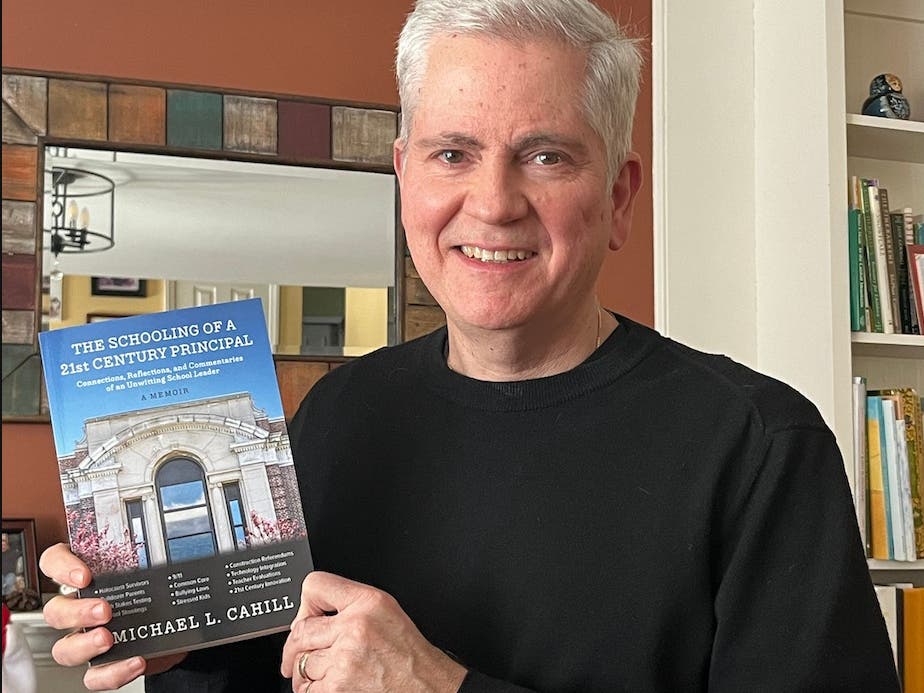
MILLBURN, NJ — What's it like to grow up in a poor city and then end up running a school in a prestigious New Jersey district with some very demanding parents?
Former Millburn Middle School Principal Michael Cahill found out in the 1990s and early 2000s as he rose through the ranks of the Millburn School District after growing up in grittier Hoboken, 40 minutes away.
Cahill — who retired from the Millburn schools in 2017 and lives with his family in Florham Park — has just self-published his memoir, "The Schooling of a 21st Century Principal," in which he candidly conveys the ups and downs of being a school administrator in modern times, particularly in one of the wealthiest ZIP codes in the country.
Find out what's happening in Millburn-Short Hillsfor free with the latest updates from Patch.
"This was not a community that took 'no' for an answer," Cahill wrote in one chapter. "Parents' efforts to push their kids into accelerated classes bordered on desperation ... I was once ordered to appear in front of an administrative law judge about our placement process. I have had parents yell, cry, insult and threaten."
But Cahill also wrote of the Millburn district — ranked as one of the top 500 in the country — "From an educator's point of view, teaching in a place like Millburn was, mostly, living the dream."
Find out what's happening in Millburn-Short Hillsfor free with the latest updates from Patch.
Cahill talked recently about his career and how he came to write the book.
Telling Tales Out Of School
Cahill, whose grandparents emigrated from Italy, grew up in Hoboken in his family's house on Fifth Street (the house is still in the family). He graduated from Sts. Peter & Paul School and then from Hoboken High School in 1978.
Cahill enrolled at the Stevens Institute of Technology in that city on a full scholarship, but wasn't sure it was the right place.
Chapter 4 of his book starts, "It was hard to turn down ... a free ride to a prominent private engineering school, two short blocks away from my home. I wanted to please my parents. I wanted to have an open mind."
He knew he wanted to be a teacher, not an engineer. Soon, Cahill transferred to Seton Hall, from which he graduated in 1982.
Cahill started a teaching job in Summit and worked on his master's in education. Of teaching at Summit's junior high school, he said, "I absolutely loved it."
After three years, he got laid off with little warning. Teaching spots were scarce, so he took a position at an insurance firm in New York City.
When Cahill spotted an opening in Millburn, the hiring official told him that she would be taking students on a class trip to the Big Apple in a few days, and could talk to him there.
"If I like you," she told Cahill, "you're coming back to New Jersey on the bus with us."
Thus, a career was born.
Baptism By Fire
Millburn's student population was growing when Cahill started there in the 1990s. It's always been a competitive district and includes the prestigious Short Hills section of town. (Cahill says in the book that the town sometimes seemed "divided" between Short Hills and the rest of Millburn. He writes that one day, he was talking to a mom outside the middle school when another mom interrupted to ask why she'd moved out of the Short Hills section: "I heard you moved to Millburn. Are you okay? Are you having money problems?")
At the middle school, Cahill taught language arts. Then he rose to become vice principal.
Cahill began his job as the principal of Millburn Middle School in September 2001 — three days before the terrorist attacks on the World Trade Center.
That day merits a chapter in the book, perhaps the most poignant of all chapters.
Rather than announce the attack over the PA system, Cahill sent hand-delivered messages to each teacher, a process they called the "Pony Express."
When Cahill finally told students in the cafeteria what had happened, he says, some asked the sorts of questions that would come only from those geographically close to the situation, such as which tower was hit.
One student remained at school until 6:30, when his father finally came to get him, covered in ash and dust, Cahill writes. (Cahill himself lost a cousin he was close with.)
It's unusual for a principal to reveal intimate details about his work, but in Cahill's 284-page tome, he travels through the mundane (long-awaited renovations to his school building) to thornier topics such as school shootings — "the nightmare that is real" — and teacher salaries.
Peer Pressure...From Parents
Largely, Cahill comes off as a strict principal who took his job seriously and played by the rules.
"Principals must be courageous enough to stand by their convictions about what is best for the students and the school, even if they are not popular," he writes.
Cahill tried to stay true to this mission even as he dealt with pressure related to academics, bullying, and which fashions to allow in school.
There was a thorny situation in which students started wearing T-shirts each Monday, en masse, displaying the name of the student whose bar or bat mitzvah they'd attended on Saturday, which made uninvited students feel left out. The matter caused so much discussion that Cahill addressed the issue each fall in the PTO newsletter.
"Something to think about," he wrote, "It's Monday morning and you are 13 years old and you walk into school, homeroom, the lunchroom, or the auditorium and everywhere you see a group of your peers wearing the same color sweatshirt or pants marking the occasion of a student's bar or bat mitzvah ... It fosters a culture of exclusivity and a competition for the greatest number of friends ... Wear the shirts and the pants, but not as a group on the same day."
(Cahill apparently learned a lot about the mores of a town with a large Jewish population, because he lists his favorite Yiddish phrases in the book.)
Cahill also talks about parents' attempts to push kids into the "accelerated" or gifted classes.
While he considered individual cases, he stuck to the criteria.
"It was something parents never let go of," he told Patch. "At a fundraising dinner years later, a parent came up to me and said, 'By the way, you didn't let my kid into the accelerated program, and he's going to Harvard.' Which was my point, too."
Other tough issues included changing morality, also as it related to fashion.
"I tried to reinforce the now apparently Victorian concept of 'under-wear,' Cahill writes in the book, "to mean that bra straps, boxer shorts, and thongs (yes, even in middle school) were supposed to be hidden from view .... Moms have told me that stores just don't sell clothes like that anymore."
Writing The Book
Cahill said that he at first expected to write about the challenges of being an educator in modern times, but the book evolved into something else.
"Writing was always something I wanted to do," he said, "but had little time for. I wanted readers to know how much education had changed ... these were huge changes that impacted teaching, assessment, culture, and the recruitment of future teachers."
As he wrote about his experiences over more than 16 years in Millburn, "I started to see the connections, contrasts, and comedies."
Cahill — who is now working on a second memoir about his Hoboken boyhood — said he hopes his talk of successful school programs will inspire other teachers and administrators.
And he looks back on his time in Millburn with fondness.
"Former students, or their parents," he says, "have thanked me years later for 'caring and not giving up.' "
You can find Cahill's book on Amazon here.
What do you think? Leave a comment below or email Millburn Patch.
Get more local news delivered straight to your inbox. Sign up for free Patch newsletters and alerts.