Community Corner
Millburn Student Says Grandma’s Fall Inspired His Alzheimer’s Outreach
Read a Millburn HS senior's essay about how memory-related conditions such as Alzheimer's can affect the people you love.


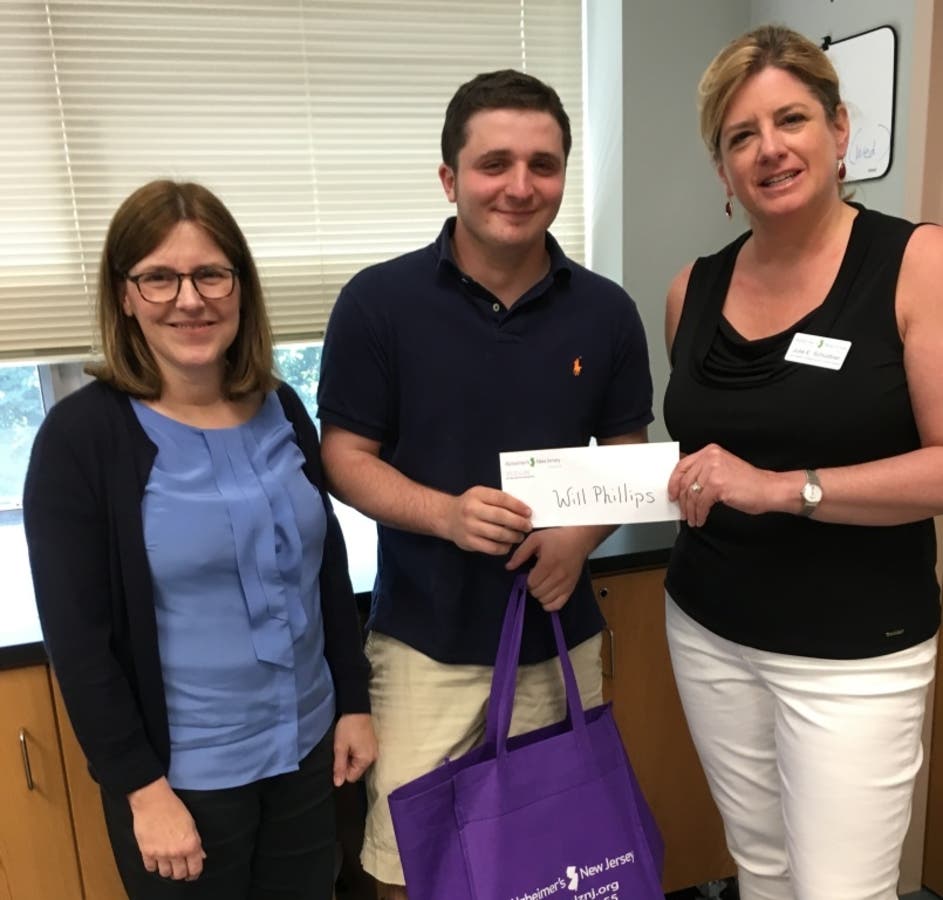
MILLBURN, NJ — Millburn High School senior Will Phillips can tell you about how memory-related conditions such as Alzheimer’s can affect the people you love. But he can also tell you how he’s helping other families in New Jersey to combat the ravages of the same afflictions.
It all started with a fall, he says.
Phillips recently placed second in Alzheimer’s New Jersey’s statewide essay contest, penning a touching tale about his grandmother’s memory, speech, and concentration issues as a result of a subdural hematoma and how this inspired his passion to find a cure for Alzheimer’s.
Find out what's happening in Millburn-Short Hillsfor free with the latest updates from Patch.
According to Alzheimer’s New Jersey:
“[Phillips] was accepted into a unique three-year science research program at Millburn High School, where he conducted this work. After completing his initial research, he reached out to a Harvard University professor for a mentorship. As a result, he helped design and pre-test an intervention for mild cognitive impairment. In addition to his research, Phillips wanted to impact the quality of life for those with Alzheimer’s and co-founded a musical group called ‘Sounds for Seniors’ through Millburn High School that entertains and interacts with residents in care facilities.”
The contest was open to New Jersey public middle and high school students (grades six through 12). Entries were judged by a panel comprised of Alzheimer’s New Jersey representatives.
Find out what's happening in Millburn-Short Hillsfor free with the latest updates from Patch.
Phillips’ essay follows below:
“When I was eight years old, my grandmother took a serious fall, sustaining a subdural hematoma; only the swift actions of highly skilled hospital staff saved her life. She suffered cognitive deficits in memory, speech, and concentration, and my desire to help triggered interests in cognitive psychology and neurology. These interests became passions when I was accepted into a unique three-year science research program at my high school. After an initial period of exploration, I specified a research topic, reached out to university faculty in search of a mentor, and began the research process. Harvard University Professor Ellen Langer became my mentor and her psychology lab became my incubator. I helped design and pre-test an intervention for patients with mild cognitive impairment, allowing me to transform my ideas into purposeful practice.
“This intervention was a three-week program designed to help improve cognition, fluid intelligence, and quality of life in people with mild cognitive impairment (MCI), an early-onset form of Alzheimer’s Disease (AD). It utilized specific exercises that patients would complete at home or for in-la psycho-educational sessions. They were designed to attenuate the cognitive and quality of life decline associated with MCI that is often associated with the individual’s attribution of a clear, specific, and unremitting progression of disease. Relative to what is remembered, forgetting is actually less frequent than what many patients perceive; a change in their mindset along these lines may be critical in delaying progression of cognitive decline in addition to providing the patient/caregiver with increased well-being.
“Although my grandmother inspired me to delve into such an immense topic, I was still fairly naive to the actual scope of the problem and the importance that my research could have in legitimately helping to improve lives. This is why in addition to my research, two years ago, I co-founded a musical group called Sounds for Seniors, a club in my high school that plays music for elderly citizens in care centers such as Care One in Livingston, New Jersey. Many of them have some type of mental ailment that involves deficits in memory and a variety of other neurological processes. Performing music for them revealed to me two things: the first was the extent to which their disease affects them, and how necessary it is for us to help in anyway we can. Playing music puts a smile on their faces and brightens up their day. It gives them time to talk to us about the past, ask the musicians questions, and create a dialogue that has emotionally attached me to the research I am continuing to work on. Not only has the music helped improve the quality of their life, albeit once a week on Sunday mornings, but it has encouraged me to continue doing this research in college. Our senior population is rising exponentially, which means that diagnoses are becoming more frequent. The fight against Alzheimer’s must only get stronger, and I fully intend on being in the front lines.”
Don’t forget to visit the Patch Millburn-Short Hills Facebook page here.
Send local news tips, photos and press releases to eric.kiefer@patch.com
Photo: Alzheimer’s New Jersey
Get more local news delivered straight to your inbox. Sign up for free Patch newsletters and alerts.