Politics & Government
Should New Sports Stadiums Get Federal Tax Breaks? N.J. Senator Says No
Wealthy team owners don't need federal tax breaks to build new stadiums, U.S. Senator Cory Booker says.


Whether you’re a sports fan or not, if you’re an American taxpayer, there’s a good chance that you’ve helped to finance a professional sports stadium in your area. But it’s not fair to make taxpayers foot the bill for these massive projects when the teams’ owners end up reaping most of the financial benefits, a pair of U.S. senators say.
On Tuesday, Cory Booker, a Democrat from New Jersey, and James Lankford, a Republican from Oklahoma, announced that they introduced bipartisan legislation in the U.S. Senate that would end what they called a “generous federal subsidy” for professional sports stadiums.
The bill, S-1342, would close a section of the tax code that allows professional sports teams to finance new stadiums with municipal bonds that are exempt from federal taxes, according to a joint statement from Booker and Lankford.
Find out what's happening in Montclairfor free with the latest updates from Patch.
According to the senators:
“Municipal bonds are intended to give communities a way to finance projects, such as hospitals, schools and roads, without needing to pay federal taxes on the debt’s interest. Using municipal bonds to finance sports stadiums diverts money away from these critical local infrastructure projects.”
Booker and Lankford added:
Find out what's happening in Montclairfor free with the latest updates from Patch.
“The bill would end federal subsidies for stadium financing, but would not prevent localities and states from bidding and offering economic incentives to teams. In eliminating this wasteful expenditure, the bill also unties the hands of local governments to finance their stadium subsidies with taxes on tickets and in-stadium purchases, in other words, allowing states to target taxes on the people who actually use and benefit from the subsidy. Current tax law does not allow local governments to finance federal stadium subsidies by levying taxes on stadium purchases.”
A spokesperson for Booker told Patch that “the bill is forward-looking, so it wouldn’t impact existing stadiums.”
As written, the bill would impact “any facility (and appurtenant real property) which, during at least five days during any calendar year, is used as a stadium or arena for professional sports exhibitions, games or training.”
A similar bill was introduced by Congressman Steve Russell, a Republican from Oklahoma, into the U.S. House of Representatives in March 2016.
‘DE-FENSE’: IN SUPPORT OF STADIUM TAX BREAKS
When the city council of Glendale, Arizona, agreed to provide millions of dollars in public subsidies to help build and maintain a new stadium for the Arizona Coyotes, Glendale First, an organization in favor of the deal, said that the team and their arena provide support to the local economy that otherwise wouldn't be there.
A spokesperson for the group claimed that sales tax revenue made up 41 percent of Glendale's budget, and a “significant portion” was derived from sales around the arena.
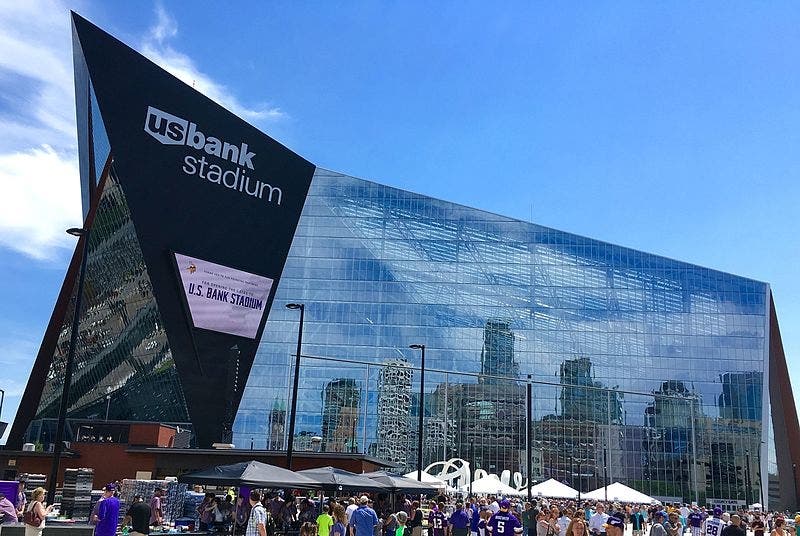
Other supporters of tax breaks for sports stadium construction have included Minnesota state officials, some of whom claim that a $1 billion stadium for the Minnesota Vikings – which was financed with tax-exempt bonds - has spurred roughly $800 million in additional investment in the area.
“I defy anyone to come here and tell us that this stadium has not generated significant economic development, and I guarantee you there is more to come,” Minnesota Sports Facilities Authority Chairwoman Michele Kelm-Helgen told the Wall Street Journal.
WHAT TEAMS ARE GETTING TAX BREAKS?
A 2016 report from the nonprofit Brookings Institution stated that since 2000, a total of 36 professional sports stadiums have been constructed or revamped under financing provided by federal tax-exempt municipal bonds, costing taxpayers over $3.2 billion dollars.
However, the study also found that despite billions of dollars of federal funding flowing toward these projects, the new stadiums have limited to no impact on local economic development.
According to the Brookings Institution, some of the professional sports teams that have received huge federal tax incentives to build new stadiums since 2000 include the following organizations:
MAJOR LEAGUE BASEBALL
- New York Yankees - $492 million
- New York Mets - $214 million
- Cincinnati Reds - $142 million
- Miami Marlins - $132 million
- Milwaukee Brewers - $117 million
- Washington Nationals - $107 million
NATIONAL FOOTBALL LEAGUE
- Indianapolis Colts $214
- Chicago Bears $205
- Cincinnati Bengals $182
- Houston Texans $147
- Seattle Seahawks $101
NATIONAL BASKETBALL ASSOCIATION
- Brooklyn Nets - $161
- Houston Rockets - $112
- Orlando Magic $93
- Memphis Grizzlies $87
NATIONAL HOCKEY LEAGUE
- New York Islanders - $161
- Pittsburgh Penguins - $65
- New Jersey Devils - $60
- Detroit Red Wings - $50
Send feedback to eric.kiefer@patch.com
Main photo of Yankee Stadium: Wikimedia Commons
Get more local news delivered straight to your inbox. Sign up for free Patch newsletters and alerts.