Neighbor News
Living Lessons - Voices, Visions and Values, a day of sharing stories of survival and courage
Robert R. Lazar Middle School hosts 55 survivors - under one roof - who talk of hope despite facing extreme challenges.



Living Lessons - Voices, Visions and Values is one of the largest gatherings of survivors and motivational speakers who are willing to share their stories with students. The tradition of bringing individuals with powerful messages together, under one roof for one day, to teach students about courage, compassion and character, originated at The Robert R. Lazar Middle School in Montville, New Jersey.
On Thursday, May 14, 2015, long before the opening bell rang, volunteers were manning the welcome table in the lobby. Students and staff were arriving quickly and early in anticipation of the arrival of speakers. Fifty-five men and women, of all ages, and from all walks of life, had traveled from around the globe, to speak at Lazar’s Living Lessons program.
Organized by English Teacher, Judy Gothelf and Technology Teacher, Derek Lynn, Living Lessons is a bi-annual program that originated at Lazar in 2005. It is presented to the 970 sixth, seventh and eighth grade students of Montville Township Public Schools every other year. The 2015 event was Lazar’s sixth Living Lessons program.
Find out what's happening in Montvillefor free with the latest updates from Patch.
Among the speakers were a dozen individuals who have triumphed over serious physical challenges, nine 9/11 survivors, six Holocaust survivors, two genocide survivors, five survivors of war, six who have faced prejudice daily, two mass shooting survivors, two recovering drug addicts, and many more who would speak about the death penalty, suicide, bullying, attitude, and being true to oneself.
As the speakers waited for their school day to begin, they mingled in the Lazar library, sharing coffee, breakfast and stories with each other.
Find out what's happening in Montvillefor free with the latest updates from Patch.
At 9:00, ten minutes before half of the speakers were scheduled to begin talking with classes, Gothelf welcomed them and shared a letter she had received from former student, Claire Sullivan.
Sullivan, now in college, had reached out to Gothelf to share her reflections on Living Lessons.
“Words cannot even begin to describe the beauty and wonder of a program such as Living Lessons,” wrote Sullivan. “I don’t believe that there is anything else that can change teenagers, other than this amazing day. It really impacted us in a way that nothing else has. No matter how informative a class in school can be, there is nothing that can teach us as much as Living Lessons.”
“And,” concluded Gothelf, “Our Living Lessons are all of you. Thank you so much for being here.”
In presentation after presentation the speakers shared stories of both physical and emotional challenges. Often the stories were both frightening and uplifting.
“As a parent, you want to hear that your kids are getting good grades,” said Newtown, CT father, Mark Barden. “But more than that you love to hear that they are good citizens.”
Barden recounted his son Daniel’s first grade experiences.
“Daniel noticed if someone was sitting alone, so much so that he would ask if he could stop what he was doing and go sit with that person.”
Today Barden is the Director of Advocacy for Sandy Hook Promise. He travels the country supporting opportunities to prevent gun violence. One of the Barden family’s projects is a foundation called What Would Daniel Do? Through both the foundation, and Sandy Hook Promise, acts of kindness are promoted. Lunch Table programs are being implemented in schools so that no one eats alone and individuals won’t get isolated, and teens are encouraged to tell someone if they see something violent on social media.
He relayed that his niece in Maryland saw an Instagram post of gun violence that she was able to trace to a student in Arkansas. She called the school, reported what she saw, and thwarted a school shooting.
“If you see something, say something,” Barden said. “You guys can do things. Do this to honor Daniel, the beautiful little boy who was going to do beautiful and compassionate things with his life. And now he can’t so it’s up to us.”
While Barden was speaking, in another classroom, Debi Young, a hate crime lawyer was sharing her experiences, Fireman Joe Torillo was telling of 9/11, and Haider Hamza was sharing his impressions of Iraq from his perspective as a journalist reporting on the war.
Each presenter spoke for 40 minutes to a class, and presented two to three times from 9:10 to 2:25.
In the next block of 40 minutes, Eugenie Mukeshimana talked to a group of students about the Rwandan Genocide. She told of her husband and father’s murders, being in hiding for three months where no one in the house where she was staying could know she was there, of giving birth as silently as possible, and of being harbored by a woman who was actually coordinating the genocide in the community and whose sons were carrying out the killing.
“They had a sister and she was really, really, really, really good,” explained Mukeshimana. “That is why it is wrong to assume that everyone is the same. Her brothers were killers, yet her love and care sustained me.”
Mukeshimana talked of what she called “dumb luck,” which saved her life and the life of her newborn daughter.
“My daughter is 21, but I was in hiding and starving when she was born,” she said.
Realizing she could not feed her daughter, nor could she keep a newborn quiet, she went to “The Killing Place.” The executioner took one look at her and said she looked like a ghost.
“’I don’t want to kill you today,’ he said.”
With that he took her home. Threatened to kill her every day, but had her cook for him. She was well fed and was able to feed her daughter.
“In the space of three months, they killed one million people,” she said.
Today Mukeshimana is the Founder and Executive Director of Genocide Survivors Support Group.
While Mukeshimana spoke to a class in one room, twenty-seven other speakers also spoke to classes in other rooms. Mike “Mighty Mike” Simmel of the Harlem Wizards, Author/Illustrator Floyd Cooper and anti-Bullying advocate, Michael Billy were among them.
Between presentations the speakers watched other presentations, or returned to the library for something to drink and to talk with each other.
Dr. Paul Wichansky, whose presentation is called Taking“Dis” Out of Disability, is a motivational speaker who has cerebral palsy. His message is: “The only real handicaps that we have are those that we create for ourselves.”
During a break, Wichansky and Haider Hamza, an Iraqi journalist, were discussing the importance of Lazar’s Living Lessons program.
“People from all over the world speak here,” said Wichansky.
“For me it’s simply about perspective,” Hamza added. “In most U.S. schools your world view is limited to your immediate life journey, but there are so many views in the world. We provide a living example of those views.”
“Yes,” agreed Wichansky. “Being here, standing in front of the students, as a living example, is more powerful.”
“They are young,” concluded Hamza. “But sometime in their life they will face adversity. And they learn from this. It’s like we are giving them a head start on life.”
Following each presentation students had an opportunity to ask questions. Often their questions centered on family and friends.
With the 2015 Living Lessons - Voices, Visions and Values now concluded, Gothelf and Lynn have already begun working on the 2017 line-up, and the students and speakers are looking forward to it.
CAPTIONS:
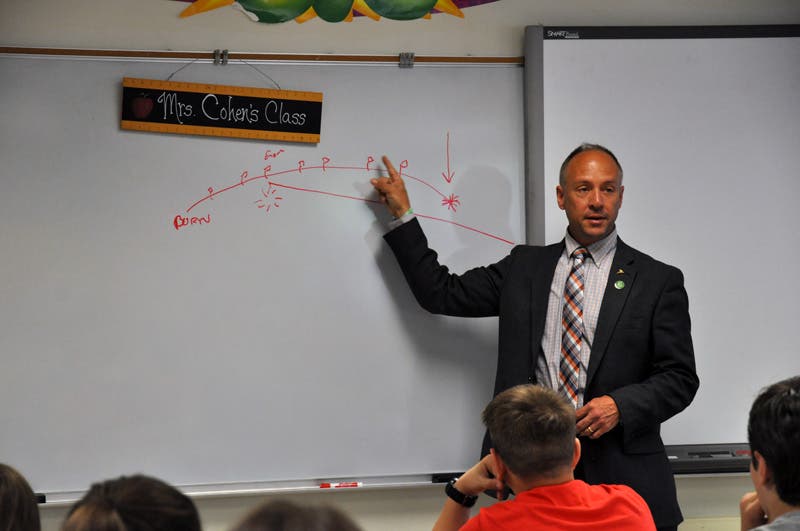
- Mark Barden’s son, Daniel, was killed in the Sandy Hook School shooting in Newtown, CT. Barden, who spoke at the Robert R. Lazar Middle School Living Lessons program, is now the Director of Advocacy for Sandy Hook Promise. He and his family also run a foundation, What Would Daniel Do. Barden is traveling the country looking for ways to prevent school shootings. “A person is born,” Barden said as he drew a graph on the board. “And they don’t just wake up one day and commit a horrible act. There are flags along the way. I want us to help people before there is violence.”
- Oklahoma City survivor, Richard Williams and Robert R. Lazar Middle School Vice Principal John Piselli. Williams is the retired District Manager for the General Services Administration Public Buildings service for the state of Oklahoma. He was severely injured in the bombing of the A.P. Murrah Building on April 19, 1995. Since 9/11 he has served on the World Trade Center Survivor’s Network Steering Committee. Williams spoke at the Robert R. Lazar Middle School Living Lessons program.
- Eugenie Mukeshimana is a survivor of the Rwandan Genocide. At the Robert R. Lazar Middle School Living Lessons program she told of her husband and father’s murders, being in hiding for three months where no one in the house where she was staying could know she was there, of giving birth as silently as possible, and of being harbored by a woman who was actually coordinating the genocide in the community and whose sons were carrying out the killing. Today Mukeshimana is the Founder and Executive Director of Genocide Survivors Support Group.
- 9/11 firefighter, Joe Torillo, 9/11 survivor, Peter Miller, and Sarah Vazquez, an international motivational speaker who has cerebral palsy, were three of the fifty-five speakers who shared stories of hope and courage with the students at Robert R. Lazar Middle School during the school’s Living Lessons program on May 14, 2015.
- Dr. Paul Wichansky, whose presentation is called Taking“Dis” Out of Disability, is a motivational speaker who has cerebral palsy. His message is: “The only real handicaps that we have are those that we create for ourselves.” During a break, Wichansky and Haider Hamza, an Iraqi journalist, were discussing the importance of Lazar’s Living Lessons program.