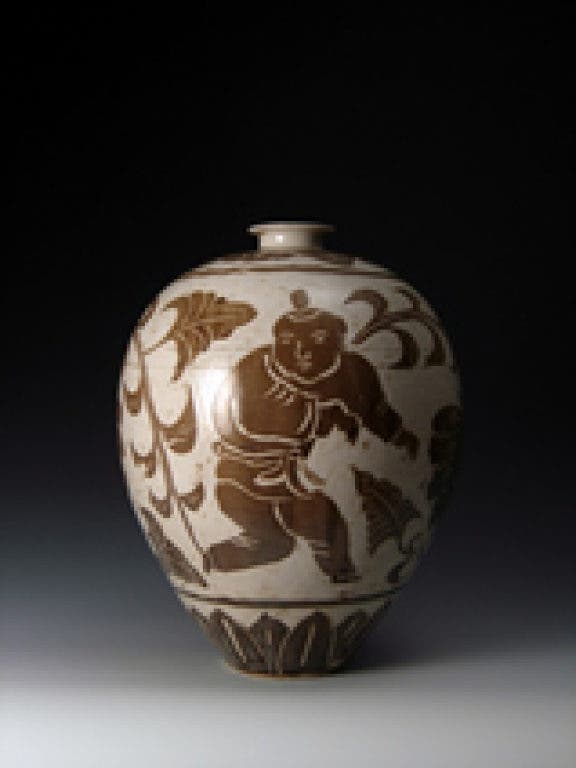
A new exhibit at the Morris Museum features a selection from a major Chinese ceramics collection.
The opening reception for Harmony in Clay: The Elegance and Refinement of Song Ceramics. will be Sunday, March 24 at 6:30 p.m.
Speaker at the reception will be Rosemary Scott,a scholar, curator and author who will present a program on Chinese ceramics. The title of her talk is “Artistic Refinement and Technological Innovation: Chinese Ceramics of the 10th-14th Centuries”.
Find out what's happening in Morris Township-Morris Plainsfor free with the latest updates from Patch.
Scott holds a degree in Chinese Art and Archaeology from the School of Oriental and African Studies, University of London, where she went on to do postgraduate research. She is the former head of the new Museums Department at SOAS, where she was responsible for both the Percival David Foundation and the new Brunei Gallery.
Tea and Chinese sweets will be served following the program. Tickets for the reception are $15. Call 973.971.3706 for reservations.
Find out what's happening in Morris Township-Morris Plainsfor free with the latest updates from Patch.
The show presents 108 objects from the Jiyuanshanfang Collection, which was assembled over decades by a single family. The exhibition showcases the ingenuity of the Song Dynasty’s (960-1279) ceramics industry, including both stoneware and porcelain, according to a museum press release.
In conjunction with this exhibition, the museum is presenting a related exhibition of Chinese costumes from the Morris Museum Collection, as well as several special programs.
Some of the most exquisite examples of Chinese ceramics emerged during the Song Dynasty, a period during which the ceramic arts reached what many believe was their peak of elegance and refinement as well as technical sophistication. Song Dynasty ceramics have long been prized for elegant shapes, unique glazes, and inventive decoration.
Zhao Kuangyin, the first Song emperor, united China after “The Five Dynasties” (907-960), a period of chaos dominated by regional warlords. The ceramic arts thrived in this environment, where they had the additional encouragement of state patronage. In his attempt to avoid dominance in politics by military forces, Emperor Zhao Kuangyin encouraged the development of agriculture, science, education and the arts after the founding of the Song Dynasty (960). The ceramic arts thrived in this environment, where they had the encouragement of state patronage.
The flourishing intellectual culture of the time led to consummate art forms and a booming ceramics industry with many kilns of renowned that were producing ceramic products of an astonishing variety and quality. As a result, the Song period witnessed a brilliant explosion in technological ceramic advances and elegantly simple new styles. This exhibition will showcase pieces from eight of the major kiln groups: Ding, Cizhou, Yaozhou, Jun, Qingbai, Jian, Longquan, and Jizhou.
About the Jiyuanshanfang Collection
The Jiyuanshanfang Collection was formed over decades. It embraces many examples of the Song Dynasty’s eight most prominent and complex kiln groups: Ding, Cizhou, Yaozhou, Jun, Qingbai, Jian, Longquan and Jizhou, the kilns whose wares fill the world’s private collections and museums. These objects were intended both for imperial and non-imperial use and demonstrate the enormous varieties of shapes, glazes and designs created by the genius of the Song potters.
Although Song Ceramics have been the subject of a variety of museum exhibitions over the years, the displays are usually limited to a small number of examples from a museum’s permanent collection. The Harmony in Clay exhibition presents visitors with the unique opportunity to view a large collection representing the Song Dynasty’s eight important kiln groups, as well as including near-complete examples of the works from each group.