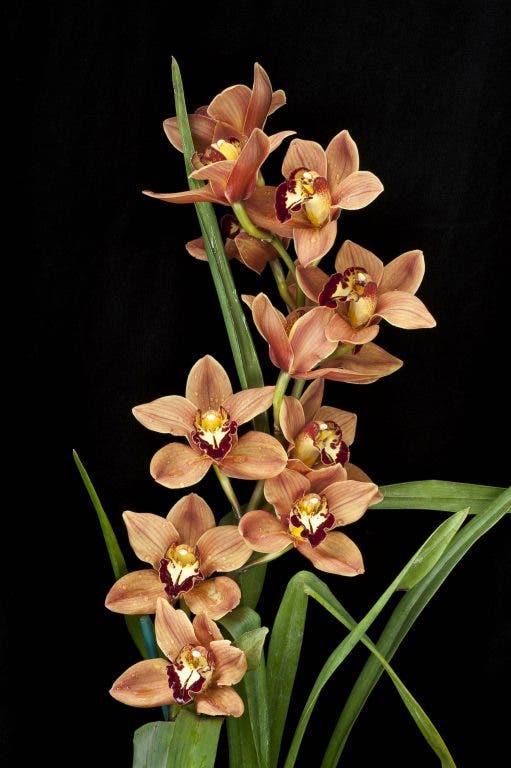


Flower photographs are often explosions of color, but Paul Donohoe’s photos of orchids are portraits.
Each flower is photographed alone against a black background. The portraits hanging now in the Frelinghuysen Arboretum are of many varieties of orchids, but since there are actually between 20,000 and 30,000, they represent only a fraction.
Donohoe is an avocational photographer. He’s been taking pictures since he was 8-years-old, but only started shooting orchids. He wasn’t even an orchid fancier, but he attended a show and liked what he saw.
Find out what's happening in Morris Township-Morris Plainsfor free with the latest updates from Patch.
“Now I’m a member of the American Orchid Society,” he said.
While there are a number of websites with 1,000 or more orchid photos, they exist to help the viewer identify the flowers, they aren’t presenting the orchids as art.
Find out what's happening in Morris Township-Morris Plainsfor free with the latest updates from Patch.
“They are documentation, not close ups of the flowers,” he said.
Most are also taken with a flash, he said.
Donohoe takes the photos at greenhouses rather than orchid shows because of the time it takes to set up his shots. Flower shows are crowded and don’t allow for the planning needed.
He carries two black boards and a black cloth for background, Donohoe said. One board is hinged so it can be set up behind the plant. The other has a slot so it can be set up around the stem of a flower, so Donohoe can isolate exactly the picture he wants.
“Greenhouse operators are so cooperative,” he said. “They let me move things around. One even turned off his fans to keep the air still.”
He doesn’t interfere with the care of the orchids, however, and some of the photos show droplets on the petals from recent watering.
Because he uses ambient light, he sets up his Nikon D700 on a tripod and sets the exposures for one-quarter to 20 second exposures. The aperture is kept narrow for maximum depth of field from his Tamron 90mm Macro lens.
He uses Silver Effects Pro 2 Photoshop and prints on an Epson printer with archival ink. He started printing on luster paper and thought the results were all right, but then he went to a photo exposition in New York City and talked to the Epson representative who told him he had four new papers. Donohoe tried two, Hotpress and Coldpress. Hotpress has a smoother finish. Coldpress is textured.
“I thought the smoother paper would bring out the flowers better, but as soon as I used coldpress, I was sold,” Donohoe said.
The exhibit will run through the month of March. Arboretum hours are 9 a.m. to 4:30 p.m..