Crime & Safety
This 19th-Century Morris Co. Murderer Was Turned Into A Wallet, Historians Say
While Antoine Le Blanc's 1833 crime shocked residents, it's what happened after he died that still sends shivers down spines.


MORRISTOWN, NJ — It’s been nearly 193 years to the day since Antoine Le Blanc was put to death for killing a Morristown family, but it’s the gruesome story’s aftermath that is still sending shivers down locals’ spines.
Le Blanc’s story in Morristown begins in the spring of 1833, when the French-speaking immigrant took a job working for the family of Judge Samuel Sayre at their South Street home.
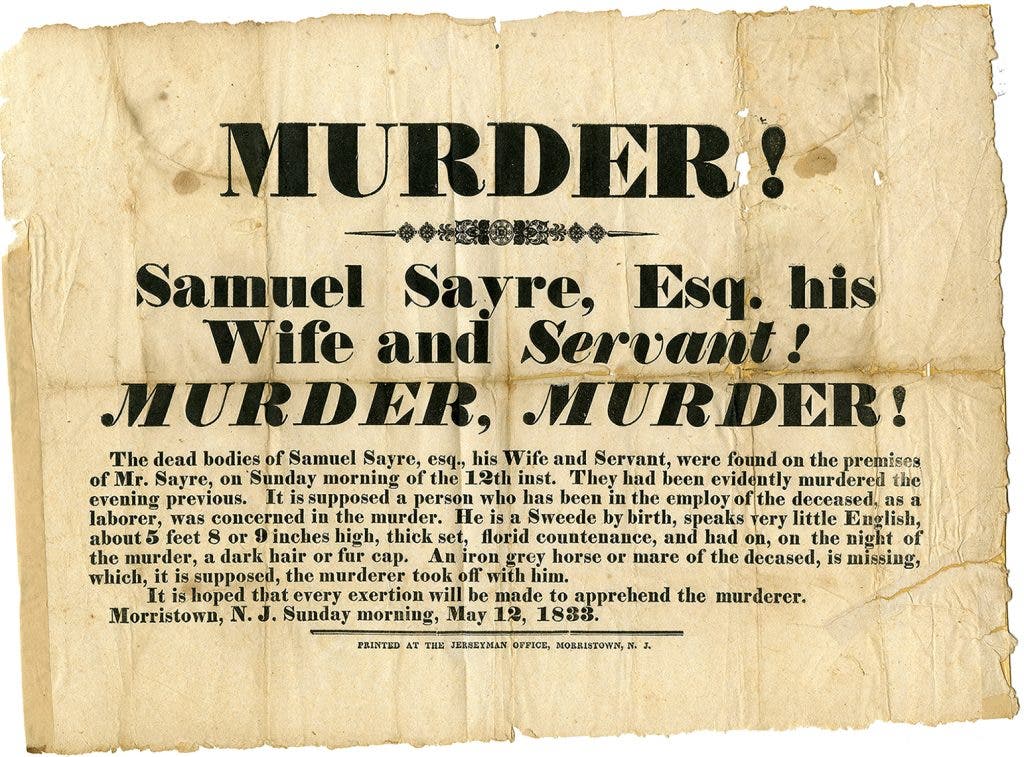
Just weeks after Le Blanc was hired, on May 12, concerned neighbors found the Sayre family’s servant, Phebe, murdered with a hatchet in her attic bedroom, according to the Morris County Historical Society.
Find out what's happening in Morristownfor free with the latest updates from Patch.
Soon after, investigators discovered that Judge Sayre, along with his wife Sarah, had also been beaten to death. They were found buried in manure in the property’s barn, experts said.
Historians say suspicions almost immediately fell on Le Blanc, who had hightailed it on the turnpike, riding a horse stolen from the Sayres from Morristown to Newark before being captured by the sheriff and returned to Morristown.
Find out what's happening in Morristownfor free with the latest updates from Patch.
Le Blanc’s August 1833 trial lasted ten days and featured “lurid details,” which caused a sensation in the Morris County Courthouse and the community.
“A parade of witnesses testified in gory detail what they had seen at the crime scene, upon examining the bodies, and Leblanc’s appearance and demeanor at the hotel bar he visited the night of the murder,” the Morris County Historical Society writes. “Found guilty by the jury after a deliberation of just 20 minutes, he was sentenced by the judge not only to be hanged, but also for his body to afterwards be taken for dissection.”
On Sept. 16, 1833, more than 12,000 people gathered to watch the life leave Le Blanc’s eyes as he was hanged in the Morristown Green, but it’s what happened after his death that really created a horrific legacy in the community.
Amid other rumored experiments, doctors created a death mask, a physical cast of a person's face made shortly after they die, of Le Blanc.
Perhaps even more gruesome, Le Blanc’s skin was used to make souvenirs, Morris County historians say.
According to Weird NJ, a publication dedicated to creepy and supernatural Garden State happenings, wallets, purses, lampshades and book jackets were produced from Le Blanc’s skin. Sold to Morristown residents and visitors as keepsakes, these items were also signed by the town sheriff to “verify their authenticity,” according to the publication.
Some historians believe these items, parts of Le Blanc’s body, are still scattered across Morristown homes in attics, basements, what-have-you. The Morris County Historical Society has called Le Blanc’s crime, and his eerie posthumous activities, “one of the most horrific chapters in local history.”
Get more local news delivered straight to your inbox. Sign up for free Patch newsletters and alerts.