Community Corner
Adrienne Wheeler: Keeper Of The Flame
Newark artist and curator honors African ancestors and her family
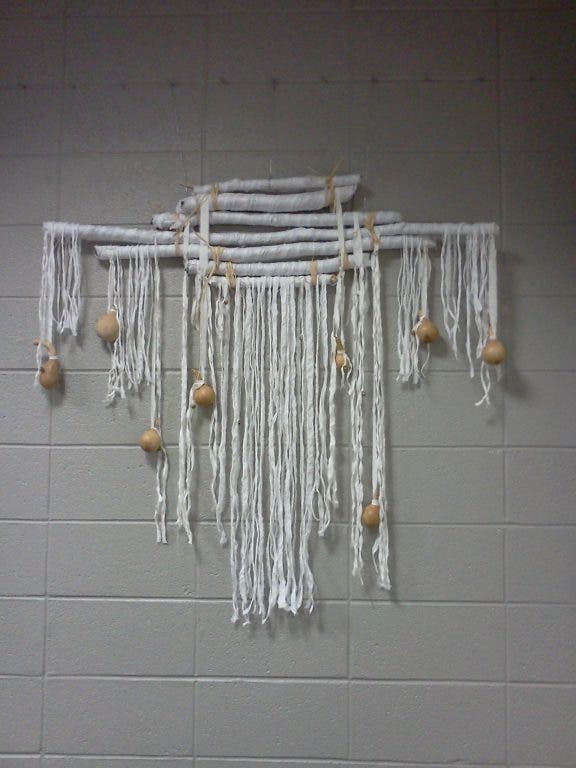


There’s still time to be among the many who have been moved by Newark’s Adrienne Wheeler’s one woman show “Lembranca/Resistencia-Memory/Resistance” at Orbit Gallery One in the Paul Robeson Center, Rutgers- Newark. Deeply rooted in ancestral African spiritual practices, her works are part of Wheeler’s struggles against oppression, the artist explained.
“For successful resistance, there must be memory of social injustice and an understanding of one own history,” Wheeler said.
Both as an artist and curator, Wheeler remains dedicated to furthering UN Resolution 64/169, which honored 2011 as the year of the art and traditions of people of the African Diaspora.
Find out what's happening in Newarkfor free with the latest updates from Patch.
“There is a request in front of the UN that the resolution be made the decade of the Diaspora, there is so much work to done over the globe,” Wheeler said. This past year, she was responsible for many Diaspora group exhibits both in the city and throughout the area, and this summer will be co-curating an exhibit of Newark-based and nearby artists to be shown in Cuba.
Wheeler remembers studying Greek and Roman mythology at Peshine Elementary School in Weequahic, but also remembered how there was no validation of the culture and traditions of Western Africa.
Find out what's happening in Newarkfor free with the latest updates from Patch.
“It’s dangerous to rob people of their cultural identity,” Wheeler said. “My works honor that identity, that’s what the UN Resolution is about. I have come to see vestiges of African healing practices in my family---an uncle pulling bark from a cherry tree to treat a cold. It’s part of our DNA.”
Her installation of sculptural wrapped branches, shaped pieces and bundles are inspired by West African art that museums have collected for decades. The show has been viewed by many visitors, and Wheeler has given artist talks, including one for the annual fall meeting of the Feminist Art Project based at Rutgers in New Brunswick.
“The pieces have impact,” Wheeler said. “People walk through—the show is in a public gallery with a great deal of exposure—and there is a quieting effect.”
While Wheeler has been on a long spiritual journey to discover her ancestral traditions, her more recent family roots are much closer to home —Wheeler Street is named for a nineteenth century forebear.
Her activism can be found in her family history. Growing up in Weequahic—she is back living now in her childhood home--she remembers her parents’ deep involvement in the civil rights movement. As a little girl, she was in the living room when they hosted neighborhood meetings with then ward leader Donald Payne over issues such as school redistricting.
“I think I was politicized in utero,” Wheeler said. “My father and his brothers were successful commercial photographers in New York. My dad had the economic resources to live anywhere,” Wheeler said. “As others left Newark after the civil disturbances of the 1960s, he stayed to contribute to the city he loved.”
She was absorbing jazz and the visual arts as a child, too. “I always had a camera, I was always photographing,” Wheeler said. Her girlhood Saturday routine included art classes at the Newark Museum and guitar lessons at “Robbie’s Music City” on Broad Street.
After majoring in sociology at Northeastern University, Wheeler later began to deal in art and photography before owning antique shops in nearby towns and, eventually, a gallery in New York City.
As to the current show, there is special joy for her in her showing at the Paul Robeson Center.
“I remember the struggles in the 1970s to name the Rutgers campus center after Paul Robeson,” Wheeler said, "and the story of my father and uncle answering the call in 1949 to be part of a human shield to protect Robeson when he sang for civil rights in Peekskill,” Wheeler said.
One of Wheeler’s uncles was injured by stones being thrown by segregationists. “My uncle got treated in a Manhattan hospital, then my dad and he turned around and went right back up there,” Wheeler said.
“My Aunt Irene exhibited in the Robeson Gallery, so I am the second Wheeler to show there, “Wheeler said. “I’m standing in the foot print of political activity that took place before me. It’s not a solo journey.”
Orbit One Gallery is on the second floor of the Paul Robeson Galleries, Campus Center, 350 Dr. Martin Luther King Boulevard, Newark, open Monday through Thursday, 10 a.m. through 5 p.m. Closed holidays. No admission.