Health & Fitness
Chasing Iron Man: Exoskeleton Empowers Teen [VIDEO]
Watch this amazing device make a life-changing difference for a teen with Duchenne muscular dystrophy.


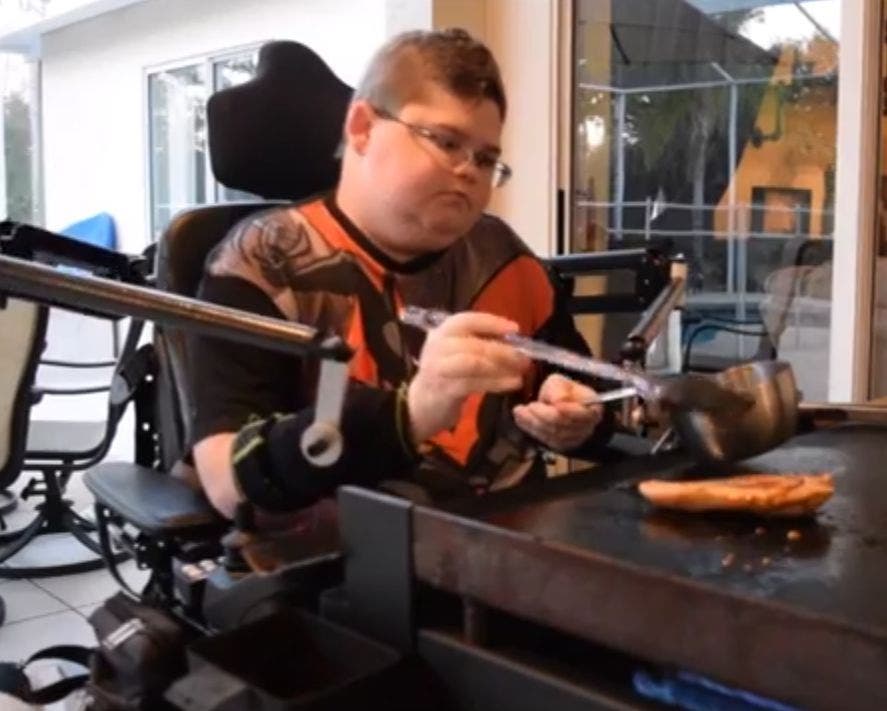
NEWARK, NJ — The technology isn’t quite at the Iron Man stage yet, but for patients like Zachary Smith, the rapidly advancing field of mechanical exoskeletons is already having a life-changing impact.
After being diagnosed with Duchenne muscular dystrophy – an often-fatal genetic disorder that can result in a debilitating loss of strength - one of the crucial challenges for Smith was to retain his independence. But when it’s a challenge to perform daily tasks such as eating, cooking and brushing your teeth, “independence” can seems like a frustrating, pie-in-the-sky concept.
“I knew I was losing my arm strength and it scared me because I had already lost the ability to use my legs,” Smith said. “So I got on my computer, started searching for exoskeletons, and e-mailed a company developing the technology. I thought that if it were used in factories to reduce workers’ muscle fatigue, why not on a wheelchair?”
Find out what's happening in Newarkfor free with the latest updates from Patch.
And that’s how, four years later, Smith has ended up as a consultant for a team of New Jersey researchers working on one of the coolest projects in the field of mechanical exoskeletons.
THE EXOSKELETON
Find out what's happening in Newarkfor free with the latest updates from Patch.
According to the Newark-based New Jersey Institute of Technology (NJIT), its biomedical engineers are teaming up with Talem Technologies of Detroit to develop a device that would be "the first of its kind to provide intuitive robotic guidance controls and motorized assistance to people with Duchenne, allowing them to continue to use their arms as their muscles weaken," NJIT administrators stated.
“NJIT’s technology uses what is known as admittance control, a robotic control paradigm in which the motion of the robot is controlled by the magnitude and direction of the forced applied by the user’s arm. Compared to passive arm supports that require the user to have sufficient strength to move them, admittance controlled devices significantly minimize friction and inertia and provide more precise compensation against gravity, reducing the exertion necessary to move a limb, particularly vertically.”
Starting this week, the study leaders – Richard Foulds and Madeline Corrigan from NJIT and Blake Mathie from Talem Technologies – will begin recruiting up to 30 non-ambulatory participants living with Duchenne from across the country to use the device and report back on their experiences incorporating it into their daily lives.
Participants in the study will receive a pair of wheelchair-mountable passive arm supports to be used regularly inside their homes, as well as in classrooms, workplaces and other community settings. After a few months, each participant will receive a modular upgrade to partially motorize their arm support, NJIT stated.
- See related article: Robot Avatar Helps Cancer-Stricken Child Attend School
Mathie called modularity a “core principle of the device,” an aspect that Talem plans to commercialize, according to NJIT.
“Not everyone needs a car with all the bells and whistles, nor a barebones model,” Mathie said. “What they need today may not be what they need tomorrow and so we are developing this device to serve the widest population possible, adding assistance as it is needed. Wheelchairs provide freedom for people who have lost the use of their legs to go where they want, but they don’t give them the independence to do what they want once they get there. This technology is designed to give them that independence.”
And in the end, that’s exactly what Duchenne patients like Smith need.
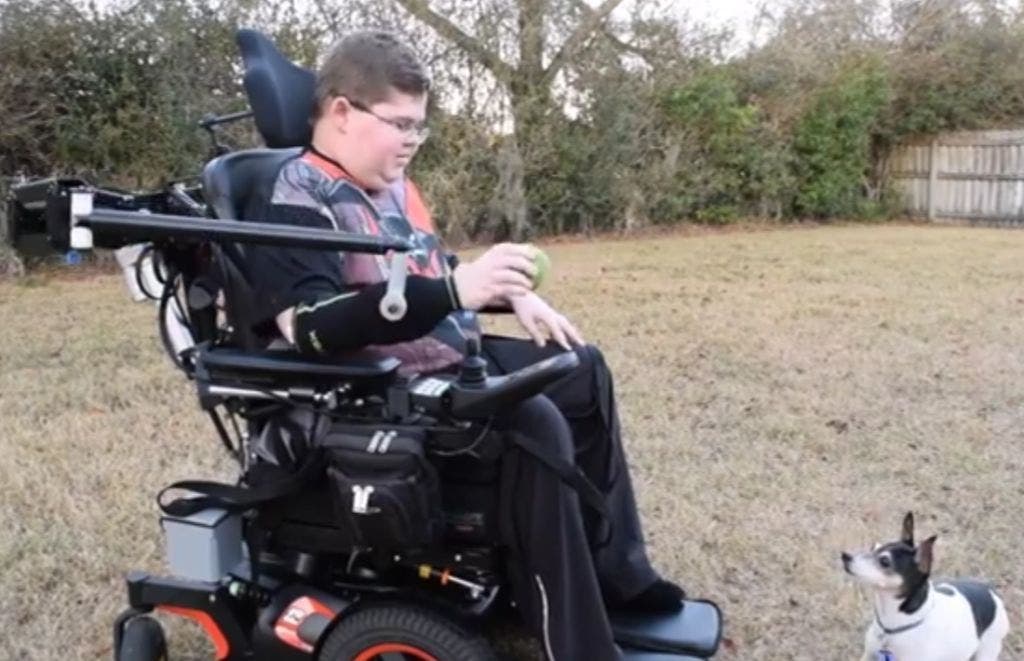
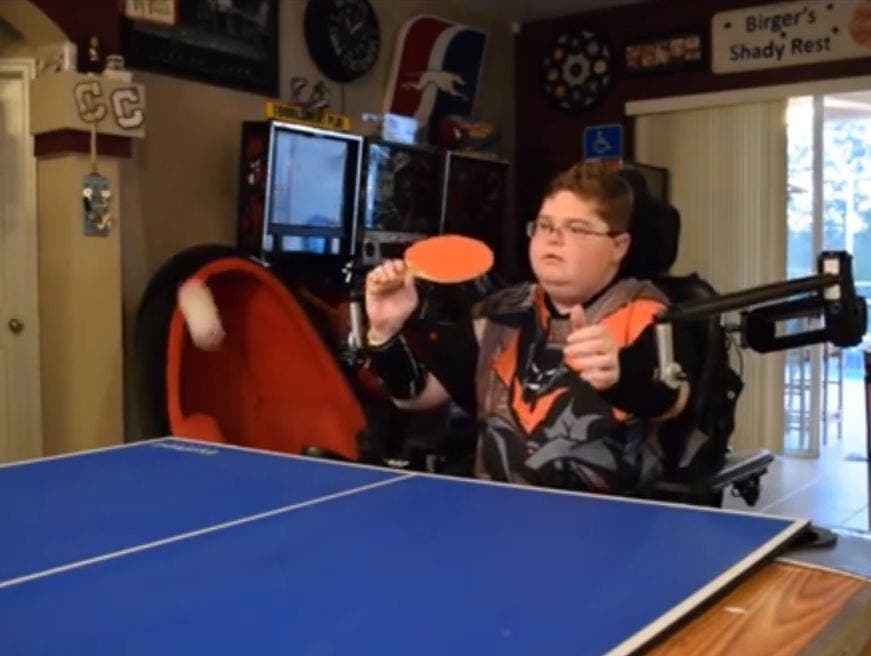
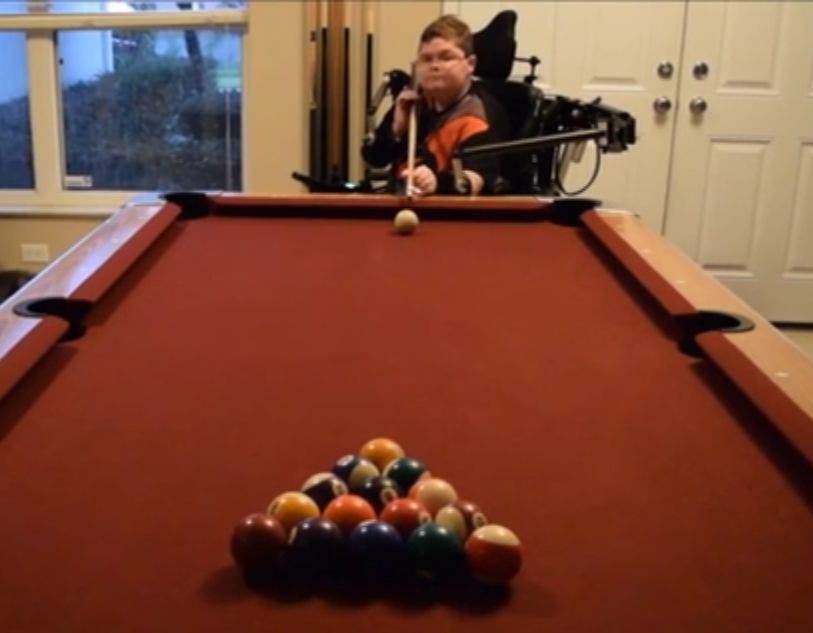
“I want to be more independent,” said the teen, who is now able to play fetch with his dog and ping pong with his grandfather. “Rather than asking my parents and sister I want to do more things on my own. I also want to show other people that just because you have a disease doesn’t mean you can’t do things. People should preserve this ability as long as they can. I want to show them they can help themselves.”
ROBOTICS, DUCHENNE AND THE FUTURE
The joint venture between NJIT and Talem Technologies recently earned a $600,000 grant from nonprofit Parent Project Muscular Dystrophy (PPMD) as part of the organization’s ongoing exploration of robotic technology to assist people living with Duchenne.
PPMD provided Talem Technologies a similar grant in 2015 that allowed Talem the ability to first test the X-Ar passive arm support with patients.
The newest grant was a “natural next step in the formation of promising exoskeleton technology,” according to PPMD founder and CEO Pat Furlong.
“We are thrilled that the teams at NJIT and Talem Technologies have come together to further enhance this exciting device,” Furlong said. “We believe this exoskeleton technology has the ability to spare muscle deterioration, keeping people with Duchenne stronger for longer.”
PPMD has also backed other recent technology projects in the same field, such as the in-development “Solid Suit,” a soft, wearable assistive device for people with Duchenne and Becker muscular dystrophy.
“Conceptually, the Solid Suit could be worn under one’s clothing next to his/her skin (picture Spider-Man’s suit),” PPMD states. “It is not yet known whether the project will yield a full body suit, an upper body suit to enhance upper body function, or a lower body suit to enhance lower limb function and mobility.”
Learn more about the Solid Suit project here.
Photos: YouTube screenshots, NJIT
Send feedback to eric.kiefer@patch.com
Get more local news delivered straight to your inbox. Sign up for free Patch newsletters and alerts.