Crime & Safety
Is Crime Up Or Down In New Jersey? Here’s What FBI Data Shows
Crime plunged nationwide in 2024, according to new data from the FBI. Here's how New Jersey fared.


Crime dropped in New Jersey last year – and plunged nationwide, according to the latest statistics from the FBI.
The federal agency released 2024 Uniform Crime Reporting (UCR) data for more than 14 million criminal offenses across the United States on Tuesday, including for New Jersey.
Nationwide, violent crime is down about 4.5 percent from 2023 estimates. That includes drops in murders (14.9%), rapes (5.2%), robberies (8.9%) and aggravated assaults (3%). Meanwhile, property crime dropped 8.1 percent last year in the United States, including burglaries (8.6%), larcenies (5.5%) and vehicle thefts (18.6%). These numbers are the lowest property crime rates and lowest violent crime rates since at least 1969, according to the Center for American Progress.
Find out what's happening in Newarkfor free with the latest updates from Patch.
The FBI noted that despite the reductions, a violent crime still took place every 26 seconds somewhere in America last year.
New Jersey’s crime rates dropped in 2024 after ticking up for two years following the COVID pandemic, according to data from the bureau.
Find out what's happening in Newarkfor free with the latest updates from Patch.
New Jersey saw 20,684 violent crimes with a population of 9,500,851 residents last year – a rate of 217.7 per 100,000 people. That’s down from 225.3 per 100,000 people in 2023. The state’s violent crime totals were below the national rate, which came to 359.1 per 100,000 people.
New Jersey experienced 135,610 property crimes last year – a rate of roughly 1,427 per 100,000 people. The statewide total is down from 1,527 per 100,000 people in 2023. Again, New Jersey was below the national rate of 1,760 per 100,000 residents.
Here are the previous 10 years of crime statistics in New Jersey for comparison:
- 2022 – Violent (217.9 per 100,000 people); Property (1,438 per 100,000 people)
- 2021 – Violent (183.4 per 100,000 people); Property (1,109 per 100,000 people)
- 2020 – Violent (195.3 per 100,000 people); Property (1,158 per 100,000 people)
- 2019 – Violent (206.7 per 100,000 people); Property (1,334 per 100,000 people)
- 2018 – Violent (208.6 per 100,000 people); Property (1,408 per 100,000 people)
- 2017 – Violent (231.8 per 100,000 people); Property (1,576 per 100,000 people)
- 2016 – Violent (243.5 per 100,000 people); Property (1,537 per 100,000 people)
- 2015 – Violent (256 per 100,000 people); Property (1,631 per 100,000 people)
- 2014 – Violent (260.9 per 100,000 people); Property (1,733 per 100,000 people)
- 2013 – Violent (288.9 per 100,000 people); Property (1,881 per 100,000 people)
The UCR program was rolled out in 1930. Nonfederal law enforcement agencies from across the country voluntarily submit their crime and law enforcement data to the program. The FBI publishes the contributed data on its Crime Data Explorer website.
More than 16,000 state, county, city, university and college and tribal agencies – covering a combined 95.6 percent of the United States population – submitted data to the UCR program through the National Incident-Based Reporting System and the Summary Reporting System last year.
Some politicians and commentators have argued that the FBI data may be fraudulent, manipulated or incomplete. However, civil rights advocacy groups such as the Brennan Center for Justice have disputed those claims.
LONG-TERM TRENDS
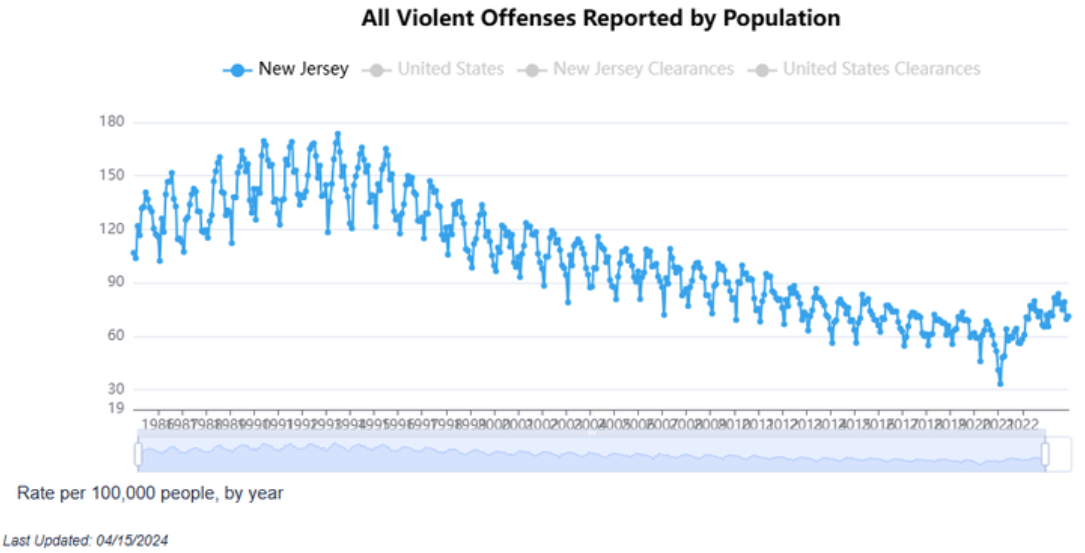
According to long-term trend data from the FBI, the Garden State has seen a big drop in violent crime over the past decades – especially from levels seen in the 1980s and 1990s.
The following graph from the FBI's crime data explorer shows the overall violent crime rate for New Jersey between January 1985 and December 2023, including homicides, rapes, robberies and aggravated assaults:
Earlier this year, New Jersey officials announced that shootings are down across the state, reaching a “historic low” from last year’s totals.
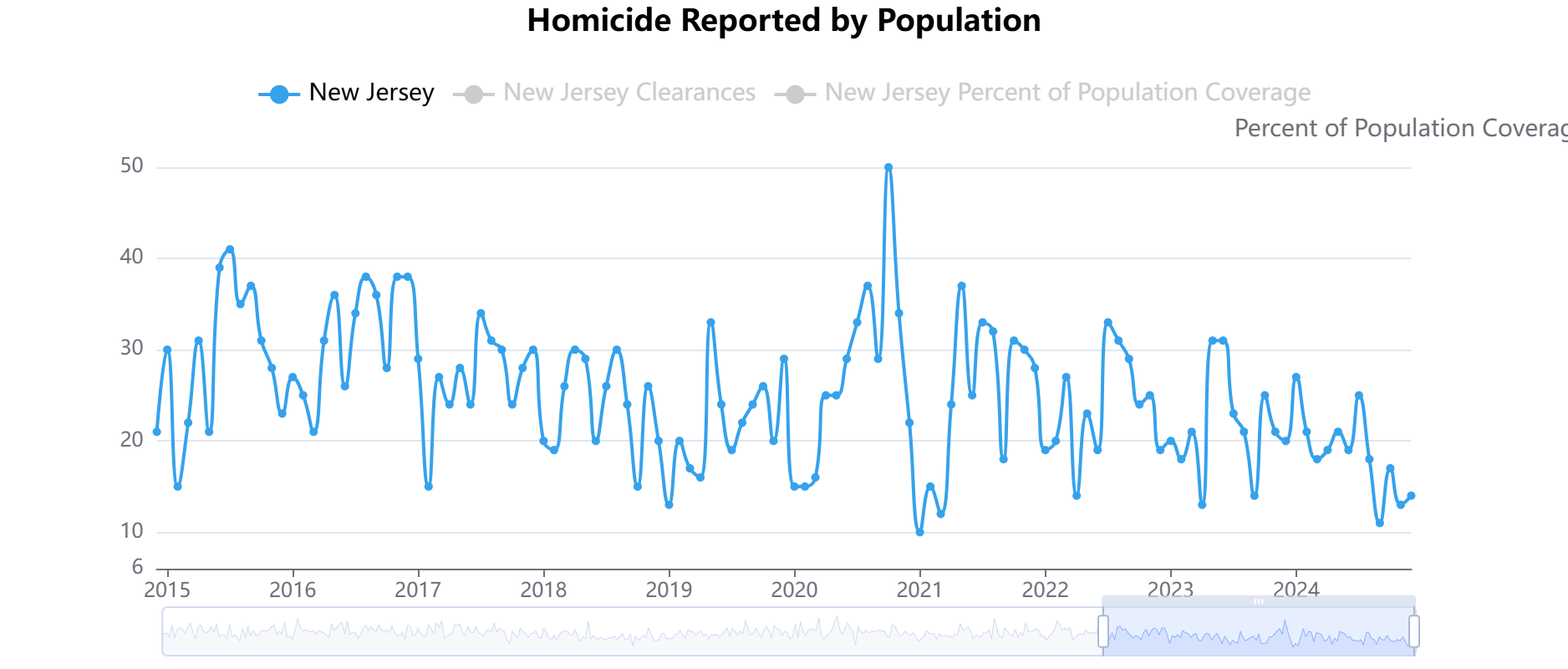
According to state public safety officials, 778 victims suffered gunshot injuries in New Jersey in 2024. That’s a 16 percent drop from 2023, which set a previous record for the lowest number of shootings since tracking began in 2009.
State officials credited the reduced number of shootings to “targeted and technologically assisted deployment of resources,” as well as “community engagement” and law enforcement partnerships.
Some pundits have pointed out that fatal shootings only make up a small percentage of violent crime, which also includes assaults, rapes, robberies and other serious offenses. Meanwhile, other deadly crimes are committed without the use of firearms, including fatal stabbings and deadly beatings that have taken place across the state in recent years.
The statewide violent crime data mirrors trends seen in New Jersey’s two largest cities: Newark and Jersey City.
Public safety officials in Newark, which has a population of 304,960, and Jersey City, which has 291,657 residents, recently released their 2024 crime statistics, including homicides and shootings. The numbers are down in both cities, officials reported.
Newark saw a 23 percent decrease in murders and a 9 percent decrease in non-fatal shootings last year. Meanwhile, Jersey City had a 40 percent drop in homicides and a 45 percent decrease in shootings.
The data wasn’t all good news. Newark’s overall violent crime rate – including robberies and aggravated assaults – ticked up 9 percent. In Jersey City, assaults were up 25 percent, rising from 789 to 986. But according to officials in both cities, the recent drop in murders and shootings is an important sign of progress.
The reductions in crime haven't only been seen in the north part of the state.
In South Jersey, the Camden County Police Department recently announced that total crime is down 13 percent through the first six months of 2025. Meanwhile, violent crime declined by another 12 percent over same time last year, making it one of the best statistical half year totals in the last half-century.
Total crime has been dropping in Camden City since it started to be recorded in 1974, authorities said.
CRIME AND PUBLIC PERCEPTION
According to a recent study from the Pew Research Center, many Americans tend to believe crime is up – even when official data shows it is down.
In 23 of 27 Gallup surveys conducted since 1993, at least 60 percent of U.S. adults have said there is more crime nationally than there was the year before, despite the downward trend in crime rates during most of that period.
Public attitudes about crime differ widely by Americans’ party affiliation, race, ethnicity and other factors, the center reported last year.
“For example, Republicans and Republican-leaning independents are much more likely than Democrats and Democratic leaners to say reducing crime should be a top priority for the president and Congress (68% vs. 47%),” researchers said.
A Rutgers-Eagleton poll found similar numbers last year, with Republicans (52 percent) more likely to say they are worried about being a victim of a crime than independents (41 percent) and Democrats (32 percent).
Overall, 57 percent of New Jerseyans said crime has stayed the same in their neighborhood as compared to five years ago, 10 percent said it has gotten better, and 30 percent said it has gotten worse.
Send local news tips and correction requests to eric.kiefer@patch.com. Learn more about advertising on Patch here. Find out how to post announcements or events to your local Patch site.
Get more local news delivered straight to your inbox. Sign up for free Patch newsletters and alerts.