Neighbor News
February 7th - National Black HIV/AIDS Awareness Day
Get Educated – Get Tested – Get Involved – Get Treated


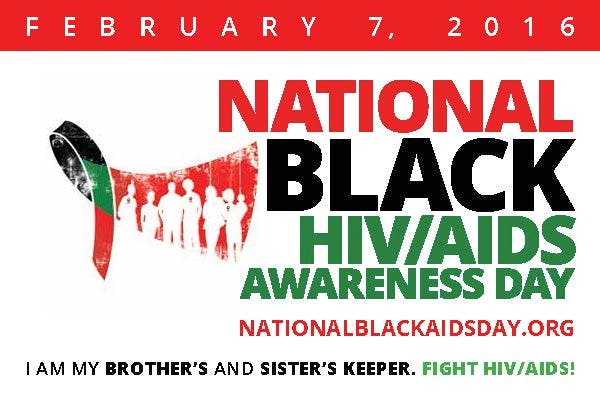

February 7, 2016 is a commemorative day designed to increase the awareness of HIV/AIDS prevention, care and treatment among African American communities locally, nationally and internationally. National Black HIV/AIDS Awareness Day (NBHAAD) encourages communities to get educated, get tested, get involved and get treated, if needed.
Why is there a need? Of all racial and ethnic groups in the United States, HIV and AIDS threaten the health and well-being of blacks/African Americans the most. “While blacks represent approximately 12% of the US population, they account for more new HIV diagnoses (44%) and people living with HIV (41%) than any other racial/ethnic group. Among all blacks, black gay and bisexual men account for the majority of new infections. Young black gay and bisexual men are especially affected.”[1]
Unfortunately, many of those who are infected with HIV are unaware of their status and may unknowingly spread the virus to others. Not knowing one’s HIV-positive status puts your health and the health of others in danger.
Find out what's happening in Newarkfor free with the latest updates from Patch.
As we know, everyone is at risk for infection regardless of one’s racial and ethnic group. Anyone can become infected through unprotected vaginal and anal sex, sharing needles to inject drugs, and/or tattooing/piercings. Even newborns are at risk when born to HIV infected mothers. Testing is the ONLY way to know if you are infected and to stop the further spread of HIV. You cannot rely on symptoms. There have been many instances where an HIV- positive individual did not have any symptoms for years and then developed severe complications. Thanks to medical advancements, getting tested is easier and more time efficient than before. A person can have a rapid test done and know their results in less than an hour.
Take control of your own health and help prevent illness of those around you. If you do not know your HIV status, don’t wait to get tested. Current recommendations by the Centers for Disease Control and Prevention (CDC) state that any individual, including pregnant women, between the ages of 13 and 64 be tested for HIV at least once as part of their routine medical care. It is strongly suggested that individuals at high risk for becoming infected be tested more often.
Find out what's happening in Newarkfor free with the latest updates from Patch.
The health care professionals at the New Jersey AIDS/HIV/STD Hotline are here to help. Are you looking to find a free, state-funded testing site near you for initial testing, follow-up care or have questions about HIV/AIDS, STDs, or hepatitis. Do you know friends, family, coworker, etc. who are HIV-positive and are no longer receiving treatment for their infection? We can help them get back into medical care by connecting them to the HIV/AIDS Navigator Project.
Contact us (The New Jersey AIDS/HIV/STD Hotline) either by calling 800-624-2377, text/email at 8006242377@njpies.org, or chat via our site at www.njhivstdline.org; the hearing impaired may also use their TTY and call 973-926-8008. Calls are free and confidential. Services available 24 hours a day, 7 days a week, every day of the year.
- Referrals for free, testing sites and other related services
- HIV/AIDS, STD and Hepatitis Prevention Information
- HIV Counseling and Treatment Locations
- HIV Treatment Information
- Referrals for free, clean needles/syringes
____________________________________
[1] National Black HIV/AIDS. Centers for Disease Control and Prevention (CDC). February 2, 2016. http://www.cdc.gov/features/blackhivaidsawareness
About NJPIES
As New Jersey’s only poison control center, the New Jersey Poison Information & Education System provides information on poison prevention and treatments. Chartered in 1983, NJPIES provides free consultation through telephone hot line services and the Web. Medical professionals such as physicians, registered nurses and pharmacists offer confidential advice regarding poison emergencies and provide information on poison prevention, drugs, food poisoning, animal bites and more. These specialists are available 24 hours a day, seven days a week.
NJPIES coordinates state poison education and research and is designated as the regional poison center by the New Jersey Department of Health and Senior Services and the American Association of Poison Control Centers. It tracks incidences of adverse reactions to food, drugs and vaccines in order to monitor potential public health issues and provide data to the U.S. Food and Drug Administration and the Centers for Disease Control and Prevention. A division of the Department of Emergency Medicine of the New Jersey Medical School of Rutgers, The State University of New Jersey. NJPIES has a state-of-the-art center located on the school’s Newark campus. NJPIES is funded, in part, by the NJ Department of Health and the United States Department of Health and Human Services.
New Jersey residents seeking immediate information about treating poison emergencies, and those with any drug information questions, should call the toll-free hot line, 800-222-1222, any time. The hearing impaired may call 973-926-8008. For more information, visit www.njpies.org or call 973-972-9280.
About Rutgers
Established in 1766, Rutgers, The State University of New Jersey, is America’s eighth oldest institution of higher learning and one of the nation’s premier public research universities. Serving more than 65,000 students on campuses, centers, institutes and other locations throughout the state, Rutgers is the only public university in New Jersey that is a member of the prestigious Association of American Universities.
Rutgers Biomedical and Health Sciences (RBHS) is the health care education, research, and clinical division of Rutgers University, comprising nine schools and their attendant faculty practices, centers, institutes and clinics; New Jersey’s leading comprehensive cancer care center; and New Jersey’s largest behavioral health care network.
###