Politics & Government
Women In The Military: Air Force General, N.J. Graduate, Speaks
What's it like to be a woman in the U.S. Air Force? Just ask four-star general and NJIT graduate Ellen Pawlikowski.


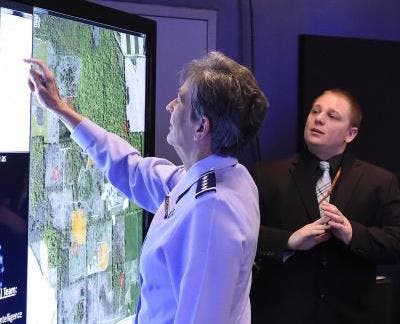
Newark, NJ - What’s it like to be a woman in the U.S. Air Force?
It’s a lot better than it used to be, according to four-star general Ellen Pawlikowski.
That was one of several topics that Pawlikowski addressed during her keynote speech at the New Jersey Institute of Technology (NJIT) Alumni Weekend last month in Newark.
Find out what's happening in Newarkfor free with the latest updates from Patch.
Pawlikowski – a NJIT class of 1978 graduate – recently stated in a university news blog that she had “no military background whatsoever” before she entered college.
But that changed when the future general joined the NJIT Air Force ROTC.
Find out what's happening in Newarkfor free with the latest updates from Patch.
While Pawlikowski began her military career out of “curiosity,” it was the atmosphere and camaraderie that got her hooked, she said.
“When I got to NJIT in 1974 it was a total commuter school, and there were fraternities, but no sororities,” Pawlikowski said. “There was very little of that collegiate social environment, particularly available to women. It wasn’t that we were excluded – it just wasn’t there. So my affinity for ROTC came from knowing that it was a place to go and socialize.”
Pawlikowski now manages about 80,000 people, but said that she never expected to rise to her current position.
“You have to remember the circumstances back then,” she emphasized. “Women couldn’t be in operational career fields, and the environment was not conducive to women staying in the military long-term. It was a time when women in uniform could be discharged from service if they became pregnant or even adopted a child.”
Pawlikowski elaborated on her experience as a woman in the military:
“To a degree, some of my experiences are hard to distinguish from those of being an engineer. When I started at NJIT, I was part of the largest women’s class to ever come in, but even then – throughout most of my ROTC career, as well as my career at NJIT – I was the only woman or one of only two women in any class. Many of the attitudes that made it challenging were as much prevalent in society as they were in the military. In the military, there were more direct institutional barriers concerning, say, becoming a pilot, a navigator or a missileer. On the engineering school side, it was less spoken but more understood that there were certain obstacles. We lived with, for example, one physics professor who started every class with, ‘Gentleman, this is what we’re going to do today.’”
However, the general said that in her opinion, the U.S. military has begun to change its institutional attitude towards females in leadership positions.
“I will also tell you from my professional experience that I believe the military is more open, more ready than other environments to acknowledge and recognize the value of providing opportunities to 100 percent of the population, rather than only 50 percent. Initially there were barriers, because there were limited places, and the attitudinal and cultural barriers that went along with that. When I was a young officer, for example, one of my instructors was giving us feedback and he said to me, ‘You did really, really well, far better than I ever thought any woman would do in this group.’ He then proceeded to tell me, ‘but I’m not going to make you a distinguished graduate because these other male officers need it more. They’re going to go off to be generals.’ Those institutional restrictions are essentially gone now.”
Women now make up about 20 percent of the U.S. Air Force, Pawlikowski stated.
“One of the contributions we’ve seen from women coming into the military is having multi-diverse teams that cover a wide spectrum of talents and capabilities and a broad scope of perspectives,” she said. “This enables us to view different things from different angles and to take different approaches.”
“Another contribution comes in the form of work-life balance,” Pawlikowski continued. “As the military has worked hard to ensure that we leverage the diversity of this country with that other 50 percent, we have made significant progress on this front.”
Read the full blog with Pawlikowski’s commentary on modern military developments here.
Send local news tips, photos and press releases to eric.kiefer@patch.com
Photo of Gen. Ellen M. Pawlikowski courtesy of the U.S. Air Force
Get more local news delivered straight to your inbox. Sign up for free Patch newsletters and alerts.