Community Corner
Newark, Black Pride And Kwanzaa: History Teacher Offers Lesson
"Because of Dr. Maulana Karenga's and Imamu Amiri Baraka's activism, Kwanzaa is now observed by thousands of Black people in Newark."


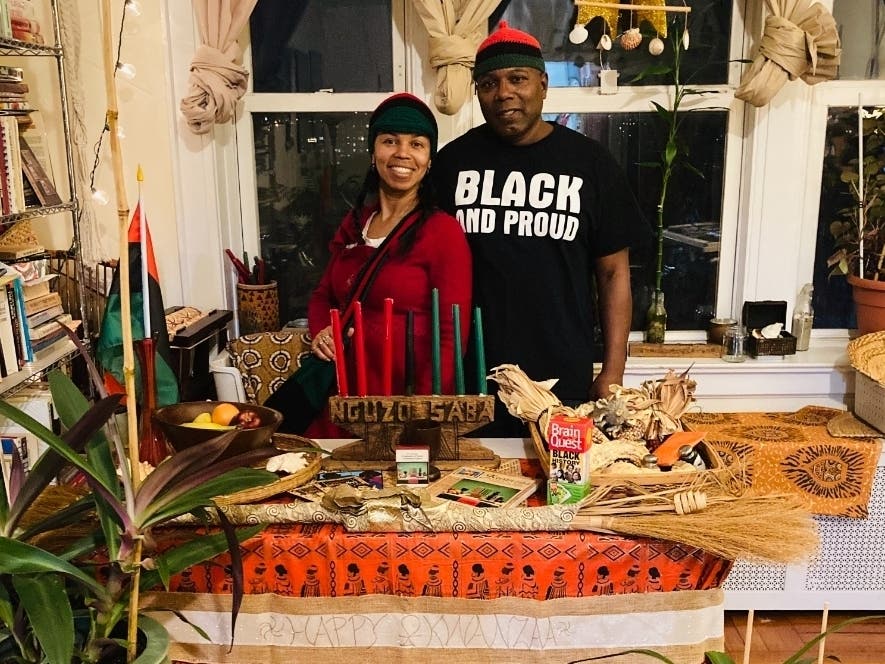

NEWARK, NJ — There’s a reason why thousands of Black residents in Newark observe Kwanzaa, a local history teacher says.
Bashir Muhammad Akinyele, a history and Afrikana studies teacher at Weequahic High School in Newark, recently shared an op-ed with Patch about the city’s relationship with the holiday, which began on Dec. 26 and ended Jan. 1.
- See related article: Newark's HotDogLady Inspires 'Ujamaa' In Her Community
Akinyele’s full op-ed follows below. Learn more about posting announcements or events to your local Patch site.
Find out what's happening in Newarkfor free with the latest updates from Patch.
Centuries of White supremacy and systematic racism left Black people in America in an oppressed condition. Many Afrikan American leaders came forward to help liberate Black people from racial discrimination. During the heightened conscious levels of the Black Liberation Movement in the 1950s to the early 1970s, Civil Rights and Black power became the worldwide rallying call for justice. We as Afrikan people in the United States have been left in a protracted struggle for blackness ever since 1619. In Afrika, and throughout the Afrikan diaspora, systematic racism made us believe that we have no history of being the very first people on the planet earth that initiated humanity, civilization, religion, and culture. But some Black leaders came forward to rebuild Afrikan Americans through Afrikan centered cultural empowerment and for Black political power. A respected Los Angeles, California community activist named Ronald McKinley Everett, an advocate for pan Afrikan self -determination in the 1960s, created a Black nationalist political and cultural empowerment philosophy called Kawaida. It is a Kiswahili word meaning "tradition" or "reason," pronounced ka-wa-EE-da. He would later change his name to Maulana Karenga and eventually become a leader for Black power.
Karenga, a voracious reader, was awarded his first PhD in 1976 from United States International University (now known as Alliant International University) for a 170-page dissertation entitled "Afro-American Nationalism: Social Strategy and Struggle for Community". Later in his career, in 1994, he was awarded a second Ph.D., in social ethics, from the University of Southern California (USC), for an 803-page dissertation entitled "Maat, the moral ideal in ancient Egypt: A study in classical African ethics."
Find out what's happening in Newarkfor free with the latest updates from Patch.
In Dr. Maulana Karenga’s book called, Kawaida: And Questions of Life and Struggle, the philosophy of Kawaida is simply defined as, "a communitarian African philosophy created in the context of the African American liberation struggle and developed as an ongoing synthesis of the best of African thought and practice in constant exchange with the world." Kawaida became the foundation for Kwanzaa, a non-religious pan-Afrikan centered holiday celebrated from December 26 to January 1.
According to Dr Karenga’s book on Kwanzaa called, Kwanzaa: A Celebration of Family, Community and Culture, on page 114 he writes, “the word Kwanzaa comes from the Kiswahili phrase “matunda ya kwanza” which means “first-fruits.” Kwanzaa’s extra “a” evolved as a result of a particular hostel of the Organization Us. It was done to as an expression of African values in order to inspire the creativity of our children. In the early days of Us, there were seven children who each wanted to represent a letter of Kwanzaa. Since kwanza (first) has only six letters, we added an extra “a” to make it seven, thus creating “Kwanzaa.”
Amy Mckeever of the National Geographic Magazine published a history article on the American racist conditions that created Kwanzaa. Her article was printed on December 22, 2020. She writes, "Kwanzaa was founded in 1966, a year after a historic rebellion rocked the Watts neighborhood of Los Angeles, California. Frustrated by years of abuse at the hands of police and crushed by poverty, the community protested and rioted. The unrest lasted a week and left 34 people dead and 1,000 injured. In the weeks after the Watts rebellion, Maulanga Karenga—an activist and leader in the Black Power Movement—founded the Us Organization to rebuild the neighborhood and promote a Black cultural revolution that would inspire pride in Black history and achievements, long dismissed and suppressed by the dominant white culture. From the beginning, the plan was to create a holiday for African Americans to honor their African roots and reaffirm their cultural connections. Kwanzaa was also envisioned as a secular alternative to the holiday juggernaut that is Christmas. To establish the traditions of the new holiday, Karenga drew upon a pan-African set of cultural symbols and practices. In particular, he believed that the annual harvest festivals—in which communities came together to celebrate the fruits of their collective labor—were an apt model for building family, community, and culture."(https://www.nationalgeographic... ).
He chose the Afrikan continental pan Afrikan language of Kiswahili to connect and communicate Kwanzaa's rituals and principles of the holiday nationalistically to the Black world.
Currently, Dr. Karenga is a professor of Afrikana Studies at California State University at Long Beach. He co-founded the Us Organization, a revolutionary cultural nationalist Black Power movement on September 7, 1965 in Los Angeles, California. He is also a co-founding member of ASCAC (the Association for the Study of Classical African Civilizations).
His Kawaida philosophy and the principles of Kwanzaa were applied to Black people's struggle for power in US politics in the late 1960s and early 1970s. It opened the door to help Black people seize Black political power.
The philosophy of Kawaida found its national voice in Newark’s own Imamu Amiri Baraka.
For example, when it comes to the struggle for Black political power, this movement was thoroughly represented by Imamu Amiri Baraka. He was one of our greatest Afrikan American leaders for Black political power. He is the father of Ras J. Baraka, the current mayor of Newark.
Born LeRoi Jones, he became a famous respected writer and poet. But his transformation into Imamu Amiri Baraka was inspired by the Black nationalist teachings of Malcolm X (Omowale El Hajj Malik El Shabazz and burgeoning struggles for the Black liberation in the African world in 1960s.
Baraka went on to become the father of the Black Arts Movement of the late 1960s and early 1970s.
He inspired many intellectuals, poets and writers across America to teach Black pride in the Afrikan / Afrikan American community.
But many scholars, activists, and community leaders, argue that Imamu Amiri Baraka is also the father of the movement for Black political power in America.
His embracement of Dr. Karenga’s philosophy of Kawaida and the principles of Kwanzaa led Baraka to mobilize masses of Black people for political power. He led, and taught the Afrikan American community, many powerful lessons on politics.
In 1967, Amiri Baraka organized the very first Black Power Conference in America in Newark, NJ. The event, “produced a Black Power Manifesto that demanded the end of “neo-colonialist control” of black populations on the globe and they wanted to unite African Americans by promoting a “philosophy of Blackness.” The document also demanded reparations for the black community because of the horrors they had to face during slavery. This was the first Black Power conference ever held, and it comprised of organizations such as the NAACP, The Urban League, Afro-American Unity, Harlem Mau and Maus along with big names such as Jessie Jackson, Ron Karenga, Floyd McKissick, Rap Brown, and Charles 27X Kenyatta” (http://blackpower.web.unc.edu/2017/04/1967-newark-black-power-conference/). He went on to organize a second Black Power conference and a Black and Puerto Rican convention in the city.
Baraka wisdom showed Black people how to acquire, organized, and seize political power under the Kawiada philosophy and the Kwanzaa principles. And one of the biggest lessons Baraka taught, by example, was organizing through "unity without uniformity." The first principle of Kwanzaa is Umoja (Kiswahili for unity). In other words, when you organize under unity without uniformity, it does not matter whether you are a Democrat or Republican, the objective is the protection of Black interests for Black power.
In 1972, Baraka was the co-convener of the National Black Political Convention in Gary, Indiana. This convention brought tens of thousands of Black people from every spectrum of life and political thought together for the sole purpose of obtaining Black political power nationally and locally in America.
With all of this political activity taken place in Black America in the early 1970s, the percentage of Black elected officials increased dramatically since US Reconstruction.
During that same year, Baraka cane back to Newark, NJ to locally organized masses of Black people to challenge White supremacy in the city. His efforts helped to elect Ken Gibson, its first Black mayor, and a myriad of Afrikan American councilpersons.
Baraka's lessons and wisdom helped to build an intelligent mass struggle for Black power in America and in Newark. His leadership has set a template for coalition building, Black unity, Black pride, a clear understanding of the Black liberation movement for future generations.
But because of Dr. Karenga’s and Imamu Amiri Baraka’s community activism, Kwanzaa is now observed by thousands of Black people in the city of Newark, NJ.
Hotep (Peace)!!!
-Bashir Muhammad Akinyele is a History and Afrikana Studies teacher at Weequahic High School in Newark, NJ. He is also the co-coordinator for ASCAC's (the Association for Study of Classical African Civilizations) Study Group Chapter in Newark, NJ. (https://ascac.org/)
Note: Spelling Afrika with a k is not a typo. Using the k in Afrika is the Kiswahili way of writing Africa. Kiswahili is a Pan -Afrikan language. It is spoken in many countries in Afrika. Kiswahili is the language used in Kwanzaa. The holiday of Kwanzaa is celebrated from December 26 to January 1.
Don’t forget to visit the Patch Newark Facebook page. Send local news tips and correction requests to eric.kiefer@patch.com
Get more local news delivered straight to your inbox. Sign up for free Patch newsletters and alerts.