Community Corner
Newark Teacher: Here’s Why I Greet My Students With ‘Hotep’
Some of my students have been drawn to our anti-violence rallies because they heard the word 'Hotep' being cried out of the microphone."


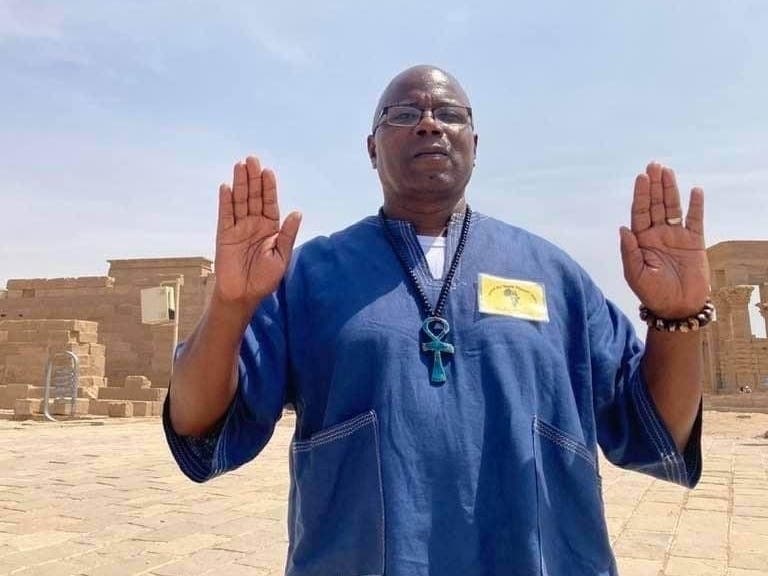
NEWARK, NJ — The following article comes courtesy of Bashir Muhammad Ptah Akinyele, a history and African studies teacher at Weequahic High School in Newark. Learn more about posting announcements or events to your local Patch site.
Despite the negative things we often say to one another; in the city of Newark, we have been greeted by the people in our community with the powerful African Kemetic / Egyptian Medu Neter word: "Hotep."
To understand where this all comes from, a little African world history must be used to give us understanding and perspective on the terms, "Hotep, Medu Neter, and Kemet."
Find out what's happening in Newarkfor free with the latest updates from Patch.
Medu Neter is the original African name for the hieroglyphics. The language of Medu Neter is the original written language of ancient Kemet. After the invasions and decimation of Kemet (Egypt) by Europeans, they changed the words Medu Neter to hieroglyphics. And since the conquest of Kemet by the Arabs in 639 AD after the Europeans, they have continued to perpetuate the name hieroglyphics to the world.
Kemet is a Medu Neter word that means land of the Blacks. Kemet was a Black civilization before the European and Arab conquerors. It is one of the greatest recorded civilizations in the annals of human society on the planet Earth.
Find out what's happening in Newarkfor free with the latest updates from Patch.
The name Kemet is the original name of Egypt. African Kemetic civilization and culture laid the foundation for today’s q, philosophy, architecture, religion, theology, monotheism, education, mathematics, astronomy, astrology, language, medicine, and government.
If you have never heard of this word Hotep, it is an offer of peace. Some scholars argue that Hotep is the oldest written word for peace in human history.
The Afrocentric Movement
In the 1980s and early 1990s, Afrocentricity became a major intellectual movement that engulfed the African world community. Under the Afrocentric movement, Black scholars boldly challenged white supremacist views on African history and culture. One of the major scholars of the Afrocentric movement is Dr. Molefi Kete Asante. He is a professor of African American Studies at Temple University and the creator of the concept of Afrocentricity. He defines Afrocentricity in his book "Afrocentricity" as "the centerpiece of human regeneration." To the degree that it is incorporated into the lives of millions of Africans on the continent and in the Diaspora, it will become revolutionary. It is purposeful, giving a true sense of destiny based upon the facts of history and experience. The psychology of the African without Afrocentricity has become a matter of great concern. Instead of looking out from one's own center, the non-Afrocentric person operates in a manner that is negatively predicable. The person's images, symbols, lifestyles, and manners, are contradictory and thereby destructive to personal and collective growth and development.
In an effort to inspire African people to reclaim our African mother tongue, African-centered scholars placed Hotep as a greeting and as a farewell benediction in the Afrocentric community. The word Hotep spread from the Afrocentric community to the world.
Afrocentricity Is Attacked by the Power Structure and Mainstream Media
Unfortunately, in the millennium, the power structure has continued its work to destroy our cultural pride in Hotep and in Africa by degrading our history and culture in the media. They intentionally called Hotep something anti-white, anti-women, and homophobic. In actuality, Hotep means none of those things. Hotep simply means peace.
For more information on the media’s role of disparaging the word Hotep and Afrocentricity, please click on this link:
(https://patch.com/new-jersey/newarknj/damon-young-i-am-proud-hotep)
The Pioneering Philosophy of Kawaida
But on another level, Hotep opens our consciousness to the importance of knowing our own African history and culture. Why is this happening in Newark? Because for decades, we have taught our history and culture in the streets. Before Afrocentricity came on the scene, Kawaida made a huge impact on the Black community in Newark in the late 1960s and early 1970s.
Kawaida is a revolutionary Black cultural nationalist philosophy. The founder of the philosophy of Kawaida is Dr Maulana Karenga. He is a professor of Africana Studies at California State University at Long Beach. Dr. Karenga also co-founded the Us Organization-a cultural Black nationalist organization established on September 7, 1965 in Los Angeles, California. Kawaida is a Kiswahili word meaning "tradition" and "reason," pronounced ka-wa-EE-da. The ideological philosophy of Kawaida is centered on Aftican people’s human right for Black cultural and political empowerment. Dr. Karanga discusses Kawaida in his book called-Kawaida And Questions of Life And Struggle. He writes that Kawaida is "a communitarian African philosophy created in the context of the African American liberation struggle and developed as an ongoing synthesis of the best of African thought and practice in constant exchange with the world." Kawaida is the foundation for Kwanzaa - A pan-African centered holiday celebrated from December 26 to January 1. Each day represents a principle of the Nguzu Saba (Kiswahili for seven principles) of Kwanzaa. For example, day 1 of Kwanzaa, one says Habari Gani (Kiswahili for what's the news). The response should be Umoja (Kiswahili) for unity-to strive for and maintain unity in the family, community, nation, and race. Day 2 of Kwanzaa, one says Harbari Gani. The response should be Kujichagulia (Kiswahili) for self-determination-to define ourselves, name ourselves, create for ourselves and speak for ourselves instead of being, name, created for and spoken for by others. Day 3 of Kwanzaa, one says Harbari Gani. The response should be Ujima (Kiswahili) for collective work and responsibility- to build and maintain our community together and make our sister's and brother's problems our problems and to solve them together. Day 4 of Kwanzaa, one should say Habari Gani. The response should be Ujamaa (Kiswahili) for cooperative economics-to build and maintain our own stores, shop and other businesses and to profit from them together. Day 5 of Kwanzaa, one should say Habari Gani. The response should be Nia (Kiswahili) for purpose-to make our collective vocation the building and developing our community in order to restore our people to their traditional greatness. Day 6 of Kwanzaa, one should say Habari Gani. The response should be Kuumba (Kiswahili) for creativity-to do always as much as we can, in the way we can, in order to leave our community more beautiful and beneficial than we inherited it. Day 7 of Kwanzaa, one should say Habari Gani. The response should be Imani (Kiswahili) for faith-to believe with all our heart in our people, our parents, our teachers, our leaders, and the righteousness and victory of our struggle.
The Leadership of Newark, NJ’s Own Imamu Amiri Baraka
Kawaida’s best spokesperson and organizer was Imamu Amiri Baraka. Long before becoming the father of Newark’s current Mayor Ras J. Baraka, Amiri was born LeRoi Jones. He rose to prominence as a poet and writer.
However, his national and international fame came from being a Black Power leader.
Father Baraka’s transformation from LeRoi Jones into the great Imamu Amiri Baraka was Inspired by the Black nationalist teachings of Malcolm X (Omowale El Hajj Malik El Shabazz) and the burgeoning revolutionary struggles for Black liberation in the African world in the 1960s.
He was one of the world's greatest African American leaders for Black political power.
Amiri Baraka went on to become the father of the Black Arts Movement of the late 1960s and early 1970s. He inspired many intellectuals, poets and writers across America to teach Black pride in the African / African American community.
But many scholars, activists, and community leaders, argue that Imamu Amiri Baraka is also the real father of the movement for Black political power in America.
Black Power Finds Its Lane Newark, NJ
His embracement of Dr. Karenga's philosophy of Kawaida, and the principles of Kwanzaa, inspired father Baraka to mobilize masses of Black people for political power. He taught many powerful lessons on the science of electoral politics from an African centered perspective.
In 1967, Amiri Baraka organized the very first Black Power Conference in America in Newark, NJ. This conference took place after Newark experienced a massive African American rebellion against years of white racist violence and oppression. The white establishment calls Black resistance to the centuries of racial discrimination in the city as "the Newark Riots."
The three day Black Power Conference in Newark produced a Black Power Manifesto. It essentially said, “the colonialist and neo-colonialist control of Black communities in America and many Black nations across the world by white supremacists necessarily is detrimental and destructive to the attainment of Black Power.”
He went on to organize a second Black Power conference and a Black and Puerto Rican convention in the city.
Black Power Organizes the National Black Political Convention in Gary, Indiana and Elects Newark, NJ’s First Black Mayor
In 1972, Amiri Baraka co-convened the National Black Political Convention in Gary, Indiana. This convention was responsible for the increase of Black elected officials in America since US Reconstruction.
That same year, father Baraka organized masses of Black people to politically challenge white supremacy in the city of Newark. His efforts helped to elect Ken Gibson, its first Black mayor, and elected a myriad of African American councilpersons to city hall.
Baraka's wisdom demonstrated to Black people how to acquire, organize, and seize political power under the Kawaida philosophy and the principles of Kwanzaa. And one of the biggest lessons Baraka taught, by example, was organizing through "unity without uniformity" manifesting itself under Umoja. The first principle of Kwanzaa is called Umoja (Kiswahili for unity).
To read more about the Afrocentricity and Kawaida, read this link:
(https://patch.com/new-jersey/newarknj/kawaida-afrikan-centricity-foundations-blackness)
The Influence of Afrocentricity
Afrocentrism in Newark influenced my life and my educational pedagogy. As a long time history and Africana Studies teacher in the city of Newark, I have greeted my students with Hotep for 28 years in the classroom. Saying Hotep not only keeps the peace in school, it opens my students curiosity to their desire to know more about the role Black people played in the development of human religions and civilization.
In the spirit of Afrocentricity, my students greet me with Hotep anywhere and everywhere I go in the Newark area with a Black power fist. Some of them have been inspired to learn more about our great history and culture. Some of my students have been drawn to our anti-violence rallies because they heard the word Hotep being cried out of the microphone at our anti-violence rallies in the middle of the intersections and at our peace walks in the city.
In Summation:
Now we must struggle to make Hotep, and our history and culture, a part of our everyday philosophical way of life to de-escalate violent conflicts amongst Black people. If we don’t, our blood will continue to be spilled in our community due to senseless community violence in America and in the world.
Peace! Hotep!
-Bashir Muhammad Ptah Akinyele is a history and African studies teacher at Weequahic High School in Newark, New Jersey. He is also the co-coordinator for ASCAC’s (the Association for Study of Classical African Civilizations) Study Group Chapter in Newark (https://(ascac.org/) and Nation of Gods and Earths
Don’t forget to visit the Patch Newark Facebook page. Send local news tips and correction requests to eric.kiefer@patch.com
Get more local news delivered straight to your inbox. Sign up for free Patch newsletters and alerts.